When evangelicals have debated, it has usually been Calvinists versus Arminians or dispensationalists versus Pentecostals. Ben Witherington III, professor of New Testament at Asbury Seminary in Kentucky, says a pox on all evangelical houses, at least exegetically. He appreciates what each tradition brings to the table—from a fresh appreciation of God's sovereignty to holiness, eschatology, and gifts of the Spirit—but he argues in his latest book that in their distinctives, all four branches are least faithful to the Bible. In the end, his book, The Problem with Evangelical Theology: Testing the Exegetical Foundations of Calvinism, Dispensationalism, and Wesleyanism (Baylor University, 2005), makes a positive argument for how biblical interpretation should be done in an increasingly postmodern setting. CT managing editor Mark Galli interviewed Witherington.
So, what is the problem with evangelical theology?
It has exegetical weaknesses that are not recognized or owned up to by the various evangelical Protestant strains of theology. That's what it boils down to.
You write that in our distinctives, we are least faithful to the Word. What do you mean?
The issue is not really with Christology, the Trinity, the virginal conception, the bodily resurrection of Jesus, or the Bible as the Word of God. The issues I'm concerned about are the distinctives of Calvinist, Arminian, dispensational, or Pentecostal theology. When they try to go some particular direction that's specific to their theological system, that's precisely the point in their argument at which they are exegetically weakest.
The Calvinist system links the ideas of predestination, irresistible grace, and perseverance of the saints. Each of those has its own exegetical weaknesses, especially perseverance of the saints.
But the same can be said about the distinctives of Arminian theology, especially when you start talking about having an experience of perfection in this lifetime. There are problems matching that up with what the New Testament says about perfection.
The same can be said about Pentecostal theology, with its teaching about a second, definitive work of grace, and about dispensationalism, with its teaching on pre-tribulation or mid-tribulation rapture. I show in my book that all of these evangelical theological systems are exegetically vulnerable precisely in their distinctives.
In what ways do you find the Calvinist teaching on the perseverance of the saints—that a person cannot lose their salvation—to be exegetically weak?
You have in the Homily to the Hebrews (usually called the Letter to the Hebrews) a long discourse warning Jewish Christians in Rome about falling away, defecting, backsliding, renouncing the grace they've received. There's this huge warning in Hebrews 6:1-6 that says, in effect: Look, you've tasted of the Holy Spirit, you've heard the gospel, you've come to the altar 15 times; if you've done all of these things and you turn back, then you've committed apostasy, and what you're facing is final judgment. He is warning all of the Jewish Christians in Rome, not a select group. That's perfectly clear from the trajectory and flow of the argument if you pursue it right through Hebrews. Christians who are eternally secure in this lifetime don't need those kinds of warnings. But the author of Hebrews doesn't think there are such people. He doesn't think you're eternally secure until you're securely in eternity.
In the Pastoral Epistles, Paul talks about people who make shipwreck of the faith. As John Wesley once said, you can't make shipwreck of something you're not sailing on.
I'll let you be an equal-opportunity offender: In what ways do you find the Arminian emphasis on perfection exegetically weak?
The issue is not: Do Christians experience the perfect love of God in this lifetime, which can cast out fear and dramatically improve our Christian life and sanctification? They do, and it should be called a sanctifying or holiness experience. But that experience of perfect love does not make our intentions or us perfect. The word perfect should be reserved for what the New Testament calls perfect—God, his love, and the final, perfect conformity of believers to Christ's image.
When the New Testament talks about completion, maturity or perfection, it's talking eschatologically, not experientially. It's not talking about a second, definitive work of grace in this life, while you're still wasting away in Margaritaville. It's talking about full conformity to the image of Christ, the Son, at the Resurrection. When we get a resurrection body like his—at that point, perfection is possible.
For example, in Philippians, Paul says though he's not already arrived, he's going on towards that goal of perfection, of being fully conformed to the image of the Son. He's not talking about having some kind of crisis experience in this life, short of death and resurrection. He's talking about the eschatological conclusion of God's plan for our lives when Christ returns, the dead are raised in Christ, and through the resurrection we're fully conformed to his image.
Article continues below
We won't belabor the point with the other two theological streams. But now that you have gone public in this book with a critique of the key teachings of Calvinist, dispensational, Arminian, and Pentecostal theologies, do you plan to have any friends left?
I'm obviously a naive person. I'm going to give some lectures in Abilene next week on "Dispensing with Dispensationalism." This is going into dispensational territory, as you know. If you hear of my martyrdom, write a nice obituary.
The serious question is this: These four streams of evangelicalism have more or less learned to co-exist for decades now. Each one brings something unique to the table, so why stir up a theological hornet's nest?
That would suggest that what matters is not truth, what matters is, "Can't we all just get along?" And I would say that the Reformation fathers, especially Luther, would absolutely disagree with that attitude. This is all about truth with a capital T. Therefore, we need to work these things out and ask where in our own tradition we have shipped water.
We have two cries as a result of the Reformation: Sola Scriptura ("only the Bible") and Semper Reformanda ("always reforming"). The more nearly we are conformed to what the Word of God actually says, the more pleasing we are to God in these matters.
Naturally, I don't think we should ever speak the truth in a way that's not loving, but I do think that iron sharpens iron, and brothers and sisters should sharpen each other. So it's absolutely necessary that we call each other to account and help each other shore up our weaknesses and be more faithful to honoring the Word of God.
In the book, your theological critique is made on the way to discussing a larger concern.
Part of the problem is the temptation to form our theology almost independently of doing our exegesis. We run to the biblical text to shore up or find proof texts for things we already believe.
In addition, we are all children of the Enlightenment, so we've tended to treat the Bible as if it were a history of ideas, where topics like soteriology, justification, the new birth, sanctification, going on to perfection, and glorification were the main themes, and our job was to link one idea to another. But in Scripture, we're not talking about a history of ideas but about spiritual realities in people's lives, about people who have stories and encounters with God. If you read the Bible carefully, on or below the surface of all of these texts is narrative, especially the story of Christ, but also the Old Testament stories of Adam and Moses and Abraham, and the story of Christians as recounted in Acts and elsewhere in the New Testament.
Article continues below
I think part of the problem is that we are still doing theology in an Enlightenment frame of mind, as if it were a string of ideas that we should logically link together, and once we've produced a nice logical circle, then we're home free. The truth is that life is a lot messier than that, and the Bible is more about stories than the history of ideas that are embedded in the stories.
Many would argue that while that may be true of Old Testament books of history, the Gospels, or Acts of the Apostles, it's not true of Paul—the didactic teacher par excellence.
That view of Paul is a travesty. It treats Paul's letters as if they were theological treatises, which they certainly are not. Paul is operating out of his storied world. He is theologizing and ethicizing into particular situations. His letters are not an abstract collection of eternal principles that we can then link. He's a pastor preaching, if you will, proclaiming, persuading his audiences on particular points.
The question is: What was he theologizing out of? And the answer is: his storied world—in particular, the story of Jesus Christ. "I resolved to know nothing while I was with you," he says to the Corinthians, "except Jesus Christ and him crucified." These are not abstract ideas. He's talking about historical events and their theological and ethical significance. So the root of the matter is the story.
When Paul thinks about sin and the fall, he thinks about Adam. When he thinks about the law, he thinks about the story of Moses. When he thinks about faith, he thinks about the story of Abraham. And, obviously, when he thinks about salvation, he thinks about the story of Jesus. So these big-ticket theological ideas are grounded in stories.
We have to remember that those who wrote the Bible were not late-Western Christians suffering from post-Enlightenment psychoses. These were people who lived in storied worlds, in an oral culture where storytelling was the essence of the thing. Most people in that culture were not even literate. They didn't live in a world bound by texts.
The Bible was not written in a text-oriented culture but for an oral culture. So these documents were meant to be heard. When you read them out loud in Greek, you notice alliteration and poetry and all kinds of things going on that are totally lost in translation. I think the oral dimension of the biblical world, very much connected to storytelling, is a crucial dimension and is a key to understanding the theology in those texts.
Article continues below
Perhaps in a postmodern culture—where image and story are more important than text and didactic argument—the Bible is more relevant than ever.
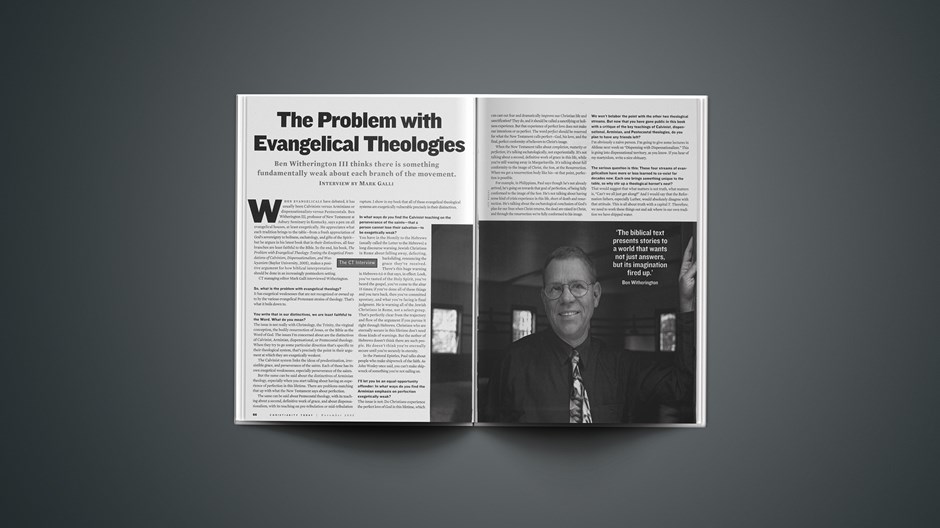
Exactly. In the 21st century, we're moving increasingly in a postmodern direction. We have a new opportunity to re-engage the biblical text, which is trying to present word pictures and stories to a world that wants not just answers to its questions, but also its imagination fired up. That's what this visual dimension of the text does.
Naturally, you argue that this requires a fresh approach to reading and interpreting the Bible. Who are some pre-Enlightenment interpreters of the Bible who are models of good exegesis for us today?
Some of the Antiochian fathers would be good—Gregory of Nyssa and Gregory Nazianzus, for example. But if there's one person who seems to be in touch with the original Greek and rhetorical ethos of the New Testament and especially Paul, that would be John Chrysostom.
I'm thankful that we've got some wonderful new studies on Chrysostom as an exegete and a theologian (like Margaret Mitchell's The Heavenly Trumpet, which helps us appreciate his numerous homilies on the New Testament). In contrast to the Latin Fathers, like Augustine, he is very much in touch with the living language of the Greek text. He is able to resonate with it, to pick up the rhetorical signals, the cultural signals, and understand the trajectory of the theology and ethics being taught.

















 While we pray for peace, we need moral clarity about this war.
 As my doubts about his teachings grew, so did a secret fascination with Jesus.
 The rage of the mob is a poor substitute for real community.






