In the debate over homosexual marriage, a predominant stereotype holds that there are two distinct and opposing sides. On the side that favors it, of course, are all fair and open-minded people who possess depths of understanding about what enlightened societies should do. On the other are small-minded, backwoods homophobes.
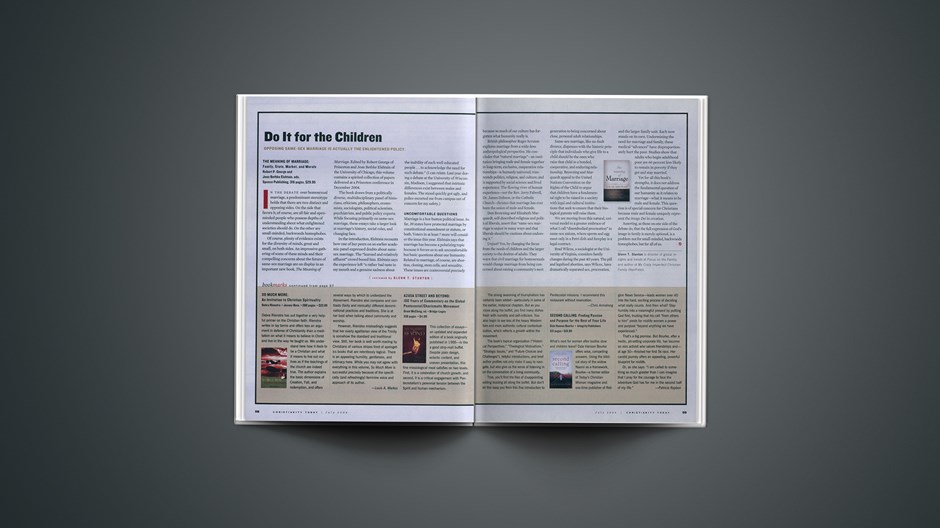
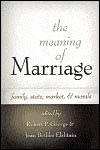
Of course, plenty of evidence exists for the diversity of minds, great and small, on both sides. An impressive gathering of some of these minds and their compelling concerns about the future of same-sex marriage are on display in an important new book, The Meaning of Marriage. Edited by Robert George of Princeton and Jean Bethke Elshtain of the University of Chicago, this volume contains a spirited collection of papers delivered at a Princeton conference in December 2004.
The book draws from a politically diverse, multidisciplinary panel of historians, ethicists, philosophers, economists, sociologists, political scientists, psychiatrists, and public policy experts. While focusing primarily on same-sex marriage, these essays take a larger look at marriage's history, social roles, and changing face.
In the introduction, Elshtain recounts how one of her peers on an earlier academic panel expressed doubts about same-sex marriage. The "learned and relatively affluent" crowd booed him. Elshtain says the experience left "a rather bad taste in my mouth and a genuine sadness about the inability of such well-educated people … to acknowledge the need for such debate." (I can relate. Last year during a debate at the University of Wisconsin, Madison, I suggested that intrinsic differences exist between males and females. The mood quickly got ugly, and police escorted me from campus out of concern for my safety.)
Uncomfortable Questions
Marriage is a hot-button political issue. So far, 39 states have protected marriage by constitutional amendment or statute, or both. Voters in at least 7 more will consider the issue this year. Elshtain says that marriage has become a polarizing topic because it forces us to ask uncomfortable but basic questions about our humanity. Related to marriage, of course, are abortion, cloning, stem cells, and sexuality. These issues are controversial precisely because so much of our culture has forgotten what humanity really is.
British philosopher Roger Scruton explores marriage from a wide-lens anthropological perspective. He concludes that "natural marriage"—an institution bringing male and female together in long-term, exclusive, cooperative relationships—is humanly universal; transcends politics, religion, and culture; and is supported by social science and lived experience. The flowing river of human experience—not the Rev. Jerry Falwell, Dr. James Dobson, or the Catholic Church—dictates that marriage has ever been the union of male and female.
Don Browning and Elizabeth Marquardt, self-described religious and political liberals, assert that "same-sex marriage is unjust in many ways and that liberals should be cautious about endorsing it."
Unjust? Yes, by changing the focus from the needs of children and the larger society to the desires of adults. They warn that civil marriage for homosexuals would change marriage from being concerned about raising a community's next generation to being concerned about close, personal adult relationships.
Same-sex marriage, like no-fault divorce, dispenses with the historic principle that individuals who give life to a child should be the ones who raise that child in a bonded, cooperative, and enduring relationship. Browning and Marquardt appeal to the United Nations Convention on the Rights of the Child to argue that children have a fundamental right to be raised in a society with legal and cultural institutions that seek to ensure that their biological parents will raise them.
We are moving from this natural, universal model to a greater embrace of what I call "disembodied procreation" in same-sex unions, where sperm and egg meet only in a Petri dish and foreplay is a legal contract.
Brad Wilcox, a sociologist at the University of Virginia, considers family changes during the past 40 years. The pill and legalized abortion, says Wilcox, have dramatically separated sex, procreation, and the larger family unit. Each now stands on its own. Undermining the need for marriage and family, these medical "advances" have disproportionately hurt the poor. Studies show that adults who begin adulthood poor are 66 percent less likely to remain in poverty if they get and stay married.
Yet for all this book's strengths, it does not address the fundamental question of our humanity as it relates to marriage—what it means to be male and female. This question is of special concern for Christians because male and female uniquely represent the imago Dei in creation.
Asserting, as those on one side of the debate do, that the full expression of God's image in family is merely optional, is a problem not for small-minded, backwoods homophobes, but for all of us.
Article continues below
Glenn T. Stanton is director of global insights and trends at Focus on the Family and author of My Crazy Imperfect Christian Family (NavPress).
We've collected our full coverage of the same-sex marriage debate.
Arkansas' highest court recently ruled that the state could not ban gay adoption because, the court said, there was no link between sexual orientation and a child's well-being.
The New York Times reported on the impact of that state's highest court's ruling that its constitution did not require same-sex marriage.
Have something to add about this? See something we missed? Share your feedback here.
Our digital archives are a work in progress. Let us know if corrections need to be made.














 While we pray for peace, we need moral clarity about this war.
 A Christian reconciliation group in Israel and Palestine warned that war would come. Now the war threatens their relevance.españolالعربيةFrançaisрусскийУкраїнська
 The plan would organize UMC churches in four global regions, with each given more leeway around same-sex marriage and other theological issues.






