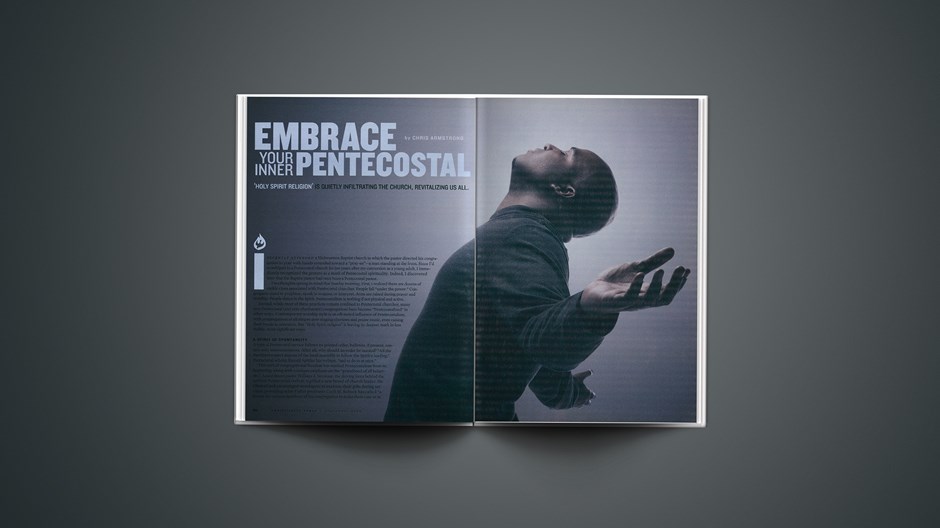
I recently attended a Midwestern Baptist church in which the pastor directed his congregation to pray with hands extended toward a "pray-ee"—a man standing at the front. Since I'd worshiped in a Pentecostal church for ten years after my conversion as a young adult, I immediately recognized the gesture as a mark of Pentecostal spirituality. Indeed, I discovered later that the Baptist pastor had once been a Pentecostal pastor.
Two thoughts sprang to mind that Sunday morning. First, I realized there are dozens of visible clues associated with Pentecostal churches. People fall "under the power." Congregants stand to prophesy, speak in tongues, or interpret. Arms are raised during prayer and worship. People dance in the Spirit. Pentecostalism is nothing if not physical and active.
Second, while most of these practices remain confined to Pentecostal churches, many non-Pentecostal (and non-charismatic) congregations have become "Pentecostalized" in other ways. Contemporary worship style is an oft-noted influence of Pentecostalism, with congregations of all stripes now singing choruses and praise music, even raising their hands in adoration. But "Holy Spirit religion" is leaving its deepest mark in less visible, more significant ways.
A Spirit of Spontaneity
A typical Pentecostal service follows no printed order; bulletins, if present, contain only announcements. After all, why should an order be needed? "All the members expect anyone of the local assembly to follow the Spirit's leading," Pentecostal scholar Russell Spittler has written, "and to do so at once."
This sort of congregational freedom has marked Pentecostalism from its beginning, along with a unique emphasis on the "priesthood of all believers." Azusa Street pastor William J. Seymour, the driving force behind the earliest Pentecostal revival, typified a new breed of church leader. He allowed and encouraged worshipers to exercise their gifts during services, providing what Fuller professor Cecil M. Robeck has called "a forum for various members of his congregation to make their case or to demonstrate their charism in the context of the worshiping community, without fear of recrimination." When someone moved beyond the bounds of accepted order, Seymour corrected him or her in a manner that, while firm, was also "gracious and soft-spoken."
Seymour also worked with a diverse team of volunteers and gave them a great deal of autonomy within certain boundaries. His leadership model was decentralized and open to genuine moving of the Spirit in his co-workers and in the entire congregation. Lay ministers were encouraged and empowered, because the Holy Spirit blew wherever he wanted to—and God forbid anyone stand in the way.
This style of ministry is seen today in many churches. A professor of religion at the University of Southern California, Donald E. Miller, noted in Reinventing American Protestantism (University of California, 1999) that Pentecostalism's transparent personal style and non-hierarchical corporate structure had migrated to three prominent California churches: Calvary Chapel, the Vineyard Christian Fellowship, and Hope Chapel. These neo-Pentecostals "truly did believe in the priesthood of all believers," Miller reported. "People were not only having their needs met, but they were finding an avenue for service. That created a lively sense of community—something that many people yearned for."
In his 1990 book Tongues of Fire, sociologist David Martin alerted English-speaking readers to the phenomenal growth and distinctive character of Pentecostalism in Latin America—a character consistent with Miller's California findings. In a review of Martin's book, religion scholar Philip Jenkins summarized: "The new churches offer transformations that are both personal and cultural. Converts feel free to speak and think for themselves in a way that was not possible when they were required to show deference to the old hierarchies of church and state."
Encountering the Divine
Go one level deeper into Pentecostal culture—beneath the worship services and leadership style—and you find a more important and pervasive way that the movement is "Pentecostalizing" world Christianity.
In the 1990s, as a new graduate student, I attended several meetings of the Society for Pentecostal Studies. Organizers set aside time during these conferences for worship and testimonies, and at one such gathering, attendees came to the microphone to describe what the Pentecostal experience of baptism in the Holy Spirit had meant to them.
Until that moment, I had been dutifully following scholarly debates about whether baptism in the Holy Spirit was primarily about holiness or power. But these testifying scholars described Spirit baptism in terms of something deeper than either one. Indeed, they all put their finger on one main effect: a new, joyous sense of communion with a loving God who counted every hair on their heads and watched over them every minute. The central moment of their Pentecostal experience had opened them to a deep well of living water from which everything else flowed; it had opened them to the personal, relational presence of the Living God.
Article continues below
A quick check of history books confirms the centrality of divine encounter for Pentecostals. William Seymour and his co-leaders repeatedly told the Azusa Street faithful that their experience with the Spirit was not about speaking in tongues. It was about God's presence through the crucified and risen Christ. Early 20th-century leader Robert Brown, echoing the testimonies of thousands of other Pentecostals, said: "To abide in him means one continual round of revelation, blessing, and power. Oh, the grandeur of it, not a passing pleasure, nor a transitory joy, but an abiding presence; not it, but him. Glory to his name!"
Though it may discomfit the religiously buttoned-down, the rationalists, and the nominal, the Pentecostal God deigns to meet with us and care for us in immediate, experiential ways. We speak to him in a language of love, saying "Abba, Father," and he responds in kind.
This encounter has always been the open secret of Pentecostal spirituality. The belief in God's real, experienced care and the passion for union with Christ—often likened to the thirst of the psalmist's deer for the stream—may turn out to be Pentecostalism's chief contributions to Christianity.
To some critics, such "divine love" seems mawkish or even self-indulgent. Though there is room for self-indulgence in Pentecostalism, its emphasis on encounter puts God, not humanity, at the center. In an encounter with God, the believer cannot help but bow and worship. Duke historian Grant Wacker calls this trait "submissiveness … a deep-seated awareness that humans do not create themselves and therefore owe their lives to another source."
A seminary colleague gave me one of the best one-word definitions of charismatic church culture I have ever heard: expectation. Charismatics believe and expect that God will do great things among them, just as he did in the Acts of the Apostles. "Do it again, Lord," they say. "As it was in the apostolic age, let it be now."
The Anti-Modern Way
Such expectation of the Holy Spirit has infiltrated even the most modern corners of Western culture. I recently received a letter from a friend and colleague—an accomplished, Ivy League–trained scholar of religion whose husband is a research scientist. These two brilliant academics reported receiving healing miracles in their own lives and said they had begun an international healing ministry. The tradition they are joining, though not exclusively Pentecostal, has been shaped by Pentecostal and charismatic practitioners.
Article continues below
What distinguishes Pentecostal healing? Wacker identifies two marks: the expectation that not just physical ailments but also addictions will be healed, and the insistence that Christians should pray for healing not as a last resort but immediately, as a first step in every case of illness.
Author Donald Miller says Pentecostalism's embodiedness makes it postmodern and cutting-edge. Pentecostals, he says, embrace "a worldview that does not dichotomize between mind and body in the way that a modernist, Enlightenment-based worldview does." Another way of putting this is to say that by their engagement with a powerful, healing, and prayer-answering God, church cultures influenced by Pentecostalism gain a sense of living in another world—a primitive world unlike our modern, secularized one, a world charged with the power and grandeur of God.
McCormick professor of missions Ogbu Kalu explains the widespread African acceptance of Pentecostal faith (a growth now outpacing even that of dynamic African independent churches) by this supernatural characteristic. It's not that Africans have been gulled by prosperity-preaching televangelists, he says, but that they think it self-evident that any God worth his salt can and will affect things like harvests, health, and wealth.
Pentecostals preach a religion that is "anti-modern," that is, it recognizes that the most important powers impinging on our lives rest not in our hands, but in God's. Pentecostals stand against the modern project rooted in Newtonian science, which has told us for centuries that by learning the laws of the universe, we can control all that is important in our lives: physical, social, moral, and even religious. I call this "Star Trek theology": the faith that through natural and social sciences, we can all live longer, solve world hunger, and make war obsolete.
From the beginning, Pentecostals reveled in a God who runs the show. Actor Robert Duvall captured this confidence perfectly in The Apostle, when the evangelist stands at a dusty crossroads, eyes toward heaven, and whispers, "Which way, Lord? Which way?"
Sweet Eudaemonia
Another facet of Pentecostal spirituality well captured in Duvall's movie is the joyfulness associated with divine communion. Far from being an innovation in Christianity, this frank enjoyment of God's presence has a history that goes right to the roots of the church. When Augustine of Hippo cried out in Confessions, "Inebriate me, O God!" he was expressing a Christian variation of a classical philosophy called eudaemonism (from the Greek word for happiness, eudaimonia).
Article continues below
Christian eudaemonists encourage disciples to acknowledge their needs and desires, seeking not an abrogation of these desires, but a transformation. Classical philosophers asked, "What makes man truly happy?" Christian eudaemonists answer out of the ubiquitous scriptural language of reward: We are happy when God fulfills his promises and our desires by giving us his loving presence. According to Augustine, the key to happiness is to want the one right thing, which is God himself. Thus, the job of the Christian, as the Westminster Confession puts it, is to "glorify God" and "enjoy him forever"—with the "forever" beginning here in our earthly lifetimes.
John Wesley defined "the character of a Methodist" as a lifelong love affair with God that produces exquisite joy. Though qualified by an understanding of the suffering and self-emptying that is sometimes necessary, Wesley's theology of salvation was nonetheless eudaemonist. Following his lead, so too is Pentecostals'.
Naturally, this position has proven to be unpopular with many Protestants since Wesley's day. Lutheran theologian Anders Nygren attacked it in his 1932 book, Agape and Eros, in which he insisted that Christian disciples must take no regard for their own desires and pleasures, but must seek only the good of God and others. Long before Nygren, Jonathan Edwards's student Samuel Hopkins had approvingly labeled this kind of motivation "disinterested benevolence," and it became the linchpin of Finneyite revivalism and social reform.
Throughout most of the 20th century, anti-eudaemonism pervaded evangelicalism. Converts were allowed to rejoice for a season, but then were told, in effect, to cool down and get to work. It was as if the joy of the Lord were just an initial gift designed to "get us saved," after which time we were to grit our teeth and get along without it. Pentecostals have a phrase to describe Christians caught in such grim religion. They call them "baptized in pickle juice."
Along with the praise choruses and freedoms that have spilled over from Pentecostalism to many other churches has come a rising acceptance of Christian desire and fulfillment. In the glow of worship, in tender moments of prayer within the warm community of saints, those of us who have been influenced by Pentecostal eudaemonism can experience the bliss of intimacy with Christ as a valid and nourishing part of our relationship with God. We can rejoice, along with Augustine, the Westminster signatories, and John Wesley, that the human desire for transcendence and love is God-given—a blessing to be enjoyed both in heaven and here on earth.
Article continues below
The late Stanley Grenz and other evangelical theologians have pointed out the church's need to recover encounter, relationship, emotional engagement, expectant prayer, and body-spirit holism—all infectious strengths of Pentecostalism. However, some of these thinkers have prefered to point to the old continental Pietists as our best examples of such practices.
There is some merit in this exhortation. But perhaps we find it easier to recommend Pietists because they are no longer around to embarrass, annoy, and even pressure us into rediscovering the fullness of the Christian life. Pentecostals and charismatics are around, and for all their human flaws and difficulties, they carry with them a precious heritage we would do well to receive.
Chris Armstrong is associate professor of church history at Bethel Seminary in Minneapolis and a senior editor of Christian History & Biography.
Christian History Corner Romanticism Gone to Seed—Part II | Have the holiness and Pentecostal movements really been "hyper-vertical" and "anti-domestic"? (Oct. 01, 2004)
God's Peculiar People | Historian Grant Wacker explains why Pentecostals survived and even flourished. (March 18, 2002)
Are Pentecostals Sex-Crazed? | John Steinbeck and Robert Duvall have portrayed them that way, and such criticism even came from inside the movement. But was it ever warranted? (Sept. 11, 2001)
Article continues below
Christian History Corner Explaining the Ineffable | In Heaven Below, a former Pentecostal argues that his ancestors were neither as outlandish as they seemed nor as otherworldly as they wish to seem. (Aug. 31, 2001)
Should We All Speak in Tongues? | Some say speaking in tongues is proof of 'baptism in the Holy Spirit.' Are those who haven't spoken in tongues without the Holy Spirit? (March 6, 2000)
A Peacemaker in Provo | How one Pentecostal pastor taught his Congregation to love Mormons. (February 7, 2000)
Christian History & Biography devoted an issue to The Rise of Pentecostalism. More on Pentecostalism from CT sister publications include:
Whither Pentecostal Scholarship? | The overlap between "people with the Spirit" and "people with Ph.D.'s." (Books & Culture, May/June 2004)















 While we pray for peace, we need moral clarity about this war.
 A Christian reconciliation group in Israel and Palestine warned that war would come. Now the war threatens their relevance.españolالعربيةFrançaisрусскийУкраїнська
 Beyoncé’s right. Whether listening to Cowboy Carter or reading theology, diversity is a good thing.






