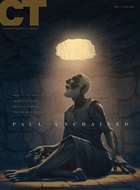
When I tell my grandchildren about America at the turn of the century, I will tell them about houses and wars.
I will tell them about houses in places like Wheaton, Illinois, a one-time center of mild, middle-class, Midwestern evangelical Christianity, where grand teardown mansions loom where bungalows once stood. I will tell them about the heady days of option ARMS, cash-out refinancing, and homebuilders whose stock prices made the front page.
I will tell them about our wars, fought with blustering confidence and dubious competence, ambitious and precarious, like a teardown on a tiny lot.
Then I will tell them two of Jesus' most misinterpreted parables.
In Luke 14, Jesus tells the stories of a tower builder and an embattled king. In many English Bibles, these twin parables are labeled "The Cost of Discipleship." But Jesus' first hearers would have known that label was exactly backwards. For these stories are not about disciples, but fools.
A man sets out to build a tower, but is unable to complete it—and in an instant, the crowd, immersed in the Hebrew Scriptures, would think of an infamous tower-building project that was never completed. A king sets out to win an unwinnable war—and these residents of occupied territories would think of Israel and Judah's humiliating defeats at the hand of imperial armies.
Make no mistake. The tower builder and the king are not models of discipleship. When does Jesus ever speak of discipleship as if it were a construction project, carefully calculated and accounted for, or a war, in which we marshal our own forces and find them adequate for the battle? Biblical faith is the abandonment of our tower building, the surrender of our ambitions to foolishly fight our way to security. These two men are at risk of becoming fools in the full biblical sense—blinded by their prosperity and power to the most basic form of common sense, not to mention the ultimate reality of their dependence on God.
And yet, as Jesus tells the story, they do have one last chance. Which of you, he asks, will not first sit down and count the cost of building the tower? When the king sees that his forces are overmatched, "he will send a delegation while the other is still a long way off and will ask for terms of peace." Each man is on the cusp of a decision. The builder's wealth is not sufficient—he must decide whether to admit it or to persist in his folly. The king's army will never win—but he still can ask for peace and avoid sending his forces into a suicidal conflict.
So Jesus invites the crowds following him to sit down and count the cost—not of discipleship, but of non-discipleship. Non-discipleship means believing that we will be able to complete our insane Babel of self-provision; non-discipleship means blindly rushing into battle as enemies of God, having vastly overestimated our ability to prevail. Discipleship is the process of soberly counting our assets and coming to terms with their insufficiency to carry us through a life lived apart from God. It is not discipleship, in the end, that is costly—it is folly.
All this makes sense of the devastating words that immediately follow: "Any of you who does not give up everything he has cannot be my disciple." The builder is deceived, or nearly so, by the surplus that enables him to consider his tower. The king's 10,000 soldiers could easily lure him into complacency. Possessions and power are instruments of blindness. They endanger our very souls. The only safe thing to do with them is to forsake them, to put them beyond use, beyond the reach of our foolish dreams.
We Americans, laden with more possessions and more power than any Judean king or Roman emperor ever imagined, pour our energies and our hopes into building projects. We confidently send our armies abroad with preemptive proclamations of victory. Do American Christians dare assume that we have not been infected with the hubris of our nation? Our only hope is discipleship, the practice of ruthlessly liberating ourselves from anything that might prop up our project of self-justification.
But if Jesus' stories are true, our story may come to a surprising and hopeful end. Perhaps we, too, will one day find ourselves at the end of our resources. We will begin to be in want. We will find ourselves in exile, in a far country, famished fools. Then we will come to ourselves, amid the ruined towers and garrisons, and begin to make our way home. And perhaps then, while we are still far off, Another will run to us offering terms of peace.
Perhaps, in these terrifying and wonderful stories, he already has.
Andy Crouch is an editor at large for Christianity Today. Before working for CT, Crouch was chief of re:generation quarterly, a magazine which won the Utne Reader's Alternative Press Award for spiritual coverage in 1999. He was formerly a campus minister with InterVarsity Christian Fellowship at Harvard University. Crouch and his wife, Catherine, a postdoctoral fellow at Harvard, have two children. His column, "Always in Parables," ran from 2001 to 2006.




















 While we pray for peace, we need moral clarity about this war.
 Church movements need magnetic leaders. But the best leaders need more than charm.
 Ethan Hawke has made a movie as scandalous as one of the writer’s short stories.