On street corners, television channels, and iPods; in passing cars, dorm rooms, and malls, the low rumble of pumping, pounding drum and bass beats throbs from speakers, peppered with rapid-fire battle rhymes chronicling the grittier perceptions of urban life. Hip-hop rakes in $4 billion a year (roughly 20 percent of records sold in the United States).
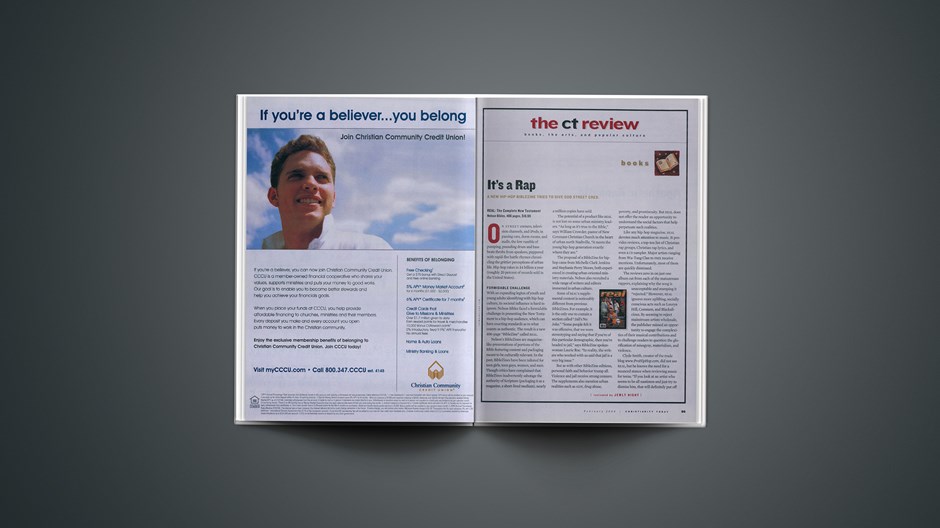
With an expanding legion of youth and young adults identifying with hip-hop culture, its societal influence is hard to ignore. Nelson Bibles faced a formidable challenge in presenting the New Testament to a hip-hop audience, which can have exacting standards as to what counts as authentic. The result is a new 406-page "BibleZine" called REAL.
Nelson's BibleZines are magazine-like presentations of portions of the Bible featuring content and packaging meant to be culturally relevant. In the past, BibleZines have been tailored for teen girls, teen guys, women, and men. Though critics have complained that BibleZines inadvertently sabotage the authority of Scripture (packaging it as a magazine, a short-lived medium), nearly a million copies have sold.
The potential of a product like REAL is not lost on some urban ministry leaders. "As long as it's true to the Bible," says William Crowder, pastor of New Covenant Christian Church in the heart of urban north Nashville, "it meets the young hip-hop generation exactly where they are."
The proposal of a BibleZine for hip-hop came from Michelle Clark Jenkins and Stephanie Perry Moore, both experienced in creating urban-oriented ministry materials. Nelson also recruited a wide range of writers and editors immersed in urban culture.
Some of REAL's supplemental content is noticeably different from previous BibleZines. For example, it is the only one to contain a section called "Jail's No Joke." "Some people felt it was offensive, that we were stereotyping and saying that if you're of this particular demographic, then you're headed to jail," says BibleZine spokeswoman Laurie Roe. "In reality, the writers who worked with us said that jail is a very big issue."
But as with other BibleZine editions, personal faith and behavior trump all. Violence and jail receive strong censure. The supplements also mention urban realities such as AIDS, drug abuse, poverty, and promiscuity. But REAL does not offer the reader an opportunity to understand the social factors that help perpetuate such realities.
Like any hip-hop magazine, REAL devotes much attention to music. It provides reviews, a top-ten list of Christian rap groups, Christian rap lyrics, and even a CD sampler. Major artists ranging from Wu-Tang Clan to DMX receive mentions. Unfortunately, most of them are quickly dismissed.
The reviews zero in on just one album cut from each of the mainstream rappers, explaining why the song is unacceptable and stamping it "rejected." However, REAL ignores more uplifting, socially conscious acts such as Lauryn Hill, Common, and Blackalicious. By seeming to reject mainstream artists wholesale, the publisher missed an opportunity to engage the complexities of their musical contributions and to challenge readers to question the glorification of misogyny, materialism, and violence.
Clyde Smith, creator of the trade blog www.ProHipHop.com, did not see REAL, but he knows the need for a nuanced stance when reviewing music for teens. "If you look at an artist who seems to be all nastiness and just try to dismiss him, that will definitely put off the kids who are fans," Smith says. "They recognize, 'Look, there's this good thing in there, too. Yeah, he talks all this junk, but there's this other side.' "
By contrast, the largely unknown Christian rappers are all rated "accepted." An essay titled "Hip Hop and Christian?" underscores this message. It lists generalizations about mainstream hip-hop's immoral legacy and encourages readers to embrace Christian rap instead. "The beat is the same as secular hip-hop," it asserts, "but this message brings life."
REAL represents a serious attempt to meet people who love hip-hop on their own turf. Unfortunately, some could interpret this BibleZine's well-intended message as an attempt merely to replace mainstream hip-hop with a Christian facsimile. What we really need is more Christians willing to participate critically but authentically in hip-hop's multifaceted culture.
Jewly Hight covers music as a Nashville-based freelance writer.
Real is available from ChristianBook.com and other book retailers.
Thomas Nelson has more information on the Real Biblezine, including a promotional video.
Time published an article last Fall on how "Bible magazines, or Biblezines, are reworking the Word of God."
Article continues below
Jana Riess, religion book review editor for Publishers Weekly, reviewed Biblezine's recent editions Becoming and Align on her personal blog (not related to her PW work).
Hip-Hop Kingdom Come | At churches across America, the hip-hop nation is setting up camp in the kingdom of God and bringing its own streetwise sensibility to the task of proclaiming the Good News of Christ. (January 5, 2001)
Hip-Hop Opera | A rock musical for a new generation tells the gospel in MTV language—for better or for worse. (February 10, 2004)
Have something to add about this? See something we missed? Share your feedback here.
Our digital archives are a work in progress. Let us know if corrections need to be made.















 While we pray for peace, we need moral clarity about this war.
 A Christian reconciliation group in Israel and Palestine warned that war would come. Now the war threatens their relevance.españolالعربيةFrançaisрусскийУкраїнська
 How groups like Hillsong learned to let go of the literal in favor of creative collaboration.españolPortuguês






