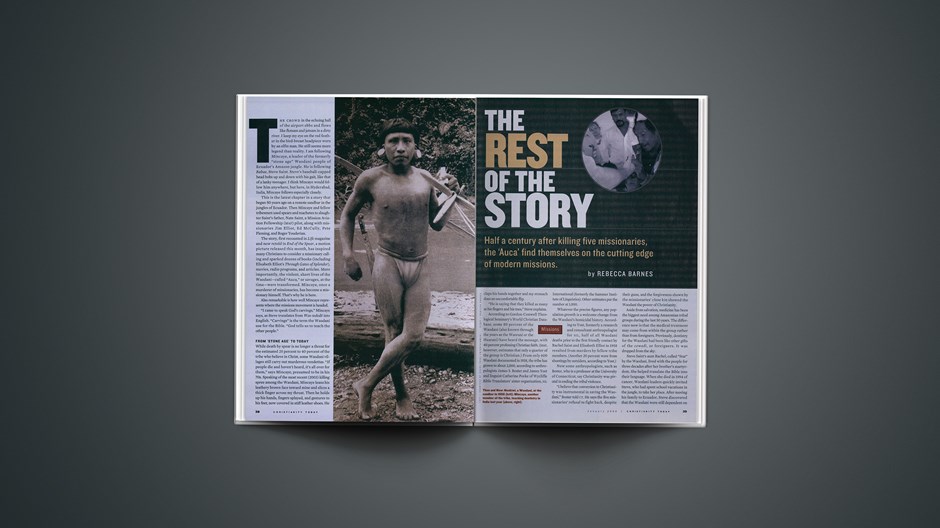
The crowd in the echoing hall of the airport ebbs and flows like flotsam and jetsam in a dirty river. I keep my eye on the red feather in the bird-breast headpiece worn by an elfin man. He still seems more legend than reality. I am following Mincaye, a leader of the formerly "stone age" Waodani people of Ecuador's Amazon jungle. He is following Babae, Steve Saint. Steve's baseball-capped head bobs up and down with his gait, like that of a lanky teenager. I think Mincaye would follow him anywhere, but here, in Hyderabad, India, Mincaye follows especially closely.
This is the latest chapter in a story that began 50 years ago on a remote sandbar in the jungles of Ecuador. Then Mincaye and fellow tribesmen used spears and machetes to slaughter Saint's father, Nate Saint, a Mission Aviation Fellowship (MAF) pilot, along with missionaries Jim Elliot, Ed McCully, Pete Fleming, and Roger Youderian.
The story, first recounted in Life magazine and now retold in End of the Spear, a motion picture released this month, has inspired many Christians to consider a missionary calling and sparked dozens of books (including Elisabeth Elliot's Through Gates of Splendor), movies, radio programs, and articles. More importantly, the violent, short lives of the Waodani—called "Auca," or savages, at the time—were transformed. Mincaye, once a murderer of missionaries, has become a missionary himself. That's why he is here.
Also remarkable is how well Mincaye represents where the missions movement is headed.
"I came to speak God's carvings," Mincaye says, as Steve translates from Wao tededö into English. "Carvings" is the term the Waodani use for the Bible. "God tells us to teach the other people."
From ‘Stone Age’ to Today
While death by spear is no longer a threat for the estimated 25 percent to 40 percent of the tribe who believe in Christ, some Waodani villages still carry out murderous vendettas. "If people die and haven't heard, it's all over for them," says Mincaye, presumed to be in his 70s. Speaking of the most recent (2003) killing spree among the Waodani, Mincaye leans his leathery brown face toward mine and slices a thick finger across my throat. Then he holds up his hands, fingers splayed, and gestures to his feet, now covered in stiff leather shoes. He claps his hands together and my stomach does an uncomfortable flip.
"He is saying that they killed as many as his fingers and his toes," Steve explains.
Opening in theaters on January 20, End of the Spear features the events of 1956 from the perspectives of a Waodani tribe leader, Mincayani (a composite character played by Louie Leonardo), and Nate Saint's son, Steve (Chase Ellison/Chad Allen). The movie is stirring and lush, shot in Panama with members of the Embera tribe cast in all but a few key Waodani roles. Produced by an independent Christian studio called Every Tribe Entertainment (ETE), the film elevates the visual storytelling portfolio of independent Christian movies.
The movie, narrated by Steve, reaches back into Mincayani's childhood. In so doing, it reveals a worldview that spawned unrelenting violence. It depicts the missionaries a bit like frat boys—goofy, exuberant, optimistic.
Last fall, ETE released on dvd its award-winning 2003 documentary about the same events, Beyond the Gates of Splendor. In different ways, the two projects reveal how two men have become like father and son. Through them, viewers can learn the power of forgiveness and reconciliation. —Lisa Ann Cockrel
According to Gordon-Conwell Theological Seminary's World Christian Database, some 80 percent of the Waodani (also known through the years as the Waorani or the Huarani) have heard the message, with 40 percent professing Christian faith. (MAF, however, estimates that only a quarter of the group is Christian.) From only 600 Waodani documented in 1958, the tribe has grown to about 2,000, according to anthropologists James S. Boster and James Yost and linguist Catherine Peeke of Wycliffe Bible Translators' sister organization, SIL International (formerly the Summer Institute of Linguistics). Other estimates put the number at 1,000.
Whatever the precise figures, any population growth is a welcome change from the Waodani's homicidal history. According to Yost, formerly a research and consultant anthropologist for SIL, half of all Waodani deaths prior to the first friendly contact by Rachel Saint and Elisabeth Elliot in 1958 resulted from murders by fellow tribe members. (Another 20 percent were from shootings by outsiders, according to Yost.)
Now some anthropologists, such as Boster, who is a professor at the University of Connecticut, say Christianity was pivotal in ending the tribal violence.
"I believe that conversion to Christianity was instrumental in saving the Waodani," Boster told CT. He says the five missionaries' refusal to fight back, despite their guns, and the forgiveness shown by the missionaries' close kin showed the Waodani the power of Christianity.
Article continues below
Aside from salvation, medicine has been the biggest need among Amazonian tribal groups during the last 50 years. The difference now is that the medical treatment may come from within the group rather than from foreigners. Previously, dentistry for the Waodani had been like other gifts of the cowadi, or foreigners. It was dropped from the sky.
Steve Saint's aunt Rachel, called "Star" by the Waodani, lived with the people for three decades after her brother's martyrdom. She helped translate the Bible into their language. When she died in 1994 of cancer, Waodani leaders quickly invited Steve, who had spent school vacations in the jungle, to take her place. After moving his family to Ecuador, Steve discovered that the Waodani were still dependent on foreign money and missionaries.
The Waodani wanted Steve, a former MAF pilot, to teach them to fly. "Before, when Star was living with us, when people's teeth were hurting, some foreigners came to fix our teeth, but they only came sometimes," Mincaye recalls. "So Kimo and I started thinking, Why can't we do this?"
Steve, with a business background, launched a new company, I-TEC (Indigenous People's Technology and Education Center), to help the Waodani use new technology. One project modified a powered parachute to transport passengers, cargo, and even stretcher patients in and out of the jungle.
Then the Waodani asked Steve to teach them basic dentistry. According to the World Health Organization, cavities and poor oral health afflict much of the world and are too costly to treat using traditional methods. But Mincaye says that the Waodani see dentistry in much the same way as missionary dentists see it—as a way to evangelize. "Teach us the tooth thing, and they will see us well," Mincaye told Steve. "That's the door opener so the people know we really care about them."
Ignoring the seeming impossibility of first learning dentistry—a profession requiring years of schooling and experience for Westerners—and then teaching it to people who 50 years ago were using stone axes to fell trees, Steve turned his entrepreneurial skills to the new challenge.
First, an American dentist taught Steve the basic skills and knowledge needed to extract and fill teeth, inject anesthesia, and prescribe antibiotics. I-TEC then developed a portable dental chair that folds into a backpack along with an instrument tray, a headlamp, and a solar-powered drill, all light enough to be packed through the jungle or loaded onto a powered parachute.
Article continues below
As intended, the dental work has opened doors for Christian Waodani to speak about eternal matters. Mincaye says he tells patients he is fixing their teeth because the Creator has done good things for him.
"In our place, whoever has fever, cut, hurting, they come to us because they know we care," Mincaye says. "We take care of their hurt, then we teach them how to take care of their heart.
"I teach them God's carvings."
For years, Charlie Vittitow, a dentist from Louisville, Kentucky, has worked among indigenous people with short-term mission teams from Southeast Christian Church. The idea that began with Mincaye's simple request to learn "the tooth thing" launched a new ministry of dentistry for Vittitow and Southeast. Using I-TEC's equipment and philosophy, they began not only bringing help but also passing on professional knowledge.
In January 2004, Vittitow taught church pastors in Ghana how to extract decayed teeth and fill cavities, inject anesthesia, and prescribe antibiotics. Vittitow admits that teaching dentistry basics to Christian ministers "tests my enthusiasm for evangelism." But he likes what he has seen so far and says the benefits far outweigh the risks. "With this model, we are empowering the indigenous people. We should do this in all aspects of ministry."
Cross-cultural Challenges
Empowering locals is a dominant theme in missions today. According to David Howard, Elisabeth Elliot's brother and a long-time missionary to Latin America, it is one of the most drastic shifts in cross-cultural outreach during the past 50 years.
"The non-Western world missionary movement is one of the most exciting things," Howard, former general director of the World Evangelical Alliance, told CT. Howard documents three historical phases in missions: dependence (1650–1945), independence (1945–1974), and interdependence (1974–present). The last phase began with the decision to focus not on geopolitical nations but on distinct ethno-linguistic groups—now estimated at more than 13,000 worldwide—to fulfill the Great Commission.
"We began to realize that the job is huge, much bigger than we realized," Howard said. The number of unevangelized groups in India, for example, has grown rather than diminished in the last few decades, simply because the nation has been regrouped according to ethnicities and tribes rather than geographic areas.
Article continues below
Mission strategist Ralph D. Winter, founder of the U.S. Center for World Mission, launched the mission concept of people groups. Winter brushes aside the common canard—heard most recently in Venezuela—that missionaries undermine indigenous cultures, such as that of the Waodani. "If it were not for missionaries," Winter tells CT, "literally thousands of indigenous languages would have perished."
The New Testament is now available not only in the Waodani language, but also in the language of the Jivaro, with whom Roger Youderian worked, and in the languages of five other Amazonian people groups.
While missionaries seek to preserve these cultures, younger members of Amazonian tribes are often willing to abandon them. Monetized economies introduced by oil companies and the subsequent trappings of civilization that follow them often exert a strong pull. The Waodani themselves rely on ecotourism to raise money for their medical ministry.
Dependency remains a risk. Steve acknowledges that technologies and skills introduced into the tribe may create a new form of reliance on outsiders if not handled carefully.
Scott Moreau, the chair of intercultural studies at Wheaton College, told CT that dependency is a perennial risk in missions. "Dependency is a monster issue, and the disparity of economic resources will always generate that possibility," Moreau acknowledged. But he expressed optimism that better cross-cultural training of missionaries and a new goal of interdependence between Westerners and non-Westerners have altered the equation.
"Theoretically," he said, "things have changed."
‘We have to go every place’
Back in India, Mincaye is testing Moreau's theory. Snapping on latex gloves and gesticulating energetically about the proper way to extract a tooth, he says to a group of Christian workers from Hyderabad, "Firm and gentle." Steve translates from Wao tededö into English, then Caleb Premanandam of Harvest Ministries in Hyderabad translates into Telugu, Urdu, and Hindi for the 10 local pastors in attendance. They show little inhibition about learning dentistry.
"They have spread their smiles," Premanandam says of the pastors now addressing the felt needs of the rural communities around Hyderabad. "This will be a platform for the gospel." Dental ministry has already also become a bridge into communities where militant Hindus were hostile to Christians.
Article continues below
Now Steve and Mincaye are speaking in a small, 10-year-old church where a Hindu extremist murdered one of the evangelizing pastors last spring.
"When I was a little boy and my dad flew off and was killed," Steve says, "I thought, How can life ever be good again? But God gave me the man who killed my father to be like a father to me and a grandfather to my children."
The Indian church prays that someday the man who killed their pastor will come to know Christ and join their family, too.
On our way back via Amsterdam, I ask Mincaye what he thinks of his mission trip to India. "Did you see it well to come so far?" Steve translates.
"Jesus told us we have to go every place," Mincaye says, "and wasn't it nice that the airplane was coming this way?"
From the beginning of the 20th century, when there were no Christians among them, the Waodani now have at least 400 Christians, as well as a global evangelist in Mincaye.
After we land, a customs official begins his interrogation of Mincaye. "You've just arrived from India?" Steve translates, and Mincaye nods. His earlobes dangle like thick rubber bands. He prefers not to wear the balsa wood discs that traditionally adorn them. He is smiling wide now, revealing shiny white dentures.
"What is his profession?" the customs officer inquires of Steve. Without blinking, Steve replies: "He's a dentist."
Rebecca Barnes is a freelance writer and editor in Louisville, Kentucky, where she is a member of Southeast Christian Church.
Interview: Death Worked Backwards | End of the Spear, a new film about the 1956 missionary martyrs in Ecuador, is similar to the Narnia story in some ways, says Steve Saint, son of one of the murdered men.
More Christianity Today articles on the Ecuador martyrs includes:
The Unfinished Mission to the 'Aucas' | Forty years ago my father, Nate Saint, and four other young missionaries (Jim Elliot, Pete Fleming, Ed McCulley, and Roger Youderian) were speared to death while trying to reach the "Auca" Indians in the Amazon jungles of South America. Today, I have a home among these people—properly called Huaorani—and some of the very men who speared my father have become substitute grandfathers to my children. By Stephen E. Saint (March 2, 1998)
Article continues below
Ecuadorian Martyrs Story on Stage | A new stage production touring the United States is retelling the story of how five missionaries lost their lives in the jungles of Ecuador 40 years ago (Oct. 28, 1996)
>Did They Have to Die? | Forty years after five missionaries lost their lives in the Ecuadorian jungle, the killers explain what really happened. By Steve Saint (Sept. 16, 1996)
Martyrs' Lost Plane Recovered in Ecuador | The skeletal remains of an aircraft, uncovered on a remote beach along a river in Ecuador, are believed to be the lost plane piloted by American missionaries shortly before their murder in 1956. (August 15, 1994)
More about End of the Spear and Beyond the Gates of Splendor from Christianity Today Movies includes:
End of the Spear Big Winner at Heartland | Film about 1956 missionary martyrs in Ecuador wins Film Festival's $50,000 Grand Prize; others also lauded at Crystal Heart Awards Ceremony. (Oct. 17, 2005)
Beyond the Gates of Splendor | This documentary, telling the true story of five American missionaries murdered on a remote sandbar in Ecuador half a century ago, explodes the myth of the noble savage. (Oct. 4, 2005)
From Film Neophyte to Movie Mogul | Before recently, Mart Green had never been in a movie theater, but he's the driving force behind two new films about the 1956 missionary martyrs in Ecuador—and the tribe that killed them. (April 26, 2005)
Have something to add about this? See something we missed? Share your feedback here.
Our digital archives are a work in progress. Let us know if corrections need to be made.















 While we pray for peace, we need moral clarity about this war.
 A Christian reconciliation group in Israel and Palestine warned that war would come. Now the war threatens their relevance.españolالعربيةFrançaisрусскийУкраїнська
 How groups like Hillsong learned to let go of the literal in favor of creative collaboration.españolPortuguês






