Not all extracanonical manuscripts reveal a 'lost Christianity.' The church's earliest discipleship manual—the Didache—is as orthodox and relevant as it gets.
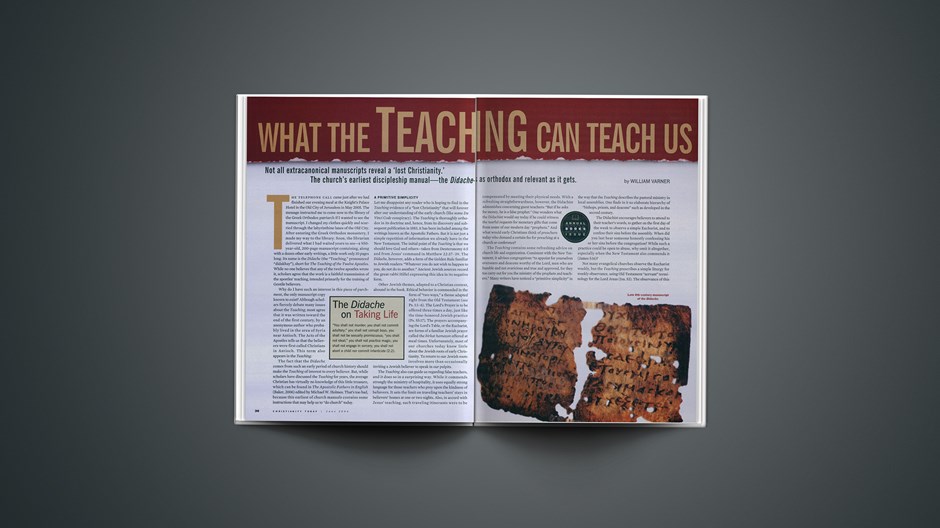
The telephone call came just after we had finished our evening meal at the Knight's Palace Hotel in the Old City of Jerusalem in May 2005. The message instructed me to come now to the library of the Greek Orthodox patriarch if I wanted to see the manuscript. I changed my clothes quickly and scurried through the labyrinthine lanes of the Old City. After entering the Greek Orthodox monastery, I made my way to the library. Soon, the librarian delivered what I had waited years to see—a 950-year-old, 200-page manuscript containing, along with a dozen other early writings, a little work only 10 pages long. Its name is the Didache (the "Teaching," pronounced "didakhay"), short for The Teaching of the Twelve Apostles. While no one believes that any of the twelve apostles wrote it, scholars agree that the work is a faithful transmission of the apostles' teaching, intended primarily for the training of Gentile believers.
Why do I have such an interest in this piece of parchment, the only manuscript copy known to exist? Although scholars fiercely debate many issues about the Teaching, most agree that it was written toward the end of the first century, by an anonymous author who probably lived in the area of Syria near Antioch. The Acts of the Apostles tells us that the believers were first called Christians in Antioch. This term also appears in the Teaching.
The fact that the Didache comes from such an early period of church history should make the Teaching of interest to every believer. But, while scholars have discussed the Teaching for years, the average Christian has virtually no knowledge of this little treasure, which can be found in The Apostolic Fathers in English (Baker, 2006) edited by Michael W. Holmes. That's too bad, because this earliest of church manuals contains some instructions that may help us to "do church" today.
A Primitive Simplicity
Let me disappoint any reader who is hoping to find in the Teaching evidence of a "lost Christianity" that will forever alter our understanding of the early church (like some Da Vinci Code conspiracy). The Teaching is thoroughly orthodox in its doctrine and, hence, from its discovery and subsequent publication in 1883, it has been included among the writings known as the Apostolic Fathers. But it is not just a simple repetition of information we already have in the New Testament. The initial point of the Teaching is that we should love God and others—taken from Deuteronomy 6:5 and from Jesus' command in Matthew 22:37-39. The Didache, however, adds a form of the Golden Rule familiar to Jewish readers: "Whatever you do not wish to happen to you, do not do to another." Ancient Jewish sources record the great rabbi Hillel expressing this idea in its negative form.
Other Jewish themes, adapted to a Christian context, abound in the book. Ethical behavior is commended in the form of "two ways," a theme adapted right from the Old Testament (see Ps. 1:1-6). The Lord's Prayer is to be offered three times a day, just like the time-honored Jewish practice (Ps. 55:17). The prayers accompanying the Lord's Table, or the Eucharist, are forms of a familiar Jewish prayer called the birkat hamazon offered at meal times. Unfortunately, most of our churches today know little about the Jewish roots of early Christianity. To return to our Jewish roots involves more than occasionally inviting a Jewish believer to speak in our pulpits.
The Teaching also can guide us regarding false teachers, and it does so in a surprising way. While it commends strongly the ministry of hospitality, it uses equally strong language for those teachers who prey upon the kindness of believers. It sets the limit on traveling teachers' stays in believers' homes at one or two nights. Also, in accord with Jesus' teaching, such traveling itinerants were to be compensated by meeting their physical needs. With a refreshing straightforwardness, however, the Didachist admonishes concerning guest teachers: "But if he asks for money, he is a false prophet." One wonders what the Didachist would say today if he could witness the tearful requests for monetary gifts that come from some of our modern day "prophets." And what would early Christians think of preachers today who demand a certain fee for preaching at a church or conference?
The Teaching contains some refreshing advice on church life and organization. Consistent with the New Testament, it advises congregations "to appoint for yourselves overseers and deacons worthy of the Lord, men who are humble and not avaricious and true and approved, for they too carry out for you the ministry of the prophets and teachers." Many writers have noticed a "primitive simplicity" in the way that the Teaching describes the pastoral ministry in local assemblies. One finds in it no elaborate hierarchy of "bishops, priests, and deacons" such as developed in the second century.
The Didachist encourages believers to attend to their teacher's words, to gather on the first day of the week to observe a simple Eucharist, and to confess their sins before the assembly. When did you last hear someone honestly confessing his or her sins before the congregation? While such a practice could be open to abuse, why omit it altogether, especially when the New Testament also commends it (James 5:16)?
Article continues below
Not many evangelical churches observe the Eucharist weekly, but the Teaching prescribes a simple liturgy for weekly observance, using Old Testament "servant" terminology for the Lord Jesus (Isa. 53). The observance of this Eucharist was in the context of an entire meal, the standard practice of the early church until well into the second century. Why do so many churches today exchange something as important as this experience for a 10-minute ceremony, tacked onto an otherwise unaltered worship service, observed once a month at most? My liturgical brethren may have something on me with their weekly Eucharist. But can they honestly say that they are observing what both Jesus and the Teaching command?
The only other sacrament or ordinance that the Teaching recognizes is baptism. However, it settles no Baptist-Presbyterian controversies, since it allows baptism by either immersion or pouring, in either cold flowing water or warm still water. This handling of the mode of baptism reveals a compassionate pastoral genius.
How, Not Why
The passage about baptism contains the following opening clause, "After you have reviewed all these things, then baptize." The "things" that were to be reviewed are the six chapters of instruction that the Didachist had just given. They consist almost exclusively of practical instructions relevant to the life of a renewed person saved from the rampant vices of a pagan empire. Missing, however, is any detailed instruction in what we today call theology. I emphasized before that the Teaching is thoroughly orthodox in doctrine, with a high Christology and a clear affirmation of the Trinity. But mostly the Teaching describes the behavior that should characterize a new believer.
My perception is that the vast majority of instruction classes in our churches today deal primarily with what we are to believe, not how we are to obey. Perhaps the Teaching has something to offer us, when we find so many doctrinally orthodox believers struggling in their daily temptations, in their marriages, and in their practical Christian walks. Maybe a training program along the practical lines of the Teaching should replace the rote doctrinal rehearsals that characterize many of our classes for baptismal candidates.
Article continues below
Some churches today place a strong emphasis on eschatology and Bible prophecy. The New Testament also indicates that believers should be aware that they live in the "last days" (Heb. 1:2; 1 John 2:18). The lapse of a couple of generations since the birth of the church did not lessen that emphasis in the Teaching, which ends with an entire chapter devoted to eschatology. But if readers expect to find answers to all the prophetic puzzles and questions they have encountered, then they will be disappointed. Yes, the Antichrist is mentioned as the "world deceiver," but we get no clues as to who, specifically, the Antichrist will be. No clear indications of a sudden rapture are mentioned, but believers are warned that a fiery test is coming for them. No clear millennial position is advocated, but a resurrection for believers only is assumed. The book ends abruptly, with a reference to seeing the Lord coming on the clouds of heaven.
The Teaching's original readers did not need to be titillated by prophecy novels, but they did need to live holy lives in light of what lies ahead. Are we who are even closer to the coming of the Lord any different in our needs?
We often remark that we desire to minister like the early church. Well, here is a book that helps us better understand how to do just that.
William Varner teaches biblical studies and Greek at the Master's College in Santa Clarita, California. His book The Way of the Didache will be published in the fall by University Press of America.
The Didache on Taking Life
"You shall not murder; you shall not commit adultery;" you shall not corrupt boys; you shall not be sexually promiscuous; "you shall not steal;" you shall not practice magic; you shall not engage in sorcery; you shall not abort a child nor commit infanticide (2:2).
The Didache on Baptism
Now concerning baptism, baptize as follows: After you have reviewed all these things, baptize "in the name of the Father and of the Son and of the Holy Spirit" in running water. But if you have no running water, then baptize in some other water; and if you are not able to baptize in cold water, then do so in warm. But if you have neither, then pour water on the head three times "in the name of Father and Son and Holy Spirit" (7:1-3).
Other Christianity Today articles on less orthodox lost manuscripts include:
Jesus Out of Focus | The Da Vinci Code is raising issues that go to the heart of the Christian faith—and it's starting to confuse us all. (May 18, 2006)
A Faith Tailored Just for You | The hoopla over the Gospel of Judas is both absurd and revealing.—A Christianity Today editorial (May 10, 2006)
Books & Culture's Books of the Week Betrayed Again | The Gospel of Judas Roadshow.
The Judas We Never Knew | Disgraced disciple actually conspired with Jesus, according to newly released Gospel of Judas. Should we believe it? (April 6, 2006)
Why the 'Lost Gospels' Lost Out | Recent gadfly theories about church council conspiracies that manipulated the New Testament into existence are bad—really bad—history. (May 21, 2004)
Breaking The Da Vinci Code | So the divine Jesus and infallible Word emerged out of a fourth-century power-play? Get real. (Nov. 07, 2003)
Leading with Conclusions | Much of Jesus scholarship is about neither the historical Jesus nor good scholarship. (April 29, 2002)
Historical Hogwash | Two books—one new, one newly reissued—debunk false claims about the "real" Jesus. (July 13, 2001)















 While we pray for peace, we need moral clarity about this war.
 We’ve got little information on Jesus’ appearance and personality. But that’s the way God designed it.españolFrançais
 The rage of the mob is a poor substitute for real community.






