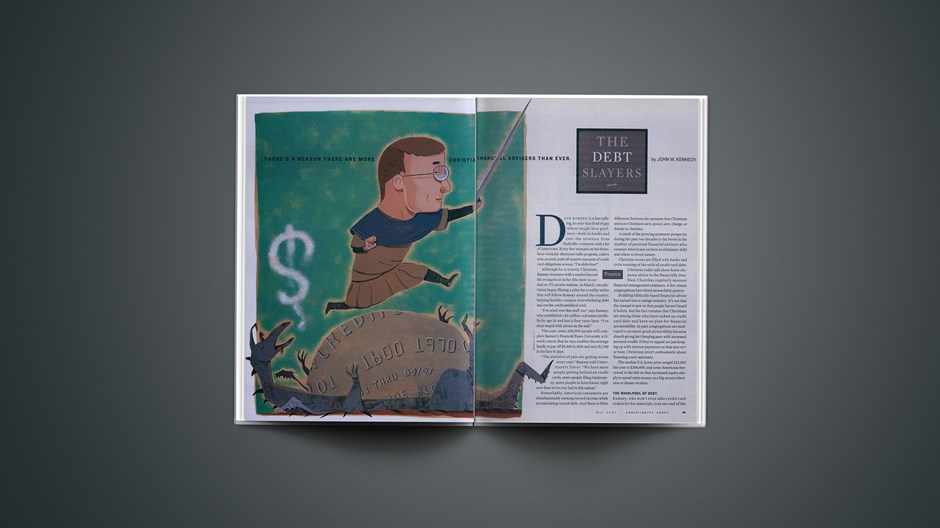
Dave Ramsey is a fast-talking, in-your-face kind of guy whose tough-love guidance—both in books and over the airwaves from Nashville—connects with a lot of Americans. Every few minutes on his three-hour weekday afternoon radio program, callers who recently paid off massive amounts of credit card obligations scream, "I'm debt-free!"
Although he is overtly Christian, Ramsey resonates with a market beyond the evangelical niche: His show is carried on 272 secular stations. In March, cbs television began filming a pilot for a reality series that will follow Ramsey around the country, helping families conquer overwhelming debt and cut the credit umbilical cord.
"I've cried over this stuff, too," says Ramsey, who established a $4 million real estate portfolio by age 26 and lost it four years later. "I've done stupid with zeroes on the end."
This year, some 200,000 people will complete Ramsey's Financial Peace University, a 13-week course that he says enables the average family to pay off $5,300 in debt and save $2,700 in the first 91 days.
"The statistics of pain are getting worse every year," Ramsey told Christianity Today. "We have more people getting behind on credit cards, more people filing bankruptcy, more people in foreclosure right now than we've ever had in this nation."
Remarkably, American consumers are simultaneously earning record income while accumulating record debt. And there is little difference between the amounts that Christians and non-Christians earn, spend, save, charge, or donate to charities.
A result of the growing economic prosperity during the past two decades is the boom in the number of personal financial advisers who counsel Americans on how to eliminate debt and where to invest money.
Christian stores are filled with books and dvds warning of the evils of credit card debt. Christian radio talk show hosts dispense advice to the financially troubled. Churches regularly sponsor financial management seminars. A few dozen congregations have hired stewardship pastors.
Peddling biblically based financial advice has turned into a cottage industry. It's not that the counsel is new or that people haven't heard it before. But the fact remains that Christians are among those who have racked up credit card debt and have no plan for financial accountability. In part, congregations are motivated to promote good stewardship because church giving isn't keeping pace with increased personal wealth. If they're tapped out just keeping up with interest payments on that new suv or boat, Christians aren't enthusiastic about financing a new sanctuary.
The median U.S. home price surged $22,500 last year to $206,600, and some Americans borrowed to the hilt on that increased equity simply to spend extra money on a big-screen television or dream vacation.
The whirlpool of debt
Ramsey, who won't even take credit card orders for his materials, is at one end of the Christian financial counselor spectrum. At the other extreme, and in the minority, is Gary Moore, who believes that most in the Christian money management industry fill churchgoers with irrational fears that hinder congregational giving.
According to CardWeb.com, Americans owed $696.7 billion on credit card loans in 2004, compared to $285.5 billion a decade earlier. In the same span, the average household credit card debt has grown to $9,312 from $4,301. The Federal Reserve reports that last year, consumers overspent their income and, for the first time since the early Great Depression, had a negative personal savings rate: minus 0.5 percent.
According to Mary Hunt, who says her Debt-Proof Living website attracts more than 8 million monthly hits, multitudes of Christians have curtailed church giving because of overspending.
"People can't believe it when I tell them they need to tithe and save even if they are deeply in debt," says Hunt. "Most of them think, I'll do that when I pay all my bills off."
"A whole bunch of us got all this stuff we really didn't want with money we really didn't have to impress people we really didn't like," Ramsey says.
Unlike a lot of parachurch ministries that emphasize budgeting and debt elimination immediately, Willow Creek Association's Good Sense takes several weeks to review foundational Scriptures in an effort to impact a heart change first.
"We are essentially trying to deprogram what many people believe is normal," says Dave Briggs, director of the South Barrington, Illinois, megachurch program that has been adopted by almost 3,000 other congregations. "Many people have bought into the teachings of the culture: the idea that debt is good, that everybody is in debt, that debt is an opportunity to get things you couldn't otherwise afford, that debt really isn't a big deal. But the more you buy into the message of the culture, the more you get into the whirlpool of debt."
Three decades ago, Larry Burkett served as the pioneer of the Christian financial counseling movement. Before he died in 2003, Burkett's Christian Financial Concepts merged with Howard Dayton's Crown Ministries to become Crown Financial Ministries. Last year, through seminars and Dayton's daily radio programs "Money Matters" and "How to Manage Your Money," around 1 million people heard Crown Financial's lessons.
Article continues below
"If people have been taught anything about handling money from God's perspective, it's usually been limited to giving 10 percent," Dayton says. "By default, people have adopted our culture's perspective, not the Lord's perspective."
Household wealth in this country has increased from $13 trillion in 1990 to $50 trillion today. During the same time, according to Ron Blue, chairman of Crown Financial's board, the number of financial service advisers has increased tenfold, to 1 million. In the past three years, the Atlanta-based Blue has trained 1,000 advisers through Christian Financial Professionals Network, which teaches clients how to be good stewards of their assets.
Some of the most popular stewardship advisers have made crossover inroads into the mainstream market, because of credibility gained through failing to get a grip on their finances and then recovering from it. Hunt, who took 13 years to repay creditors, now is a Woman's Day columnist and aol money coach.
No blanket judgments
Most Christian financial leaders acknowledge that debt isn't called sin in the Bible, but they believe that Scripture discourages debt. They concede that debt is a reality of modern life and even drives the economy, but warn against a lifelong pattern of debt.
"We can't make a blanket statement that all debt is wrong," says Blue, author of Master Your Money, now in its 32nd printing. "But it doesn't make sense to borrow your way to prosperity."
Christian ministries usually take a hard line on debt the borrower can't eradicate quickly. For instance, mortgage debt and car loans have safety valves, because the property can be sold. But student loans and credit card debts can't be easily liquidated.
Hunt disagrees with counselors who see college loans as secured debt, based on the assumption that the graduate will earn a good living. "I know way too many people who thought they were going to be a doctor, and it didn't work out," she says.
Hunt also laments that students at Christian colleges and seminaries have become burdened with loans. "It's keeping people from going into ministry and to the mission field."
Hunt maintains every family needs at least one all-purpose credit card simply for modern technology transactions. It's difficult to rent a car, secure an airplane ticket, or buy anything over the internet without one. But when pre-approved credit card applications arrive in the mail almost every day, and mortgages, income taxes, and even tithing can be rung up on credit cards, charging is dangerously effortless.
Article continues below
"We've been sold debt as a product by the most sophisticated marketing teams in the world, and they're called banks," Ramsey says. "We've come to believe that debt is a way of life, that the way to prosper is through the use of a credit card, that you can't be a student without a student loan."
Blue doesn't blame lending institutions or advertisers. "Convenient credit never got anybody into financial trouble," he contends. "It's the person holding the card who gets into trouble."
Dayton says households that participate in Crown Financial Ministries' small groups pay off an average of $20,000 in debt and increase savings by $10,000 within three years.
Doug and Sherrie Spracklen of Fair Grove, Missouri, are typical beneficiaries. They believe an intensive 13-week Crown Ministries course at Peace Chapel Assembly of God strengthened their marriage and transformed their lives.
Doug, 35, says in his younger years he bought things like a car stereo system and golf clubs, but didn't have the money to pay for them. His credit card balance further escalated when he started his own insurance business and bought office furnishings and business suits.
Four years into their marriage, the Spracklens had amassed $20,000 in unsecured debt. They had two vehicle payments, an older house that needed repairs, and no equity. They made minimum payments on their credit cards and rolled debt over whenever a zero percent credit offer came along, but those introductory benefits soon expired. The Crown classes helped them devise a plan to get out of debt in two years, just before the birth of the first of their two sons.
Although he always had tithed, the Crown course taught Doug Spracklen to view giving as something more joyful than a mere obligation. Since becoming debt-free, the Spracklens have increased giving to missions, benevolence needs, and savings. He hired three agents, and his business income quadrupled in six years. The Spracklens have purchased 30 acres, but are in no hurry to go into debt by borrowing to build a home.
Ramsey says he doesn't berate callers for taking out a 15-year fixed mortgage. "It's not my job to tell people they're going to hell if they have a home mortgage," Ramsey says. "But I can't find in the Bible that it's okay."
Article continues below
Brian Walters, who owns a five-employee optical manufacturing and retail shop in Oklahoma City, first heard Ramsey speak at a live event five years ago. Although Walters hadn't accumulated credit card or vehicle debts, Ramsey's motivational talk spurred him to eliminate mortgage debt.
Walters turned 30 in February, the same month he paid off his home, valued at $160,000. That took great discipline for Walters and Rebecca, his wife of eight years, a stay-at-home mom to their two children.
The family has never taken a vacation. Walters drives a 13-year-old pickup. He would like a newer model, but that won't happen until he has cash in hand. Rebecca wants a new dining room table, but the same rules apply.
"We have friends who have much nicer homes and drive much nicer cars," says Brian Walters. "But they have a lot more stress."
A different story
On the other end of the spectrum is the Sarasota, Florida–based Gary Moore, who provides "counsel to spiritual and ethical investors." He advises the Templeton Foundation and is a board treasurer of Opportunity International, an organization that sees loans as a means of empowerment for the poor. "Small loans," its website proclaims, "sometimes as little as $50, in the hands of a poor entrepreneur, can transform the lives of individuals, families, and entire communities." Not surprisingly, then, Moore paints a much different picture than Dayton, Ramsey, Blue, and Hunt.
He argues that Americans are in the top 1 percent of all wage earners in history and that less than 2 percent of Americans have serious credit card debt. Federal Reserve reports indicate that of the households that carry a credit card balance (45 percent of all households), the median amount owed is $1,900. "As the average American lives on $40,000 a year, that's hardly an economic earthquake," Moore comments. Only 29 percent of households owe $1,000 or more on their cards, 4 percent owe $10,500 or more, and 1 percent owe $21,400 or more. Moore contends that debt can be empowering rather than enslaving, and that credit is compatible with Christian values.
"Credit card companies probably make credit too available for young people like my son," Moore says, "but for adults to say it's all credit card companies' fault is to imitate Flip Wilson's 'the Devil made me do it' excuse, or to deny personal responsibility."
According to Moore, sages of the Christian personal finance industry in the past quarter century have been disconnected from the reality of prosperity, creating unfounded fears about inflation, stock market collapse, Y2K, and foreign oil dependency. As a result, he believes some Christians have become obsessed with accumulating money to ward off such imagined worries.
Article continues below
Regarding lending and borrowing, Moore notes, "Jesus said to lend to anyone in need." Furthermore, he says, "Free credit and credit forgiveness is clearly the way to abundant life."
Still, even if only 2 percent of Americans have serious debt difficulties, financial ministries report they hear the debtors' anguished cries every day. Apparently, cbs television thinks there are enough of them to create a successful reality show with Ramsey at the helm.
In the end, the different approaches appeal to people in different financial situations. For those who have been able to manage their credit wisely, counselors like Moore make sense. For those who have become addicted to credit, abstinence might be the only way to financial sobriety.
John W. Kennedy is a freelance writer based in Springfield, Missouri. He is a former news editor at Christianity Today.
Dave Ramsey, Mary Hunt and Gary Moore's websites have more information about their ministries, money management, and what the Bible has to say about giving.
Good $ense and Crown Financial Ministry have more information about handling money as well as ways to start a money ministry at your church.
More recent articles on personal finance include:
Salary Quandary | Ministries pay executives less than their secular nonprofit counterparts. Should they? (April 26, 2006)
Profitable Servants | New mutual fund expands the church-bond market. (March 7, 2006)
What Would Jesus Buy? | Saving the world one cashmere sweater at a time. (Jan. 31, 2006)















 While we pray for peace, we need moral clarity about this war.
 As my doubts about his teachings grew, so did a secret fascination with Jesus.
 How groups like Hillsong learned to let go of the literal in favor of creative collaboration.españolPortuguês






