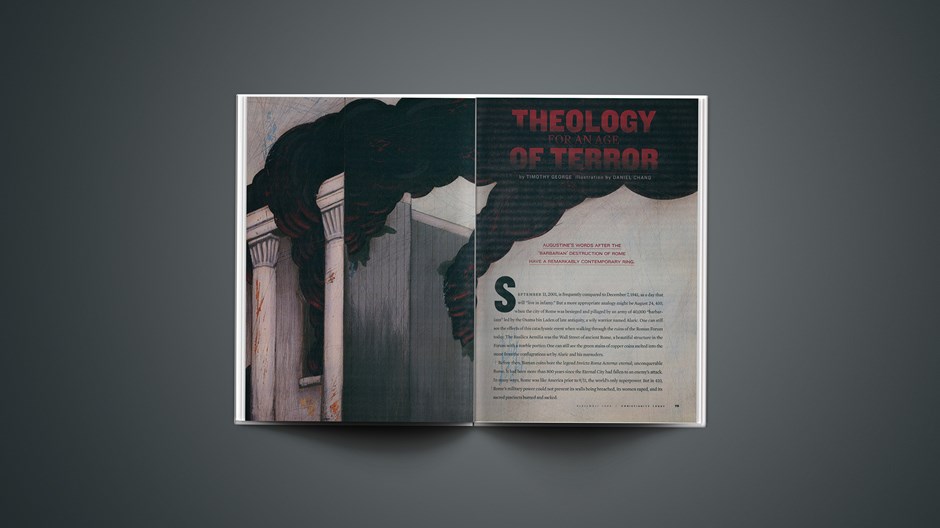
September 11, 2001, is frequently compared to December 7, 1941, as a day that will "live in infamy." But a more appropriate analogy might be August 24, 410, when the city of Rome was besieged and pillaged by an army of 40,000 "barbarians" led by the Osama bin Laden of late antiquity, a wily warrior named Alaric. One can still see the effects of this cataclysmic event when walking through the ruins of the Roman Forum today. The Basilica Aemilia was the Wall Street of ancient Rome, a beautiful structure in the Forum with a marble portico. One can still see the green stains of copper coins melted into the stone from the conflagrations set by Alaric and his marauders.
Before then, Roman coins bore the legend Invicta Roma Aeterna: eternal, unconquerable Rome. It had been more than 800 years since the Eternal City had fallen to an enemy's attack. In many ways, Rome was like America prior to 9/11, the world's only superpower. But in 410, Rome's military power could not prevent its walls being breached, its women raped, and its sacred precincts burned and sacked.
When Jerome heard about the fall of Rome in faraway Bethlehem, he put aside his Commentary on Ezekiel and sat stupefied in total silence for three days. "Rome was besieged," Jerome wrote to a friend. "The city to which the whole world fell has fallen. If Rome can perish, what can be safe?" The British monk Pelagius, who was in Rome when the attack occurred, gave this report: "Every household had its grief, and an all-pervading terror gripped us."
Responding to those who said Rome fell as the gods' punishment against the ascendant Christians, Augustine, the bishop of Hippo in North Africa, began writing The City of God, an opus magnum et arduum, as he called it—a "great and laborious work." Augustine completed the book shortly before his death in 430. Its influence extended to the Reformation and beyond. For 1,500 years, it has been the bedrock of a Christian philosophy of history.
Augustine's Journey
As a theologian in an age of terror, Augustine provides wisdom for our own precarious situation. Like C. S. Lewis, Augustine came to the Christian faith through a tortuous process of denial, doubt, false starts, dead ends, and surprising discovery. For nearly nine years, he followed the way of the Manicheans, radical dualists who divided the world into kingdoms of light and darkness and who taught that matter itself was inherently evil. Next he turned to academic skepticism. The skeptics, not unlike some postmodernists today, denied that there was any knowable absolute truth.
Later, he turned to Neo-Platonism, which offered a model of transcendence: It explained the world in terms of a spiritual reality—the ideals of truth, goodness, beauty—that could not be reduced to the flow and flux of the visible, changing world around us. Neo-Platonism continued to influence Augustine even after he became a Christian.
There were, however, two major problems with this philosophy that could not be squared with biblical faith. First, Neo-Platonism argued that matter had always existed. Creation was the work of an artisan who reshaped primordial matter into some other form. But the first five words of the Bible contradicted this cosmogony: "In the beginning God created." Augustine reflected deeply on the creation narrative in Genesis. In book 11 of Confessions he made a startling, brilliant discovery. He came to see that God had not only created both time and space, but that he had created them simultaneously and interdependently. (This insight, which Augustine derived from meditation on the Bible, anticipated Einstein's theory of relativity by 1,500 years.)
Second, Neo-Platonism had no explanation of history. The Christian doctrine of Creation does not mean merely that when God said "poof," the material cosmos popped into being. It means also that God is a principal actor in the unfolding drama of the world, its peoples, and its destiny. As John 1:14 puts it, "The Word became flesh and made his dwelling among us." Neo-Platonism had no place for the Incarnation, but Augustine came to see that this central datum of Christian revelation was the key to understanding the human story.
Between the conversion of Constantine in 312 and the conversion of Augustine in 386, the Christian movement had been transformed from a small, persecuted sect into a tolerated, then legally recognized, and finally officially established religion within the Roman Empire. While there were many benefits that came with this transformation, including the fact that Christians were no longer routinely hauled into the arena or fed to hungry lions, there was a downside as well.
Within a few generations, those who had once been persecuted became persecutors. For the first time, Christians had to think about what it means to follow Jesus Christ while also participating in civil governance. What does it mean to wage a just war? Can followers of a Palestinian peasant who declined to call armies of angels to deliver him from physical assault now sanction violence against heretics and recalcitrant pagans in his name?
Article continues below
Eusebius of Caesarea, the biographer of Constantine, had hailed the emperor as the 13th apostle and acclaimed his conversion in utopian terms. Nearly a century later, Augustine realized that such hopes were as misplaced as they had been premature. As wealthy refugees from Rome began to stream into Hippo with their horror stories of Alaric's acts—temples burned, women raped, citizens forced to flee for their lives—Augustine reminded his hearers that the City of God in its pilgrimage here on earth was not exempt from the ravages of time, that it was ever marked "by goading fears, tormenting sorrows, disquieting labors, and dangerous temptations."
Forgotten Distinction
With the assumptions of "Christendom" shaken again today by the forces of terror, Augustine teaches us that we must not equate any political entity—whether it be the Roman Empire, the American republic, the United Nations, or anything else—with the kingdom of God. Islam proclaims an undifferentiated understanding of the human community (ummah), whereas Christianity, especially in the Augustinian perspective, requires a proper respect for the complementary but clearly distinguishable roles of church and civil authority.
Whenever this distinction is forgotten or minimized, the Christian faith is in danger of being politicized and the state idolized. When this happens, religious liberty invariably gets trampled. The danger of being co-opted by forces inimical to the gospel is not limited to one political party or ideology. It can arise from any point along the political spectrum, from the raucous right, the loony left, or the mushy middle.
In the early 1930s, many earnest Christians in Germany equated the Nazi state with the direct unfolding of God's purpose in the world. In the face of this crisis, Karl Barth, Dietrich Bonhoeffer (whose 100th birthday we celebrated this year), and other courageous church leaders supported the Barmen Declaration. The first and second articles in this statement of faith argue for the supremacy of Jesus Christ over every temporal authority that would usurp the crown rights of the King of Kings:
Jesus Christ, as he has testified to us in the Holy Scripture, is the one Word of God whom we are to hear, whom we are to trust and obey in life and death. … Just as Jesus Christ is the pledge of the forgiveness of our sins, just so, and with the same earnestness, [he] is also God's mighty claim on the entirety of human life. In him we encounter a joyous liberation from the godless claims of this world to free and thankful service to its creatures.
Article continues below
This is one side of the Augustinian equation, but there is another. Christians hold a double citizenship in this world. Like the apostle Paul—who could claim that his true political identity was in heaven (Phil. 3:20), but who also appealed to Caesar as a Roman citizen when his life was at stake—so believers in Christ live as sojourners, resident aliens, in a world of profound discontinuity and frequently contested loyalty.
Jean Bethke Elshtain summarizes the counsel Augustine gives to believers beset by such fears and hopes: "Resisting altogether any notion of earthly perfection, Augustine offers instead a complex moral map that creates space for loyalty and love and care, as well as for a chastened form of civic virtue."
The key word here, chastened, calls for a posture of engagement that acknowledges, in the words of the old gospel hymn, "This world is not my home; I'm just a-passing through," while at the same time working with all our might to love our neighbors as ourselves and to seek justice and peace as we carry out what Augustine called "our business within this common mortal life."
There are two major (and regrettably common) mistakes Augustine wants us to avoid. One is the lure of utopianism. This is the mistake of thinking that we can produce a human society that will solve our problems and bring about the kingdom of God on earth. This was the basic error of both Marxism and 19th-century liberalism.
The other error, equally disastrous, is cynicism. This creeps up on us as we see ever-present evil. We withdraw into our own self-contained circle of contentment, which can just as well be a pious holy huddle as a secular skeptics club.
Fragile World, Strong Faith
How can we avoid such reactions? Perhaps another great Christian of the past, Francis of Assisi, can help. One day when Francis was riding to Assisi, he saw a leper on the road. He reached out to embrace the leper and actually gave him the kiss of peace. While embracing this filthy, diseased outcast, Francis said, he was overcome by a dual sensation. One was nausea. The other was a sense of sweetness and well-being. Like Francis, we need both.
If all we experience is nausea, we will become cynics. We will give up on the world and turn away. But if all we have is sweetness, then our faith will amount to little more than sentimental fluff.
Article continues below
Genuine Christian faith, and true ministry, takes place on the thin line between nausea and sweetness. Feel-good Christianity, so common in our popular culture, actually masks the suffering and pain of the world for which Christ died.
C. S. Lewis preached at the University Church of St. Mary the Virgin at Oxford on October 22, 1939. Less than two months earlier, Hitler had invaded Poland. Britain was about to face the horrible Nazi onslaught. This is what Lewis told the assembled students:
It may seem odd for us to carry on classes, to go about our academic routine in the midst of a great war. What is the use of beginning when there is so little chance of finishing? How can we study Latin, geography, algebra in a time like this? Aren't we just fiddling while Rome burns?
This impending war has taught us some important things. Life is short. The world is fragile. All of us are vulnerable, but we are here because this is our calling. Our lives are rooted not only in time, but also in eternity, and the life of learning, humbly offered to God, is its own reward. It is one of the appointed approaches to the divine reality and the divine beauty, which we shall hereafter enjoy in heaven and which we are called to display even now amidst the brokenness all around us.
That is our calling, too, amidst the brokenness—including the threat of terrorism—all around us. We are to be faithful to God's calling, to bear witness to the beauty, the light, and the divine reality that we shall forever enjoy in heaven. We are to do this in a culture that seems, at times, like Augustine's, a crumbling world beset by dangers we cannot predict.
As Augustine aged, he increasingly thought of the world, its politics, culture, and institutions, as a tottering old man whose days were numbered: "You are surprised that the world is losing its grip? That the world is grown old? Don't hold onto the old man, the world; don't refuse to regain your youth in Christ, who says to you: 'The world is passing away; the world is losing its grip; the world is short of breath. Don't fear, your youth shall be renewed as an eagle.'"
As Augustine lay dying in 430, a new wave of terror swept across the Mediterranean world. The Vandals, led by a ferocious warrior named Genseric, surrounded Hippo—bringing torture, violence, and disarray to its churches and its people. As Augustine chanted the psalms on his deathbed, he might have come across this verse in Psalm 31:21: "Blessed be the Lord, for he showed his wonderful love to me when I was in a besieged city."
Timothy George is dean of Beeson Divinity School of Samford University and an executive editor of Christianity Today.















 While we pray for peace, we need moral clarity about this war.
 A Christian reconciliation group in Israel and Palestine warned that war would come. Now the war threatens their relevance.españolالعربيةFrançaisрусскийУкраїнська
 How groups like Hillsong learned to let go of the literal in favor of creative collaboration.españolPortuguês






