
Editor's note, added May 8, 2013: Dallas Willard died today at age 77, days after being diagnosed with cancer. This profile originally ran in our September 2006 issue.
We have also posted John Ortberg's tribute to Willard.
It's the first week of class at the University of Southern California, and a young woman named Sarah is standing on a soapbox in Hahn Plaza giving her testimony. She describes her first girlfriend, and says that when her mother found out about their relationship, she sent her to therapy. It wasn't until Sarah came to USC that she fully embraced her identity as a lesbian.
Stories like this may strike fear in the heart of many a Christian parent, but for the past 41 years, USC students have also had the opportunity to hear the teaching of a provocative Christian thinker named Dallas Willard.
It's a short walk from Hahn Plaza to Willard's office in the Mudd Hall of Philosophy. A stately brick building with a clock tower stretching to the sky, Mudd Hall was modeled after an Italian monastery and built in 1929. The father of the building's architect and the department chair that year, Ralph Tyler Flewelling, was a Methodist who wanted to establish a Christian intellectual outreach to the Far East. It's a fitting home for a man devoted to reestablishing the exalted place moral reasoning once held in the academy.
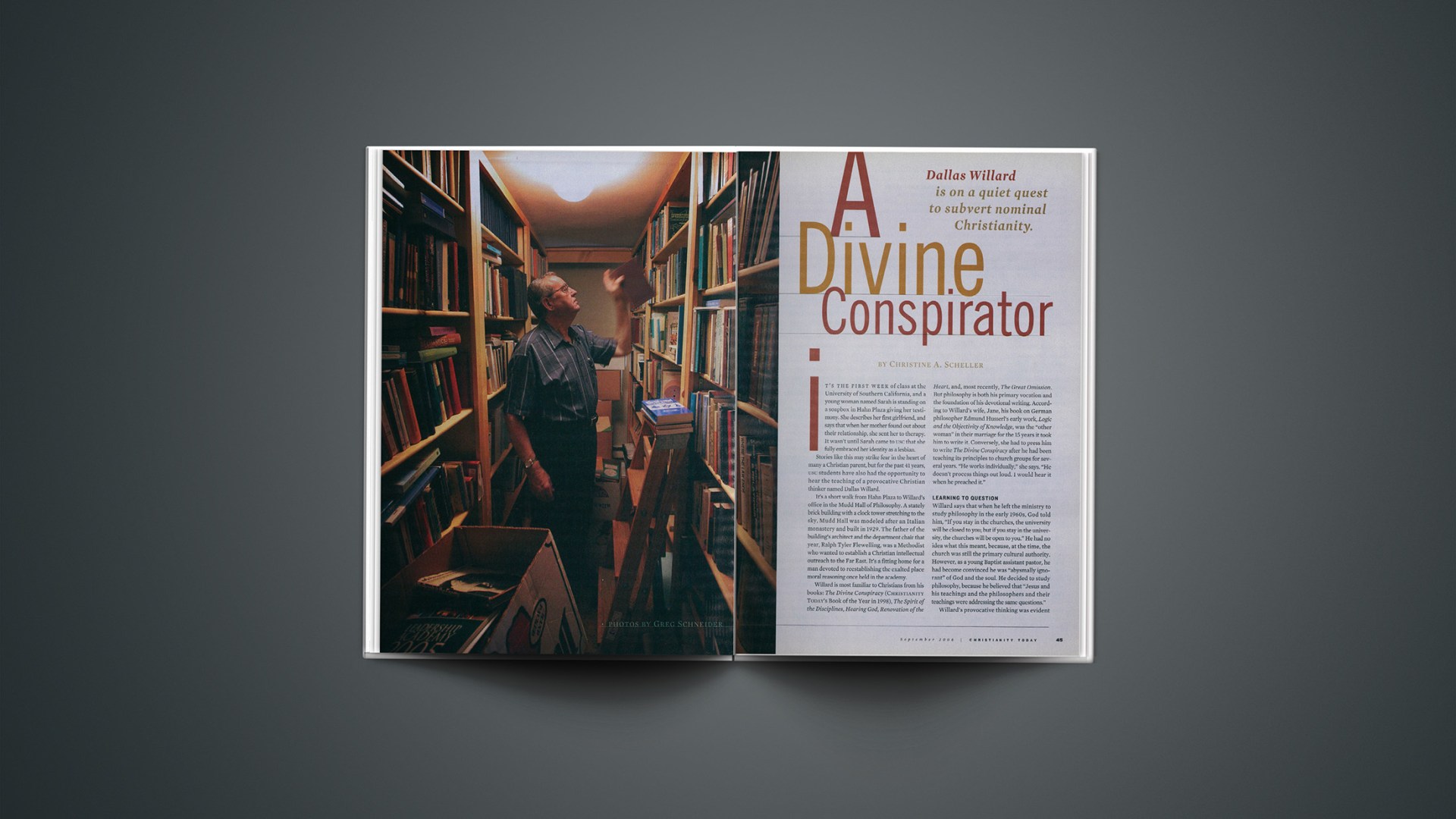
Willard is most familiar to Christians from his books: The Divine Conspiracy (Christianity Today's Book of the Year in 1998), The Spirit of the Disciplines, Hearing God, Renovation of the Heart, and, most recently, The Great Omission. But philosophy is both his primary vocation and the foundation of his devotional writing. According to Willard's wife, Jane, his book on German philosopher Edmund Husserl's early work, Logic and the Objectivity of Knowledge, was the "other woman" in their marriage for the 15 years it took him to write it. Conversely, she had to press him to write The Divine Conspiracy after he had been teaching its principles to church groups for several years. "He works individually," she says. "He doesn't process things out loud. I would hear it when he preached it."
Learning to Question
Willard says that when he left the ministry to study philosophy in the early 1960s, God told him, "If you stay in the churches, the university will be closed to you; but if you stay in the university, the churches will be open to you." He had no idea what this meant, because, at the time, the church was still the primary cultural authority. However, as a young Baptist assistant pastor, he had become convinced he was "abysmally ignorant" of God and the soul. He decided to study philosophy, because he believed that "Jesus and his teachings and the philosophers and their teachings were addressing the same questions."
Willard's provocative thinking was evident even in the 1960s. He recalls shocking his college classmates with statements like this one: "If you could find a better way, Jesus would be the first one to tell you to take it. And if you don't believe that about him, you don't have faith in him, because what you're really saying is that he would encourage you to believe something that is false." This realization freed Willard "from ducking or trying to avoid issues raised against the content of the teachings of Jesus. … It made it possible to do honest inquiry in any area and to meet those of different persuasions on the field of common inquiry, not on that of assumptions to be protected at all costs."
A consequence of Willard's academic honesty is his unwillingness to state who's in and who's out spiritually, which bothers critics who worry that he is a universalist. He says he doesn't believe anyone will be saved except by Jesus, but he adds, "How that works out, probably no one knows." He teeters on the edge of openness theology, saying God can choose not to know the future if he wants to, but he doesn't go as far as many openness adherents, whose views he believes "slip into process theology." Still, as apologist Dave Hunt notes in his critique of The Renovaré Spiritual Formation Study Bible—of which Willard was a coeditor—some conservative critics remain disturbed by the kind of openness to ambiguity that marks the Renovaré Bible and its editors.
James Higginbotham, chairman of USC's philosophy department, says Willard's reputation among philosophers stems chiefly from his work on Husserlian realism. Like Husserl, Willard believes that we can have direct experiences with the world that transcend cultural and linguistic barriers. What intrigued him about the German philosopher was partly his obscurity. "I thought the fashionable views were a disaster," says Willard. "I wouldn't have stayed in philosophy if it weren't for realism."
From Moral Knowledge to Transformation
As Sarah rattles on about her sexuality in Hahn Plaza, Willard is teaching a class on the history of modern philosophy in an antiquated Mudd Hall classroom. He is a subversive and sophisticated apologist for the existence of truth in a setting that he claims has abandoned its mandate to transfer moral knowledge to the next generation. Point by point, he explains where and how modern thought went wrong. He begins with the Renaissance, unravels the Reformation-inspired battle over authority, then moves in broad strokes from rationalism to relativism.
On the first day of class, he transformed this group of seemingly bored 19- and 20-year-olds into attentive students by carefully explaining that philosophy would help them "find a basis in knowledge for action." Senior Zachary Muro says Willard's ability to make real life connections, along with his kindness, is why he keeps taking his classes.
Talbot School of Theology distinguished professor of philosophy J. P. Moreland says that three of Talbot's five philosophy professors were Willard's students. He says Willard models the integration of philosophy, the life of the spirit, and mature discipleship, and that they are attempting to emulate his approach at Talbot. Moreland recalls a student who came to him following a seminar he was giving at USC and asked, "Do you believe Jesus can come up to you and listen to you?" He had been wondering about this ever since Willard told him that it was indeed possible. Moreland assured him that, in his own unique way, Willard had spoken the truth. The student later gave his life to Christ.
In philosophy classes, Willard mentions the Intelligent Design debate as an example of the battle over who gets to decide what constitutes knowledge. He says this is important, because it inevitably determines who has the right to formulate and carry out public policy. It annoys him that people who identify with science, professionally or otherwise, get to decide what knowledge is, while people who aren't scientists can rarely be taken seriously in the id debate. "There is knowledge of God and the spiritual nature of man, as well as other types of reality (e.g. moral obligations) that are not reducible to the world dealt with by the so-called 'natural sciences.' The idea that knowledge—and, of course, reality—is limited to that world is the single most destructive idea on the stage of life today."
His elders told him he was insatiable about the "why questions" as a child. Willard doesn't remember that. He remembers the struggle to stay alive during the Great Depression and the anguish of being separated from his siblings some years after their mother died when Willard was only two years old. He has been devouring books ever since he followed his siblings to their one-room Missouri schoolhouse as a four-year-old. Plato was his companion when he worked as an agricultural laborer after high school. He still loves to work with his hands, doing carpentry and landscaping on his hilltop property north of Los Angeles.
Willard recalls giving his Baptist Sunday school teachers a "very bad time" as a young teenager. He didn't think it made sense that you "got saved" and were "stuck with it." He says he recognized that "even though we want to say salvation is by grace and that anyone can be saved, behaving in certain ways simply is inconsistent with having eternal life." Nevertheless, he was later ordained as a Southern Baptist pastor.
His Arminian bent can be traced to the influence of his Methodist grandmother, but also to his feelings of failure as a young pastor. That's when he began reading John Wesley and Charles Finney and aspiring to emulate them. "Generally, what I find is that the ordinary people who come to church are basically running their lives on their own, utilizing 'the arm of the flesh'—their natural abilities—to negotiate their way," he says. "They believe there is a God and they need to check in with him. But they don't have any sense that he is an active agent in their lives. As a result, they don't become disciples of Jesus. They consume his merits and the services of the church. … Discipleship is no essential part of Christianity today."
He says these problems are theologically grounded: "We don't preach life in the kingdom of God through faith in Jesus as an existential reality that leads to discipleship and then character transformation." He adds, "When you don't have character transformation in a large number of your people, then when something happens, everything flies apart and you have people acting in the most ungodly ways imaginable."
The last "great outbreak" of the kingdom of God in the Western world, according to Willard, was the Wesleyan movement, which transformed both people and public institutions "without regard to churches or not churches." When I ask Willard about later revivals such as the 1970s Jesus Movement, he says that they haven't changed public institutions, particularly academia.
The Willard Laboratories
An early laboratory for Willard's theology was a little Quaker church in the San Fernando Valley that the Willards attended in the 1970s. The founder of the Renovaré movement, Richard Foster, was the pastor. Willard led singing, and Jane played the organ. "I was fresh out of seminary and ready to conquer the world," Foster recalls. "Dallas was so patient with me. He really, in a way, pastored from the pew. … When I would teach, folks might come, but when Dallas taught, they brought their tape recorders. We all did." Foster recalls sensing that they were "onto something big" when Willard taught through the Book of Matthew.
These days there are multiple and varied laboratories for Willard's ideas. He teaches in seminaries and is invited to many conferences, and he acts as an informal mentor to a cadre of young men whom Jane refers to as "our boys." He also serves on the board of Renovaré and speaks and counsels at its events.
Willard has avoided many of the trappings of a high-impact ministry; colleagues like Moreland, Foster, and Higginbotham mention his generosity of spirit and his patient humility. He doesn't have a book agent, has never pursued a book deal, doesn't charge a set speaking fee, and doesn't sell his books when he speaks.
Willard's influence has sometimes led to radical changes at churches. Oak Hills Church in Folsom, California, was running along smoothly according to the Willow Creek model throughout the 1990s. Senior pastor Kent Carlson says that after a period of rapid growth, the church leadership finally had "time to think." The leaders read a book that essentially said consumerism was a mainstay of American culture, so if the church couldn't beat the culture, it might as well join it. Carlson says, "This was a distasteful concept to us." At the same time, senior co-pastor Mike Lueken was taking a course taught by Willard at Fuller Theological Seminary in Pasadena, California.
While church leaders were grappling with these conflicting ideas, they had a powerful experience with God at a leadership retreat. Carlson says that afterward they made a decision to "restructure the church so that people would have a genuine encounter with God that leads to transformation." Oak Hills' seeker service was canceled in the belief that evangelism would be more effective as people began to "live more contagiously."
Instead of "trying to get people's papers in order for heaven," the church began concentrating on helping spiritually hungry people "pursue their life with God." Carlson adds, "We probably didn't do a very good job at this. We had a bit of an attitude that didn't always come across as positive. There was anxiety at having built this large organization that we had to keep functioning while we were more enthralled by the more substantive thing."
Tackling the Big Issues
Willard intends to tackle the question of how to live rightly on a grand scale when he takes a sabbatical from teaching this academic year. He is planning a new book, tentatively titled The Disappearance of Moral Knowledge. In it, he will attempt to demonstrate how it came to be that the "institutions of knowledge have nothing to provide in terms of moral enlightenment that would be available to an ordinary person." He says, "People today don't know how unique that is to our times." Harking back to the century after Wesley once again, he adds, "There was a moral synthesis at the end of the 1800s. It was an enlightened form of Judeo-Christian ethics, and really what I want to do is return to that, to bring it up to date and say, 'Here is moral knowledge.' "
Ken Archer, a graduate student at the Catholic University of America, notes that moral knowledge has been an important theme for Willard, philosophically and theologically. Archer has written about the impact of phenomenology on the theology of both John Paul II and Willard. He notes a similarity in both men's practical application of realism. "It is often pointed out by biographers of Pope John Paul II that [the] call to see in the moral actions of a person who the person has chosen to become is very much a reaction against the routine hypocrisy required for survival in communist Poland," he writes. Later, he summarizes John Paul's insight: "You are who you are, not what you would be if the system was different."
Likewise, Archer points out, Willard asks in The Spirit of the Disciplines, "Why is it that we look upon salvation as a moment that began our religious life instead of the daily life we receive from God?" In The Divine Conspiracy, Willard writes, "God has yet to bless anyone except where they actually are, and if we faithlessly discard situation after situation, moment after moment, as not being 'right,' we will simply have no place to receive his kingdom into our life. For those situations and moments are our life."
To those who wonder if he advocates a new perfectionism, Willard replies, "They're thinking the righteousness here is doing or not doing certain things, and that leads to what Jesus called the 'leaven of the Pharisees': hypocrisy." What "killed" the Wesleyan movement, according to Willard, was people taking Jesus' teachings—in which he refuted general rules without establishing new ones—in the Sermon on the Mount and turning them into legalisms.
Willard says the intersection between his philosophical and devotional work can be found in the simple question: Who are you going to become?
Husband, Father, Workaholic
Who Willard has become in his 70 years on earth is perhaps most evident at the meandering hilltop property north of Los Angeles where he and Jane raised their children, John and Becky. To say the house, furnishings, and outbuildings are modest would be an overstatement by American standards. However, the bucolic hills where Willard and the children spent afternoons exploring are visible from every room, and Jane's quiet strength fills the house on a Saturday morning visit. Next door is the rental house they built with their own hands, and beyond that is the building containing their offices, with Willard's makeshift library between them.
Willard was only 19 years old when he married Jane. They met in the library at Tennessee Temple University in Chattanooga. She was a popular, blonde music major. He was a favorite of professors. Jane thought he was a rebel, because he went sockless and wore his shirttails out; yet she was attracted to his musical gifts, the depth of his preaching, and his sensitivity in prayer. She says it was only recently that she learned his habit of going sockless had been primarily a result of poverty. Still, she remarks, "He did have rebellion in him."
About his family life, Willard is candid: "I have not been a wise husband or father, and this has cost us dearly." He declines to comment further for the sake of the privacy of the people involved. But Becky Heatley says her father was a "great example of unconditional fatherly love." She says he was always singing hymns and silly songs around the house and that he taught her and her brother to think. She recalls one such experience when she was in junior high school. Billy Joel's song "Only the Good Die Young" was playing on the car radio, and her dad provocatively asked, "Is it true that only the good die young?"
Willard says apart from the knowledge of God, Jane has been the greatest blessing in his life: "On many occasions, she has held me steady and preserved me from going off-track." These days, Jane, who is a marriage and family therapist, needs the help of a small committee to keep Willard's demanding schedule on track. She says he has a hard time relaxing: "If there was a blood test for workaholism, he would come up positive." A devoted co-laborer in the work of getting his message out, she adds, "I certainly don't feel unloved, at least at this juncture. … Always down deep in my formation was this thing before God of 'I cannot stand in his way.'"
It was with Jane that Willard had an early experience that set him on his life course. He and Jane had prayed to fully surrender their lives to Christ during a campus service at Tennessee Temple University. Afterward, R. R. Brown was laying hands on Willard and praying over him. Jane says Willard lost consciousness, later describing the experience as being enveloped in a cloud. A spiritual reality became tangible for Willard in that moment.
In some sense, he has been trying to describe and teach it ever since.
Christine A. Scheller is a writer living in Southern California.
Copyright © 2006 Christianity Today. Click for reprint information.
Related Elsewhere:
Also posted today is:
Dr. Willard's Diagnosis | Why we need to really die before we can really live.
More about Dallas Willard's latest book The Great Omission and his other writings is available from his website.
More articles by or about Willard's books include:
The Making of the Christian | Richard J. Foster and Dallas Willard on the difference between discipleship and spiritual formation. (Sept. 16, 2005)
Not a Hallmark Bible | Richard Foster and Dallas Willard on the newly published Renovaré Spiritual Formation Bible. (Sept. 16, 2005)
In His Steps | How to Become an Apprentice of Jesus. A review of The Divine Conspiracy by Dallas Willard. (1999)
Articles by Willard include:
Gray Matter and the Soul | What is the difference between the brain and the soul? By Dallas Willard (Nov. 15, 2002)
Taking God's Keys | The keys of the kingdom also unlock the joys of your calling. By Dallas Willard (Leadership, October 31, 2001)