Nothing in her evangelical upbringing prepared Laura Watkins for John Piper.
"I was used to a very conversational preaching style," said Watkins, 21. "And having someone wave his arms and talk really loudly made me a little scared."
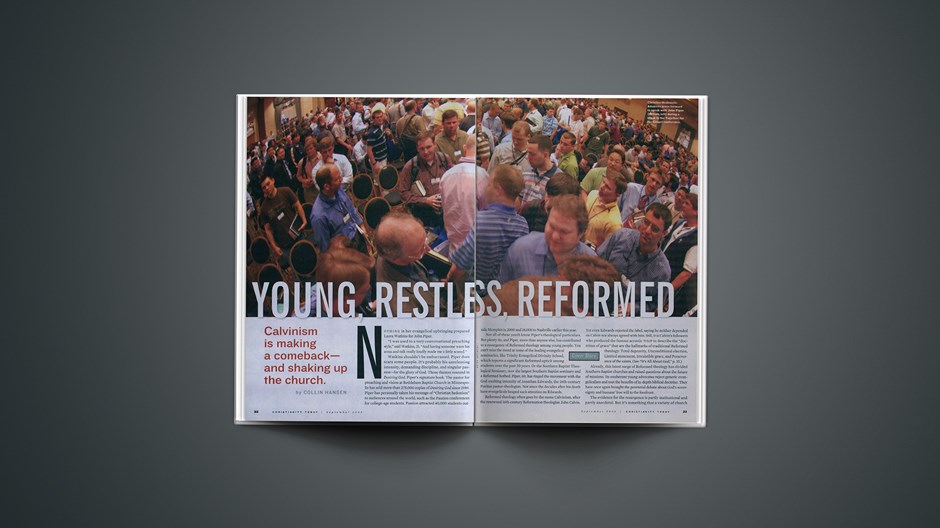
Watkins shouldn't be embarrassed. Piper does scare some people. It's probably his unrelenting intensity, demanding discipline, and singular passion—for the glory of God. Those themes resound in Desiring God, Piper's signature book. The pastor for preaching and vision at Bethlehem Baptist Church in Minneapolis has sold more than 275,000 copies of Desiring God since 1986. Piper has personally taken his message of "Christian hedonism" to audiences around the world, such as the Passion conferences for college-age students. Passion attracted 40,000 students outside Memphis in 2000 and 18,000 to Nashville earlier this year.
Not all of these youth know Piper's theological particulars. But plenty do, and Piper, more than anyone else, has contributed to a resurgence of Reformed theology among young people. You can't miss the trend at some of the leading evangelical seminaries, like Trinity Evangelical Divinity School, which reports a significant Reformed uptick among students over the past 20 years. Or the Southern Baptist Theological Seminary, now the largest Southern Baptist seminary and a Reformed hotbed. Piper, 60, has tinged the movement with the God-exalting intensity of Jonathan Edwards, the 18th-century Puritan pastor-theologian. Not since the decades after his death have evangelicals heaped such attention on Edwards.
Reformed theology often goes by the name Calvinism, after the renowned 16th-century Reformation theologian John Calvin. Yet even Edwards rejected the label, saying he neither depended on Calvin nor always agreed with him. Still, it is Calvin's followers who produced the famous acrostic TULIP to describe the "doctrines of grace" that are the hallmarks of traditional Reformed theology: Total depravity, Unconditional election, Limited atonement, Irresistible grace, and Perseverance of the saints. (See "It's All About God.")
Already, this latest surge of Reformed theology has divided Southern Baptist churches and raised questions about the future of missions. Its exuberant young advocates reject generic evangelicalism and tout the benefits of in-depth biblical doctrine. They have once again brought the perennial debate about God's sovereignty and humans' free will to the forefront.
The evidence for the resurgence is partly institutional and partly anecdotal. But it's something that a variety of church leaders observe. While the Emergent "conversation" gets a lot of press for its appeal to the young, the new Reformed movement may be a larger and more pervasive phenomenon. It certainly has a much stronger institutional base. I traveled to some of the movement's leading churches and institutions and talked to theologians, pastors, and parishioners, trying to understand Calvinism's new appeal and how it is changing American churches.
God Starts the Party
A pastors' conference is the wrong place to schedule a private meeting with Joshua Harris. He didn't even speak at the conference I attended, but we still struggled to find a quiet spot to talk at his hotel. Slight and short, Harris doesn't stick out in crowds. But that doesn't stop pastors from recognizing him and introducing themselves. The unassuming 31-year-old took time to chat with each of them, even as our interview stretched late into the night.
Harris was a leader among his generation even before he published I Kissed Dating Goodbye in 1997. But the bestseller introduced him to a wider evangelical audience, earning many fans and at least as many detractors. Now he pastors Covenant Life Church, a congregation of 3,800 in Gaithersburg, Maryland.
Harris grew up as a youth leader in a seeker-sensitive church and later joined a charismatic congregation. Neither place emphasized doctrine. "Even just thinking doctrinally would have been foreign to me," he explained. He knew enough to realize he didn't like Calvinism, though. "I remember some of the first encounters I had with Calvinists," Harris told another group of pastors during Mark Driscoll's Reform and Resurge conference in Seattle in May. "I'm sorry to say that they represented the doctrines of grace with a total lack of grace. They were spiteful, cliquish, and arrogant. I didn't even stick around to understand what they were teaching. I took one look at them and knew I didn't want any part of it."
Harris's response is anything but uncommon in evangelical history. Reformed theology has periodically boomed and busted. Calvinists have always inspired foils, such as Jacob Arminius. The Dutch theologian argued that God frees up human will so people can accept or reject God's offer of salvation. That debate prompted his critics to respond with TULIP. Reformed theology waned during the Second Great Awakening. Most recently, Calvinism has played second fiddle to the charismatic and seeker-sensitive/church-growth movements, all of which downplay many theological distinctives.
Article continues below
For Harris, things started changing when he read Piper describe God's glory and breathtaking sovereignty. Later, C. J. Mahaney, a charismatic Calvinist and founding pastor of Covenant Life, took Harris under his wing and groomed him to take over the church. Mahaney, 51, turned Harris on to his hero, Charles Spurgeon, the great 19th-century Calvinistic Baptist preacher in London. Mahaney assigned him a number of texts, such as Iain H. Murray's Spurgeon vs. Hyper-Calvinism. "I would have been reading Christian comic books if left to myself," Harris told me, flashing the characteristic self-deprecating humor he shares with Mahaney.
The theological depth attracted Harris. "Once you're exposed to [doctrine]," he said, "you see the richness in it for your own soul, and you're ruined for anything else."
He notices the same attraction among his cohorts. "I just think there's such a hunger for the transcendent and for a God who is not just sitting around waiting for us to show up so that the party can get started."
Passion conferences also inspired Harris to trust in a God who takes the initiative. Harris first attended Passion in 1999 and sought the help of conference founder Louie Giglio to plan a similar event, from which blossomed Harris's New Attitude conferences. "Someone like Louie is saying, 'You know what, it's not about us, it's about God's glory, it's about his renown.' Now I don't think most kids realize this, but that's the first step down a pathway of Reformed theology. Because if you say that it's not about you, well then you're on that road of saying it's not about your actions, your choosings, your determination."
Passion's God-exalting focus keeps Piper coming back to speak year after year. He attributes the attraction of Reformed theology to the spirit of Passion—namely, pairing demanding obedience with God's grandeur. "They're not going to embrace your theology unless it makes their hearts sing," Piper said.
More Than a 'Crazy Guy'
During the weekend when I visited Piper's church, the college group was learning TULIP. The student teacher spent about 30 minutes explaining unconditional election. "You may never feel the weight, you will never feel the wonder of grace, until you finally relinquish your claim to have any part of your salvation," he said. "It's got to be unconditional."
Article continues below
Following that talk, I met with a group that included Laura Watkins, a recent graduate of the University of Minnesota. Like Harris, Watkins grew up in an evangelical church that downplayed doctrine. Calvinism certainly wasn't much of a draw for Watkins as she searched for a church in college. "The only exposure I had was high-school textbooks that teach about John Calvin as this crazy guy who burned people," she said.
Yet she stayed for the spiritual maturity and depth she noticed in the church. Now she's as articulate an advocate of Calvinism as I met. She unwittingly paraphrased Spurgeon as she explained her move toward Reformed theology. "When you first become a believer, almost everyone is an Arminian, because you feel like you made a decision," Watkins said.
Watkins didn't stop with election. An enlarged view of God's authority changed the way she viewed evangelism, worship, and relationships. Watkins articulated how complementary roles for men and women go hand in hand with this type of Calvinism. "I believe God is sovereign and has ordered things in a particular way," she explained. Just as "he's chosen those who are going to know him before the foundations of the earth," she said, "I don't want to be rebelling against the way God ordered men and women to relate to one another."
Piper no longer scares Watkins. He's more like a father in the faith, though she says they have never spoken. Privately, Piper contrasts sharply with his authoritative pulpit persona. I dare say he's even a little meek, if relentlessly serious. We mused on Reformed theology in his home in February following one of the last sermons he delivered before undergoing surgery for prostate cancer. He reflected on the rebellion he has unrepentantly fomented.
"One of the most common things I deal with in younger pastors is conflict with their senior pastors," Piper said. "They're a youth pastor, and they've gone to Trinity or read something [R. C.] Sproul or I wrote, and they say, 'We're really out of step. What should we do?'"
He tells them to be totally candid and ask permission to teach according to their newfound convictions, even if they are in Wesleyan-Arminian churches. Of course, he tells the young pastors to pray that their bosses would come to share their vision.
Article continues below
Baptist and Reformed
Starting in 1993, the largest Protestant denomination's flagship seminary quickly lost at least 96 percent of its faculty. SBC inerrantists had tapped 33-year-old Al Mohler to head the Southern Baptist Theological Seminary, which until then had remained open to moderate and liberal professors. Mohler addressed the faculty and re-enforced the school's confession of faith, derived from the landmark Reformed document, the Westminster Confession.
"I said, in sum, if this is what you believe, then we want you to stay. If not, then you have come here under false pretenses, and you must go," Mohler, now 45, said. "As they would say, the battle was joined."
Indeed, television cameras and news helicopters made it difficult for Mohler to work for a while. He still isn't welcome in some Louisville churches. That's not surprising, since no more than 4 faculty members—from more than 100—stayed with Southern after Mohler arrived.
Now it's hard to believe that less than 15 years ago, Southern merited a reputation as a liberal seminary. Mohler has attracted a strong faculty and spurred enrollment to more than 4,300 students—which makes it the largest Southern Baptist seminary. But SBC conservatives may have gotten more than they bargained for in Mohler. The tireless public intellectual freely criticizes perceived SBC shortcomings, especially what he considers misguided doctrine. Oh, and Mohler is an unabashed Calvinist. His seminary now attracts and turns out a steady flow of young Reformed pastors.
"This generation of young Christians is more committed, more theologically intense, more theologically curious, more self-aware and self-conscious as believers because they were not raised in an environment of cultural Christianity," Mohler said. "Or if they were, as soon as they arrived on a university campus, they found themselves in a hostile environment." Mohler explained that Calvinism offers young people a countercultural alternative with deep roots.
Mohler's analysis brought to mind one Southern seminarian I met in Louisville. Bradley Cochran grew up attending a mainline church with his family in rural Kentucky. He hated Sunday mornings, and by age 15 he had racked up a police rap sheet and developed a drug problem. But Cochran's troubles softened his heart to the gospel, and he fled his hometown to enroll at Liberty University. While there, he eagerly shared the Good News and earned an award for his evangelistic enthusiasm. A classmate loaned him some Sproul books, where he learned about predestination. He grew to accept this doctrine, but he said other students criticized his Calvinism before he even understood what the term meant. They couldn't understand how he squared God's sovereign choice with evangelism. Those challenges only intensified his study of Reformed theology. He became emboldened to persuade others.
Article continues below
"I felt like Calvinism was more than abstract points of theology," said Cochran, 25. "I felt you would get a much bigger view of God if you accepted these things, an understanding of justice and grace that would so deepen your affections for God, that would make you so much more grateful for his grace."
Cochran bolstered his arguments by boasting that he had never even read Calvin. Indeed, the renowned reformer appears not to be a major figure among the latest generation to claim the theology he made famous. Centuries ago, George Whitefield, the Calvinistic Methodist evangelist of the First Great Awakening, similarly argued: "Alas, I never read anything that Calvin wrote; my doctrines I had from Christ and his apostles; I was taught them of God."
The relationship of theology to evangelism has become a flash point among Southern Baptists. SBC Life, the journal of the SBC's executive committee, published two articles on Calvinism in April. In one, Malcolm Yarnell, associate professor of systematic theology at Southwestern Baptist Theological Seminary, argued that Southern Baptists generally reject any notion that God "arbitrarily chooses individuals to be damned before they are born."
"[T]he greatest tragedy is when adherence to TULIP leads to division in churches and prevents them from cooperation in, and urgency for, a passion toward fulfilling the Great Commission," Yarnell wrote. He concluded, "Southern Baptists are first, last, and always followers of Jesus Christ, not John Calvin."
The most provocative comments in the SBC may belong to Steve Lemke, provost of New Orleans Baptist Theological Seminary. In April 2005, he presented a paper on "The Future of Southern Baptists as Evangelicals." Lemke warned, "I believe that [Calvinism] is potentially the most explosive and divisive issue facing us in the near future. It has already been an issue that has split literally dozens of churches, and it holds the potential to split the entire convention."
Article continues below
Lemke noted that Calvinism has periodically waxed and waned among Southern Baptists. "However, the number of Calvinist faculty dramatically increased [starting in the 1980s and] over the next 20 years." Lemke and many others explained to me that Calvinists like Mohler earned leadership roles during the SBC's inerrancy battles due to their reliably conservative theology. Their academic and biblical rigor suited them for seminary positions. Now, Lemke said, their influence has made the "newest generation of Southern Baptist ministers … the most Calvinist we have had in several generations."
Lemke doubts that Calvinism has yet reached its high-water mark in the SBC. But he is no fan of this trend. Baptism and membership figures, he said, show that the Calvinist churches of the SBC's Founders Ministries lack commitment to evangelism. According to Lemke, the problem only makes sense, given their emphasis on God's sovereign election.
"For many people, if they're convinced that God has already elected those who will be elect … I don't see how humanly speaking that can't temper your passion, because you know you're not that crucial to the process," Lemke explained.
Evangelicals who adhere to Reformed theology have long chafed at such charges. They remind their critics that Whitefield, one of history's most effective evangelists, believed God elects his church. In addition, Edwards defended the First Great Awakening's revivals with Religious Affections. More recently, J. I. Packer's Evangelism and the Sovereignty of God (1961) showed persuasively that there is no contradiction between those two ideas.
"I think the criticism of Reformed theology is being silenced by the mission and justice and evangelism and worship and counseling—the whole range of pastoral life," Piper said. "We're not the kind who are off in a Grand Rapids ghetto crossing our t's and dotting our i's and telling the world to get their act together. We're in the New Orleans slums with groups like Desire Street Ministries, raising up black elders through Reformed theology from 9-year-old boys who had no chance."
Deep into Doctrine
Calvinistic Baptists often told me they have less of a problem with churches that don't teach election than with churches that downplay doctrine in general. An SBC Life piece published in April by Daniel Akin, a former Southern professor and current president of Southeastern Baptist Theological Seminary in Wake Forest, North Carolina, presented this perspective. "Let us be known for being rigorously biblical, searching the Scriptures to determine what God really says on [God's sovereignty] and other key doctrinal issues," Akin wrote. "For the most part, we are not doing this, and our theological shallowness is an indictment of our current state and an embarrassment to our history!"
Article continues below
The young people I talked to want churches to risk disagreement so they can benefit from the deeper challenges of doctrine. Joshua Harris said years after he graduated from high school, he bumped into his old youth pastor in the grocery store. The pastor seemed apologetic as they reminisced about the youth group's party atmosphere, focused more on music and skits than Bible teaching, Harris said. But the youth pastor told Harris his students now read through Wayne Grudem's Systematic Theology.
"I think there's an expectation that teens can't handle that, or they'll be repulsed by that," Harris told me. "[My youth pastor] is saying the exact opposite. That's a dramatic change in philosophy in youth ministry."
Pastor Kent Hughes senses the same draw for students who cross the street from Wheaton College to attend College Church. "If there's an appeal to students, it's that we're not playing around," Hughes said. "We're not entertaining them. This is life and death. My sense is that's what they're interested in, even from an old man."
Perhaps an attraction to serious doctrine brought about 3,000 ministry leaders to Louisville in April for a Together for the Gospel conference. The conference's sponsors included Mohler and Mahaney, and Piper also spoke. Most of the audience were in their 20s and 30s. Each of the seven speakers holds to the five points of TULIP. Yet none of them spoke of Calvinism unless I asked about it. They did express worry about perceived evangelical accommodation to postmodernism and criticized churches for applying business models to ministry. They mostly joked about their many differences on such historically difficult issues as baptism, church government, eschatology, and the gifts of the Holy Spirit. They drew unity as Calvinist evangelicals from their concerns: with seeker churches, church-growth marketing, and manipulative revival techniques.
Article continues below
Roger Olson, professor of theology at Truett Seminary, Baylor University, said more than just Calvinists worry about these problems. "A lot of us evangelical Arminians agree with them in their criticisms of popular folk religion," Olson said. "I agree with their basic theological underpinnings—that doctrine is important, that grace is the decisive factor in salvation, not a decision we make."
If Olson is right, co-belligerency on these concerns could forestall further conflict, at least on the Calvinist-Arminian debate.
A Passion for Puritans
Mark Dever hasn't sold books to the degree Piper has. And he doesn't head a flagship institution like his longtime friend Mohler. He doesn't even pastor a megachurch. But oh, how strategic his church is. Hop off Washington, D.C.'s Metro on the Capitol South stop. Head north past the Library of Congress and the Capitol. Turn right and bear east before you reach the Supreme Court. A couple blocks later you'll see Capitol Hill Baptist Church, which Dever has led for 12 years, beginning when he was 33.
Yet location isn't what makes Dever's church so strategic. Maybe it's all the political maneuvering in the air, but Dever networks effectively. He conceived Together for the Gospel and otherwise works to connect conservative evangelicals who worry about the same things. Dever's church also trains six interns at a time, imprinting his beliefs about how a local church should run through a related ministry, 9 Marks.
I visited Capitol Hill Baptist in January. The church kicked off with Sunday school, which really should have been called Sunday seminary. Class options included a survey of the New Testament, spiritual disciplines, and a systematic theology lesson on theories of the Atonement.
Such rigor can be expected from a church led by Dever, who earned a Ph.D. from Cambridge studying the Puritans. He embodies the pastoral theologians who are leading young people toward Reformed theology. He has cultivated a church community in the Puritan mold—unquestionably demanding and disciplined. And the church attracts a very young crowd. Its 525 members average 29 years old. Dever mockingly rejected my suggestion that they aim to attract an under-30 crowd. "Yes, that's why we sing those hymns and have a [55-minute] sermon." Dever smiled. "We're seriously calibrated for the 18th century."
Article continues below
Dever and others have turned a young generation onto some old teachers. He organizes his study around a canon of renowned church leaders that includes Augustine, Luther, Calvin, John Owen, John Bunyan, B. B. Warfield, Martin Lloyd-Jones, and Carl Henry. It's mostly Puritans who have fueled this latest resurgence of Calvinism. Leaders like R. C. Sproul and J. I. Packer have for decades told evangelicals they have something to learn from this post-Reformation movement. During the late 1950s, Banner of Truth starting reprinting classic Reformed works, including many from Puritans.
Among the Puritans, Edwards is most popular. Trinity Evangelical Divinity School professor and Edwards scholar Douglas Sweeney said his seminary includes many more Calvinists than 20 years ago. Not unrelated, he said among evangelicals "there is more interest in Edwards today than there has been since the first half of the 19th century."
Garth Rosell, church history professor at Gordon-Conwell Theological Seminary, has noticed his students' increased interest in Puritan studies, especially Edwards. He suspects young evangelicals gravitate toward the Puritans looking for deeper historic roots and models for high-commitment Christianity.
That's at least what Jordan Thomas, a 28-year-old church planter, told me about the Puritans. "I don't read them to find out what these guys say about Calvinism," Thomas told me in Piper's church. "It's their big-hearted love for Christ. They say things about their devotion to him that I'm just like, I wonder if I know the same Jesus these guys love."
Scripture Trumps Systems
Evangelicals have long disagreed on election and free will. The debate may never be settled, given the apparent tension between biblical statements and the limits of our interpretive skills. In addition, some will always see more benefit in doctrinal depth than others.
Those fearing a new pitched battle can rest easy. That's not because the debate will go away—for the foreseeable future, the spread of Calvinism will force many evangelicals to pick sides. And it's not because mission will trump doctrine—young people seem to reject this dichotomy.
It's because the young Calvinists value theological systems far less than God and his Word. Whatever the cultural factors, many Calvinist converts respond to hallmark passages like Romans 9 and Ephesians 1. "I really don't like to raise any banner of Calvinism or Reformed theology," said Eric Lonergan, a 23-year-old University of Minnesota graduate. "Those are just terms. I just like to look at the Word and let it speak for itself."
Article continues below
That's the essence of what Joshua Harris calls "humble orthodoxy." He reluctantly debates doctrine, but he passionately studies Scripture and seeks to apply all its truth.
"If you really understand Reformed theology, we should all just sit around shaking our heads going, 'It's unbelievable. Why would God choose any of us?'" Harris said. "You are so amazed by grace, you're not picking a fight with anyone, you're just crying tears of amazement that should lead to a heart for lost people, that God does indeed save, when he doesn't have to save anybody."

















 While we pray for peace, we need moral clarity about this war.
 A Christian reconciliation group in Israel and Palestine warned that war would come. Now the war threatens their relevance.españolالعربيةFrançaisрусскийУкраїнська
 Beyoncé’s right. Whether listening to Cowboy Carter or reading theology, diversity is a good thing.






