It is said that emerging Christians confess their faith like mainliners—meaning they say things publicly they don't really believe. They drink like Southern Baptists—meaning, to adapt some words from Mark Twain, they are teetotalers when it is judicious. They talk like Catholics—meaning they cuss and use naughty words. They evangelize and theologize like the Reformed—meaning they rarely evangelize, yet theologize all the time. They worship like charismatics—meaning with their whole bodies, some parts tattooed. They vote like Episcopalians—meaning they eat, drink, and sleep on their left side. And, they deny the truth—meaning they've got a latte-soaked copy of Derrida in their smoke- and beer-stained backpacks.
Along with unfair stereotypes of other traditions, such are the urban legends surrounding the emerging church—one of the most controversial and misunderstood movements today. As a theologian, I have studied the movement and interacted with its key leaders for years—even more, I happily consider myself part of this movement or "conversation." As an evangelical, I've had my concerns, but overall I think what emerging Christians bring to the table is vital for the overall health of the church.
In this article, I want to undermine the urban legends and provide a more accurate description of the emerging movement. Though the movement has an international dimension, I will focus on the North American scene.
To define a movement, we must, as a courtesy, let it say what it is. Eddie Gibbs and Ryan Bolger, in their book, Emerging Churches: Creating Christian Community in Postmodern Cultures (Baker Academic, 2005) define emerging in this way:
Emerging churches are communities that practice the way of Jesus within postmodern cultures. This definition encompasses nine practices. Emerging churches (1) identify with the life of Jesus, (2) transform the secular realm, and (3) live highly communal lives. Because of these three activities, they (4) welcome the stranger, (5) serve with generosity, (6) participate as producers, (7) create as created beings, (8) lead as a body, and (9) take part in spiritual activities.
This definition is both descriptive and analytical. D. A. Carson's Becoming Conversant with the Emerging Church (Zondervan, 2005) is not alone in pointing to the problems in the emerging movement, and I shall point out a few myself in what follows. But as a description of the movement, Carson's book lacks firsthand awareness and suffers from an overly narrow focus—on Brian McLaren and postmodern epistemology.
To prevent confusion, a distinction needs to be made between "emerging" and "Emergent." Emerging is the wider, informal, global, ecclesial (church-centered) focus of the movement, while Emergent is an official organization in the U.S. and the U.K. Emergent Village, the organization, is directed by Tony Jones, a Ph.D. student at Princeton Theological Seminary and a world traveler on behalf of all things both Emergent and emerging. Other names connected with Emergent Village include Doug Pagitt, Chris Seay, Tim Keel, Karen Ward, Ivy Beckwith, Brian McLaren, and Mark Oestreicher. Emergent U.K. is directed by Jason Clark. While Emergent is the intellectual and philosophical network of the emerging movement, it is a mistake to narrow all of emerging to the Emergent Village.
Emerging catches into one term the global reshaping of how to "do church" in postmodern culture. It has no central offices, and it is as varied as evangelicalism itself. If I were to point to one centrist expression of the emerging movement in the U.S., it would be Dan Kimball's Vintage Church in Santa Cruz, California. His U.K. counterpart is Andrew Jones, known on the internet as Tall Skinny Kiwi. Jones is a world-traveling speaker, teacher, and activist for simple churches, house churches, and churches without worship services.
Following are five themes that characterize the emerging movement. I see them as streams flowing into the emerging lake. No one says the emerging movement is the only group of Christians doing these things, but together they crystallize into the emerging movement.
Prophetic (or at least provocative)
One of the streams flowing into the emerging lake is prophetic rhetoric. The emerging movement is consciously and deliberately provocative. Emerging Christians believe the church needs to change, and they are beginning to live as if that change had already occurred. Since I swim in the emerging lake, I can self-critically admit that we sometimes exaggerate.
Our language frequently borrows the kind of rhetoric found in Old Testament prophets like Hosea: "For I desire mercy, not sacrifice, and acknowledgment of God rather than burnt offerings" (6:6). Hosea engages here in deliberate overstatement, for God never forbids Temple worship. In a similar way, none in the emerging crowd is more rhetorically effective than Brian McLaren in Generous Orthodoxy: "Often I don't think Jesus would be caught dead as a Christian, were he physically here today. … Generally, I don't think Christians would like Jesus if he showed up today as he did 2,000 years ago. In fact, I think we'd call him a heretic and plot to kill him, too." McLaren, on the very next page, calls this statement an exaggeration. Still, the rhetoric is in place.
Article continues below
Consider this quote from an Irish emerging Christian, Peter Rollins, author of How (Not) to Speak of God (Paraclete, 2006): "Thus orthodoxy is no longer (mis)understood as the opposite of heresy but rather is understood as a term that signals a way of being in the world rather than a means of believing things about the world." The age-old canard of orthodoxy versus orthopraxy plays itself out once again.
Such rhetoric makes its point, but it sometimes divides. I hope those of us who use it (and this critique can't be restricted to the emerging movement) will learn when to avoid such language.
Postmodern
Mark Twain said the mistake God made was in not forbidding Adam to eat the serpent. Had God forbidden the serpent, Adam would certainly have eaten him. When the evangelical world prohibited postmodernity, as if it were fruit from the forbidden tree, the postmodern "fallen" among us—like F. LeRon Shults, Jamie Smith, Kevin Vanhoozer, John Franke, and Peter Rollins—chose to eat it to see what it might taste like. We found that it tasted good, even if at times we found ourselves spitting out hard chunks of nonsense. A second stream of emerging water is postmodernism.
Postmodernity cannot be reduced to the denial of truth. Instead, it is the collapse of inherited metanarratives (overarching explanations of life) like those of science or Marxism. Why have they collapsed? Because of the impossibility of getting outside their assumptions.
While there are good as well as naughty consequences of opting for a postmodern stance (and not all in the emerging movement are as careful as they should be), evangelical Christians can rightfully embrace certain elements of postmodernity. Jamie Smith, a professor at Calvin College, argues in Who's Afraid of Postmodernity? (Baker Academic, 2006) that such thinking is compatible, in some ways, with classical Augustinian epistemology. No one points the way forward in this regard more carefully than longtime missionary to India Lesslie Newbigin, especially in his book Proper Confidence: Faith, Doubt, and Certainty in Christian Discipleship (Eerdmans, 1995). Emerging upholds faith seeking understanding, and trust preceding the apprehension or comprehension of gospel truths.
Article continues below
Living as a Christian in a postmodern context means different things to different people. Some—to borrow categories I first heard from Doug Pagitt, pastor at Solomon's Porch in Minneapolis—will minister to postmoderns, others with postmoderns, and still others as postmoderns.
David Wells at Gordon-Conwell Theological Seminary falls into the to category, seeing postmoderns as trapped in moral relativism and epistemological bankruptcy out of which they must be rescued.
Others minister with postmoderns. That is, they live with, work with, and converse with postmoderns, accepting their postmodernity as a fact of life in our world. Such Christians view postmodernity as a present condition into which we are called to proclaim and live out the gospel.
The vast majority of emerging Christians and churches fit these first two categories. They don't deny truth, they don't deny that Jesus Christ is truth, and they don't deny the Bible is truth.
The third kind of emerging postmodernity attracts all the attention. Some have chosen to minister as postmoderns. That is, they embrace the idea that we cannot know absolute truth, or, at least, that we cannot know truth absolutely. They speak of the end of metanarratives and the importance of social location in shaping one's view of truth. They frequently express nervousness about propositional truth. LeRon Shults, formerly a professor of theology at Bethel Theological Seminary, writes:
From a theological perspective, this fixation with propositions can easily lead to the attempt to use the finite tool of language on an absolute Presence that transcends and embraces all finite reality. Languages are culturally constructed symbol systems that enable humans to communicate by designating one finite reality in distinction from another. The truly infinite God of Christian faith is beyond all our linguistic grasping, as all the great theologians from Irenaeus to Calvin have insisted, and so the struggle to capture God in our finite propositional structures is nothing short of linguistic idolatry.
Praxis-oriented
The emerging movement's connection to postmodernity may grab attention and garner criticism, but what most characterizes emerging is the stream best called praxis—how the faith is lived out. At its core, the emerging movement is an attempt to fashion a new ecclesiology (doctrine of the church). Its distinctive emphases can be seen in its worship, its concern with orthopraxy, and its missional orientation.
Article continues below
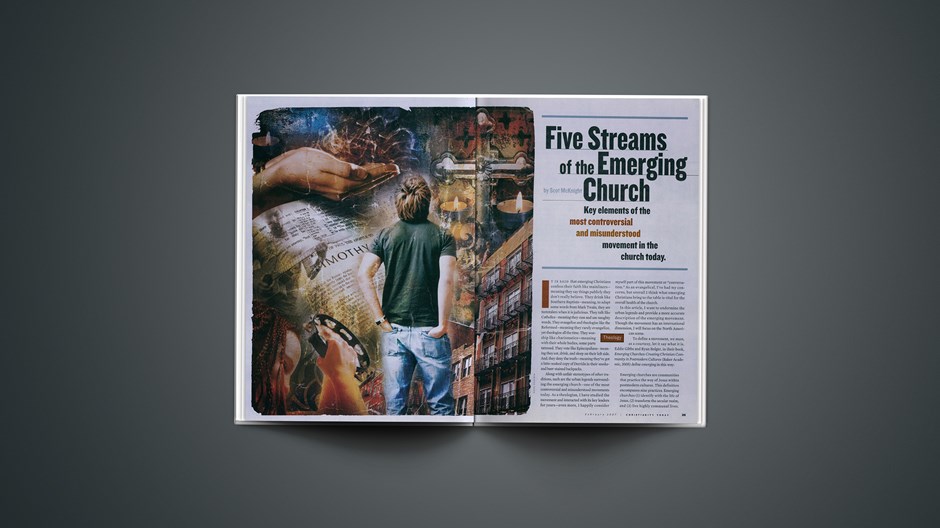
Worship: I've heard folks describe the emerging movement as "funky worship" or "candles and incense" or "smells and bells." It's true; many in the emerging movement are creative, experiential, and sensory in their worship gatherings.
Evangelicals sometimes forget that God cares about sacred space and ritual—he told Moses how to design the tabernacle and gave detailed directions to Solomon for building a majestic Temple. Neither Jesus nor Paul said much about aesthetics, but the author of Hebrews did. And we should not forget that some Reformers, knowing the power of aesthetics, stripped churches clean of all artwork.
Some emerging Christians see churches with pulpits in the center of a hall-like room with hard, wooden pews lined up in neat rows, and they wonder if there is another way to express—theologically, aesthetically, and anthropologically—what we do when we gather. They ask these sorts of questions: Is the sermon the most important thing on Sunday morning? If we sat in a circle would we foster a different theology and praxis? If we lit incense, would we practice our prayers differently? If we put the preacher on the same level as the congregation, would we create a clearer sense of the priesthood of all believers? If we acted out what we believe, would we encounter more emphatically the Incarnation?
Orthopraxy: A notable emphasis of the emerging movement is orthopraxy, that is, right living. The contention is that how a person lives is more important than what he or she believes. Many will immediately claim that we need both or that orthopraxy flows from orthodoxy. Most in the emerging movement agree we need both, but they contest the second claim: Experience does not prove that those who believe the right things live the right way. No matter how much sense the traditional connection makes, it does not necessarily work itself out in practice. Public scandals in the church—along with those not made public—prove this point time and again.
Here is an emerging, provocative way of saying it: "By their fruits [not their theology] you will know them." As Jesus' brother James said, "Faith without works is dead." Rhetorical exaggerations aside, I know of no one in the emerging movement who believes that one's relationship with God is established by how one lives. Nor do I know anyone who thinks that it doesn't matter what one believes about Jesus Christ. But the focus is shifted. Gibbs and Bolger define emerging churches as those who practice "the way of Jesus" in the postmodern era.
Article continues below
Jesus declared that we will be judged according to how we treat the least of these (Matt. 25:31-46) and that the wise man is the one who practices the words of Jesus (Matt. 7:24-27). In addition, every judgment scene in the Bible is portrayed as a judgment based on works; no judgment scene looks like a theological articulation test.
Missional: The foremost concern of the praxis stream is being missional. What does this mean? First, the emerging movement becomes missional by participating, with God, in the redemptive work of God in this world. In essence, it joins with the apostle Paul in saying that God has given us "the ministry of reconciliation" (2 Cor. 5:18).
Second, it seeks to become missional by participating in the community where God's redemptive work occurs. The church is the community through which God works and in which God manifests the credibility of the gospel.
Third, becoming missional means participating in the holistic redemptive work of God in this world. The Spirit groans, the creation groans, and we groan for the redemption of God (see Rom. 8:18-27).
This holistic emphasis finds perfect expression in the ministry of Jesus, who went about doing good to bodies, spirits, families, and societies. He picked the marginalized up from the floor and put them back in their seats at the table; he attracted harlots and tax collectors; he made the lame walk and opened the ears of the deaf. He cared, in other words, not just about lost souls, but also about whole persons and whole societies.
Post-evangelical
A fourth stream flowing into the emerging lake is characterized by the term post-evangelical. The emerging movement is a protest against much of evangelicalism as currently practiced. It is post-evangelical in the way that neo-evangelicalism (in the 1950s) was post-fundamentalist. It would not be unfair to call it postmodern evangelicalism. This stream flows from the conviction that the church must always be reforming itself.
The vast majority of emerging Christians are evangelical theologically. But they are post-evangelical in at least two ways.
Post-systematic theology: The emerging movement tends to be suspicious of systematic theology. Why? Not because we don't read systematics, but because the diversity of theologies alarms us, no genuine consensus has been achieved, God didn't reveal a systematic theology but a storied narrative, and no language is capable of capturing the Absolute Truth who alone is God. Frankly, the emerging movement loves ideas and theology. It just doesn't have an airtight system or statement of faith. We believe the Great Tradition offers various ways for telling the truth about God's redemption in Christ, but we don't believe any one theology gets it absolutely right.
Article continues below
Hence, a trademark feature of the emerging movement is that we believe all theology will remain a conversation about the Truth who is God in Christ through the Spirit, and about God's story of redemption at work in the church. No systematic theology can be final. In this sense, the emerging movement is radically Reformed. It turns its chastened epistemology against itself, saying, "This is what I believe, but I could be wrong. What do you think? Let's talk."
In versus out: An admittedly controversial element of post-evangelicalism is that many in the emerging movement are skeptical about the "in versus out" mentality of much of evangelicalism. Even if one is an exclusivist (believing that there is a dividing line between Christians and non-Christians), the issue of who is in and who is out pains the emerging generation.
Some emerging Christians point to the words of Jesus: "Whoever is not against us is for us" (Mark 9:40). Others, borrowing the words of the old hymn, point to a "wideness in God's mercy." Still others take postmodernity's crushing of metanarratives and extend that to master theological narratives—like Christianity. They say what really matters is orthopraxy and that it doesn't matter which religion one belongs to, as long as one loves God and one's neighbor as one's self. Some even accept Spencer Burke's unbiblical contention in A Heretic's Guide to Eternity (Jossey-Bass, 2006) that all are born "in" and only some "opt out."
This emerging ambivalence about who is in and who is out creates a serious problem for evangelism. The emerging movement is not known for it, but I wish it were. Unless you proclaim the Good News of Jesus Christ, there is no good news at all—and if there is no Good News, then there is no Christianity, emerging or evangelical.
Personally, I'm an evangelist. Not so much the tract-toting, door-knocking kind, but the Jesus-talking and Jesus-teaching kind. I spend time praying in my office before class and pondering about how to teach in order to bring home the message of the gospel.
So I offer here a warning to the emerging movement: Any movement that is not evangelistic is failing the Lord. We may be humble about what we believe, and we may be careful to make the gospel and its commitments clear, but we must always keep the proper goal in mind: summoning everyone to follow Jesus Christ and to discover the redemptive work of God in Christ through the Spirit of God.
Article continues below
Political
A final stream flowing into the emerging lake is politics. Tony Jones is regularly told that the emerging movement is a latte-drinking, backpack-lugging, Birkenstock-wearing group of 21st-century, left-wing, hippie wannabes. Put directly, they are Democrats. And that spells "post" for conservative-evangelical-politics-as-usual.
I have publicly aligned myself with the emerging movement. What attracts me is its soft postmodernism (or critical realism) and its praxis/missional focus. I also lean left in politics. I tell my friends that I have voted Democrat for years for all the wrong reasons. I don't think the Democratic Party is worth a hoot, but its historic commitment to the poor and to centralizing government for social justice is what I think government should do. I don't support abortion—in fact, I think it is immoral. I believe in civil rights, but I don't believe homosexuality is God's design. And, like many in the emerging movement, I think the Religious Right doesn't see what it is doing. Books like Randy Balmer's Thy Kingdom Come: How the Religious Right Distorts the Faith and Threatens America: An Evangelical's Lament (Basic Books, 2006) and David Kuo's Tempting Faith: An Inside Story of Political Seduction (Free Press, 2006) make their rounds in emerging circles because they say things we think need to be said.
Sometimes, however, when I look at emerging politics, I see Walter Rauschenbusch, the architect of the social gospel. Without trying to deny the spiritual gospel, he led his followers into the social gospel. The results were devastating for mainline Christianity's ability to summon sinners to personal conversion. The results were also devastating for evangelical Christianity, which has itself struggled to maintain a proper balance.
I ask my fellow emerging Christians to maintain their missional and ecclesial focus, just as I urge my fellow evangelicals to engage in the social as well.
All in all, it is unlikely that the emerging movement will disappear anytime soon. If I were a prophet, I'd say that it will influence most of evangelicalism in its chastened epistemology (if it hasn't already), its emphasis on praxis, and its missional orientation. I see the emerging movement much like the Jesus and charismatic movements of the 1960s, which undoubtedly have found a place in the quilt called evangelicalism.
Article continues below
Scot McKnight is professor of religious studies at North Park Theological Seminary in Chicago, Illinois. He is author of The Jesus Creed (Paraclete, 2004) and, most recently, The Real Mary: Why Evangelicals Can Embrace the Mother of Jesus (Paraclete, 2006 ). This article is condensed and adapted from a lecture given at Westminster Theological Seminary, Philadelphia, in October 2006. See the blog JesusCreed.org for more of McKnight's emerging musings.















 While we pray for peace, we need moral clarity about this war.
 A Christian reconciliation group in Israel and Palestine warned that war would come. Now the war threatens their relevance.españolالعربيةFrançaisрусскийУкраїнська
 How groups like Hillsong learned to let go of the literal in favor of creative collaboration.españolPortuguês






