Forty years ago, Ardmore, Tennessee's Christian radio station would have been typical. Purchased by a neighborhood pastor, it aired church services during blocks of time the congregation could afford and Southern gospel music the rest of the week. As Christian Radio author Bob Lochte recalls, the few advertisements it garnered were from area businesses like the local Goodyear Tires outlet.
Locally owned and operated, such stations provided a modest service to their communities. But rarely, if ever, did they draw in large numbers of people or make a significant profit. Most struggled simply to remain on-air.
There were exceptions, of course. Some of the stalwarts of Christian broadcasting enjoyed tremendous success throughout the years. Aimee Semple McPherson's Los Angeles station rode the colorful evangelist's popularity in the early 1920s. Charles Fuller's Old-Fashioned Revival Hour began broadcasting in 1937 and was syndicated to as many as 650 radio stations before the Bible teacher's death in 1968. And Moody Radio in Chicago has broadcast professionally produced gospel programming since its founding in 1926 right up to the present day.
These trailblazers helped make radio an established part of evangelicals' media outreach, complementing books, magazines, tracts, and, eventually, TV and internet. But they were unusual. Before the 1970s and 1980s, most listeners to Christian radio tuned in to stations and programming of widely varying quality and reach.
Those days are long gone. Today, popular Christian programs, such as Focus on the Family and Insight for Living, draw audiences of up to 1.5 million every show. The Barna Group estimates that 46 percent of Americans tune in to Christian broadcasting. While other radio formats have been in decline, reports Lochte, the Christian radio audience has grown 38 percent since 1998.
Christian broadcasting has become professional, national, and, yes, even profitable. And the engine driving this transformation—indeed, the company more responsible for it than any other—is Salem Communications.
Based in beachside Camarillo, California, Salem owns many of the frequencies that feature programs like Focus and Insight. It operates 97 stations, 61 of them in the country's top-25 markets.
By comparison, other significant Christian chains barely touch the country's largest cities, where half of all Americans live. Contemporary music's K-LOVE owns more total stations than Salem, but only 10 in major markets. Moody Broadcasting operates 31 frequencies, but just 3 in the big cities of Chicago and Cleveland. And Bott Radio,with 38 stations, holds none in major markets.
With far and away the largest audience of any Christian radio network, Salem's industry competitors aren't Christian broadcasters at all—they're the giants of secular radio, companies like Clear Channel Communications and CBS Radio.
Salem also syndicates its own shows, which air on more than 2,000 stations around the country. Popular Salem hosts include Bill Bennett, the elder President Bush's drug czar and author of The Book of Virtues; Janet Parshall, a former housewife turned political commentator; and Al Mohler, the president of Southern Baptist Theological Seminary.
Attuned to new media realities, Salem has led Christian radio beyond the airwaves as well. Beginning in 1999, the company purchased websites like OnePlace.com, Crosswalk.com, now among the most-visited Christian destinations on the internet, and Townhall.com, a clearinghouse for conservative news and opinion. It publishes seven magazines, including CCM Magazine and Youthworker Journal, and in 2006 it bought on-demand publisher Xulon Press.
All of this makes Salem's influence among conservative Christians "unparalleled," says Craig Detweiler, Reel Spirituality professor at Fuller Theological Seminary. Lochte agrees, calling Salem "the undisputed leader" in Christian radio.
Although few listeners know Salem by name, one thing is certain: The company dominates Christian broadcasting in a way that would have been unimaginable a generation ago. "They're just doing it in a way that hasn't been done before," says Frank Wright, president of the National Religious Broadcasters (NRB). "They're breaking new ground."
The Price of Success
As the biggest Christian broadcaster inthe nation, though, Salem attracts its share of critics. Most, especially radio insiders, keep their complaints quiet. After all, Salem is the industry's largest employer; it's not wise to burn a bridge of that size and importance.
But CT heard plenty of off-the-record, private critiques during the reporting for this piece. Most fell into two general categories: money and ministry focus. Fair or not, Salem has gained a reputation in some circles for pursuing market dominance with businesslike indifference. Salem doesn't coexist peacefully with other Christian radio stations and websites, the criticism goes, but instead seeks primarily to increase its share of the Christian audience—and the accompanying advertising revenue. Such critics envision small, gospel-oriented stations and local programs with loyal audiences being forced off the air, unable to compete with Salem. The company's 1999 entry into public financing cemented such fears.
Article continues below
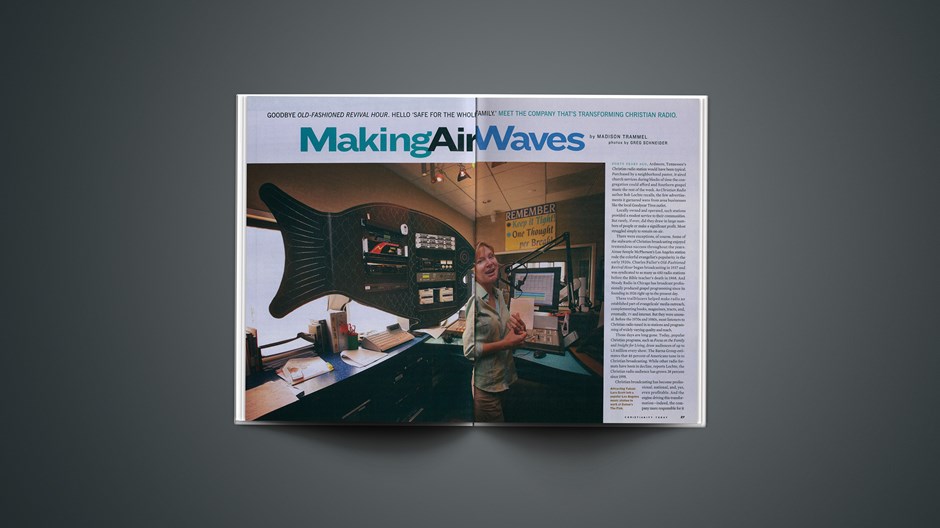
Other critics see Salem as compromising its ministry commitment by expanding beyond Christian teaching and talk into Christian music—it owns 13 contemporary Christian music stations, most tagged The Fish. It's also begun to engage in politics: The company is actively growing a series of secular talk stations that air conservative heavyweights like Dennis Prager and Michael Medved, but little or no explicitly Christian content.
In the end, both sets of critics conclude, it is the listeners who suffer, as the overall ministry of Christian radio gets monopolized and diluted of the gospel.
But Edward Atsinger, the co-founder and ceo of Salem Communications, pays little attention to such complaints. He sees nothing sinister in growing his company or promoting conservative, Judeo-Christian values. He, too, was once one of the little guys, scrabbling to keep a station on the air. Everything he built, he did the right way.
Atsinger purchased his first radio license in Garner, North Carolina, in 1967. The FCC stipulated that his station not broadcast into nearby Raleigh, a restriction he hadn't anticipated. So Atsinger paid extra for a three-tower transmitter that would blanket his suburb without encroaching on the city nearby. He gave the station a country music format, hired several employees, and managed to oversee the entire operation while living and teaching in Los Angeles.
Whenever it rained, employees heading back and forth to the station—housed in a mobile home in a converted cow pasture—would get stuck in mud.
"You think back on that and say, 'I really don't want to go back and have to do that again,' but you wouldn't trade that experience for anything," Atsinger says now. "You gain a lot of confidence."
Flush with the success of keeping a low-power, small-market station financially afloat, Atsinger entered two ventures in the early 1970s that shaped the rest of his career. First, he initiated a partnership with Salem co-founder Stuart Epperson, acquiring with him an oldies station in Bakersfield, California. Both graduates of Bob Jones University, Atsinger and Epperson were also linked by a close family connection: Epperson had married Atsinger's sister several years earlier.
Next, Atsinger bought a station in Oxnard, California, just miles from Salem's current corporate headquarters, and transformed it into a Christian teaching and talk station. Within a few years, Epperson and Atsinger had plunged headlong into Christian radio, selling all of their other stations.
Article continues below
A Winning Formula
According to chief operating officer Joe Davis, Salem offers Christian radio two indispensable values: a stable presence in the market and a high-contact relationship with listeners. The first distinctive is due primarily to Salem's size and public financing, which allows it to float large investments; the second, to Davis himself.
A former Salem station manager, Davis created the archetype for Salem's successful teaching-and-talk stations. Within six months after Salem purchased New York City's WMCA-AM in 1989 for more than $12 million, Davis began receiving cancellation letters from national program producers. Listener response wasn't bringing in enough donations for them to afford his airtime.
In desperation, Davis negotiated rate cuts and brainstormed a program to raise his station's profile. Called the "church of the week," its rules were simple: If Davis could speak in a church's Sunday morning service and distribute a station guide to all attendees, he would air the church's Sunday morning service and interview its senior pastor during the following week.
Within three years, Davis had visited 154 congregations—"churches of all kinds, denominations, racial groups, and geographical areas [within the city]"—buoyed his listenership, and brought in the response program producers needed to afford staying on the air.
"At that time, nobody had ever done anything like this before," Davis says. "Now, it's an important part of our entire operation that we minister to pastors and the gatekeepers."
Program producers large and small appreciate Salem's high-touch approach and major-market stability. "Salem is a business that is continually trying to help their [audience]," says Word of Life's Florida marketing director Dan Darling, "so they probably do more [for me] than the Christian stations that are listener-supported. … They're trying to earn my dollar."
Focus on the Family vice president John Fuller credits Salem with helping James Dobson's daily show to expand its reach—and Focus may now be the most listened to Christian radio program ever.
"I think as folks at [Salem] stations have endeavored to run their stations with greater professionalism and to add stations in certain regions and cities, we've benefited because we've been able to reach their audience," Fuller says. "Certainly, as Salem has grown, we have grown with them."
Article continues below
The key, says Davis, is to keep ministry to local listeners at the forefront. "Our mission on [Christian talk] stations is to help the church be the church," says Davis. "We understand that when God reaches a city, he doesn't do it through a radio station; he does it through the church. Our task is simply to come alongside, provide a platform—amplification—for that voice of the church, turn up the volume a bit, and allow them to reach the people that God has called them to reach."
Money Matters
But some in radio believe financial realities unduly influence Salem's decision-making. Radio veteran Chris Lash says his first encounter with Salem Communications came through a corporate lawyer's email. According to Lash, Salem's lawyer threatened further action if Lash didn't change the moniker of his western Pennsylvania radio station.
By some quirk of misfortune or creative minds thinking alike, Lash had developed a radio format similar to Salem's The Fish in the late 1990s, which he called Fish FM. He intended for it to air the kind of musical guests he invited to his local Christian rock festival, Godstock. But his idea took years to come to fruition. He began hosting a Fish FM website in 1998 and wasn't approved for a low-power FM radio license until 2003, three years after Salem launched its first Fish station in Los Angeles.
Six months after his 100-watt station took to the airwaves in rural Indiana, Pennsylvania—with a reach that barely touched nearby towns of Homer City and Clymer—Lash says he received the email from a Salem lawyer. Lash argued that he had come up with his format independently, before Salem, and that he could hardly be considered a competitor. The nearest music station owned by Salem was 175 miles away, in Cleveland.
But Salem wouldn't budge, Lash says. In the end, he changed his station's name to The Switch and let ownership of his Web domain expire.
"Here was the largest Christian broadcasting company in the world going after the smallest," Lash says. "It shed some light as to what kind of a company they really are."
The president of the National Religious Broadcasters (NRB), Frank Wright, defends Salem's business practices as above-board, even exemplary. "The fiduciary duties that directors of a public company have to their shareholders probably required them to defend [The Fish] brand," Wright says. Still, he admits that the "open question" on Salem is whether their Wall Street financing puts "pressure on them to make decisions that wouldn't have been made otherwise, because investors demand a return on their investment and Salem's stock price has been somewhat lower of late."
Article continues below
Like all media corporations specializing in radio, Salem's stock price has been on what chief financial officer David A. R. Evans calls "a bit of a roller coaster." From a high in 2004 of $33.08 per share, salm dropped to $11.19 per share by mid-December 2006.
The area where Salem's financing affects program producers most, perhaps, is in its airtime rates. As a publicly traded company, one of Salem's goals is to increase its revenue annually. It accomplishes this, in part, by charging teaching and talk programs more each year for their time slots. Such increases can make it hard for some of the programs listeners most appreciate to remain on-air—and it's not just small ministries that struggle to keep up with radio's expense.
This past September, John Piper's Desiring God ministry cancelled its half-hour program altogether. Matt Perman, Desiring God's director of internet strategies (and former director of radio), doesn't blame Salem for the show's demise. In fact, he praises co-founder and board chairman Stuart Epperson for the personal effort he put into making Desiring God's program work.
"[But Salem does] want to increase your rates by X percentage every year," Perman says, "and their rates are already high. Being on the side that I'm on, I would question: 'Are the rates representative of the value being received, given the [industry-wide] downturn in listenership and what the response actually is?'"
A former assistant operations manager of a Salem station cluster wonders if traditional, non-commercial Christian radio stations are better able to keep listeners' concerns prioritized above finances.
"For instance, I don't miss playing state lottery commercials," he says, referring to Salem's practice of airing outside programming, such as sports broadcasts, that occasionally contain advertisements the company would otherwise reject. "I [also] don't miss playing 'Work from home in your pajamas and make thousands a month!' commercials."
Mixed Frequencies
Before the Telecommunications Act of 1996, broadcasters could only own and operate one station in a given market. That meant, essentially, that they had to choose a format and run with it. Not anymore. With the act freeing broadcasters to own up to eight stations in large cities, major companies can now seek to be all things to all people—that is, in Salem's case, all people who are Christians, conservatives, or preferably both.
Article continues below
Some see in Salem's expansion a loss of ministry focus. Its Fish stations, for instance, broadcast Christian music and encouraging talk that's "safe for the whole family," but they rarely present any substantive teaching.
Without referencing Salem specifically, Charles Colson bemoaned the increasing popularity of music on Christian radio in a CT column last April. "What is the job of Christian radio, after all?" he wrote. "To give people what they want, or—as with any ministry—to give them what they need? Music is important in the life of the church and can inspire us to focus on Christ. But it cannot take the place of solid teaching."
In addition, when public affairs are discussed on Salem's Christian teaching and talk stations, listeners can expect to hear viewpoints that hew tightly to Republican priorities.
Mark Elfstrand, now a Moody Radio host, worked for Salem's Pittsburgh station WORD-FM throughout much of the 1990s. During a hiring interview, he says, CEO Atsinger asked questions to get a feel for Elfstrand's political leanings. One such question: What did Elfstrand think of Operation Rescue founder Randall Terry?
"At its worst, Salem has a political orthodoxy that guides its coverage," says Sojourners president Jim Wallis. He sees evangelicals broadening their political concerns to include issues such as Darfur, sex trafficking, the environment, and poverty. "If there is a political orthodoxy at Salem, [I think] it's not only bad theologically, but they're going to have a market failure here [eventually]," Wallis says. "Because they'll be misreading where evangelicalism is going."
Harold Feld, senior vice president of Media Access Project, a public-interest telecommunications law firm, bemoans the monopoly of perspective created by any large radio chain, Salem included.
"Within the Christian community, there are debates that people should be having, [such as], 'What is an appropriate way to be looking at war and politics and local affairs through a Christian perspective?'" Feld says. "So to have a company that creates just one perspective, and brands it as the Christian perspective—and this is the only Christian perspective you will find on the air—creates a very serious problem."
Article continues below
Detweiler agrees, somewhat. He says Salem represents some listeners' views well, "but one must never assume that they represent all of the evangelical community." Detweiler says he would "challenge [Salem] to create a more progressive or inclusive Christianity for the 21st century."
No doubt a certain segment of Salem's listeners would be pleased by such a change. But it's not likely to happen. Both Epperson and Atsinger have been active in conservative political causes for decades, and Epperson ran for Congress as a Republican twice in the mid-1980s. For Salem's co-founders, the connection between Christian talk and conservative talk springs from deeply held convictions.
Besides, points out CFO Evans, Salem's research indicates that when listeners leave its Christian talk stations, they tend to tune in to news or talk. Expanding into the conservative talk format represents just another way of reaching Salem's target audience.
"Many people have criticized Salem for being right-wing politically in terms of their programming," says Grand View College communications professor Stephen Winzenberg. "I think it's all in your perspective. Because [most] of us who are Christians would call them a fairly traditional Christian radio programmer. . . . I think they're very mainstream conservative."
Good Night and Good Luck
While the debates swirling around Salem show no sign of resolution, the company continues to serve more listeners than any other Christian broadcaster, redefining the ministry of Christian radio. In 1999, Salem became the sole provider of Christian programming on xm Satellite radio, and it continues to innovate with radio formats, Web-radio synergy, and other new technologies.
In short, whatever direction Christian broadcasting heads in the future, Salem will likely be at the forefront. NRB president Frank Wright believes Salem's leadership is good for all involved—for other Christian station owners, who benefit from Salem's industry trailblazing; for the ministries that produce Christian programming, who reach more listeners than ever through Salem's expanded reach; and for listeners who tune in for teaching and encouragement, who regularly hear the highest-quality Christian programming.
"I think it's pretty hard to criticize Salem," says Wright, citing the company's "strong leadership" and "very high commitment to their Christian mission."
One question highlights Salem's importance: If the company were not in 23 of the country's top-25 markets, would many of those cities lack any Christian radio presence?
Article continues below
"To [Salem's] high credit, they have acquired outstanding broadcast properties in key markets that, if they hadn't acquired them, would have gone secular," Wright says. "Look, if there were no Salem, those 97 stations would all be doing country music or whatever format those stations would want to do to make the most money."
That doesn't mean the company's critics will disappear anytime soon. Call it jealousy, territorialism, or a simple desire for survival, but a number of people within broadcasting are leery of Salem's success.
"If you see them nibbling around the edges of what you're trying to do," Wright says, "you see them as the New York Yankees, and you wish they weren't so good."
"Making Radio Waves," Christianity Today's August 1994 cover story, focused on accountability in Christian talk radio.
Madison Trammel's articles for Christianity Today include:
Liberating Faith | When Korea threw off Japanese rule in 1945, it was as much a victory for the church as for the nation. (January 25, 2007)
Salvation Army Wins Battle | But the broader struggle for religious freedom continues. (December 6, 2006)
What's Next: Publishing & Broadcasting | New media, old story: What evangelical leaders say are the priorities and challenges for the next 50 years. (October 6, 2006)
Axis Denied | Willow Creek ends "church-within-church" for 20-somethings. (September 22, 2006)















 While we pray for peace, we need moral clarity about this war.
 As my doubts about his teachings grew, so did a secret fascination with Jesus.
 How groups like Hillsong learned to let go of the literal in favor of creative collaboration.españolPortuguês






