


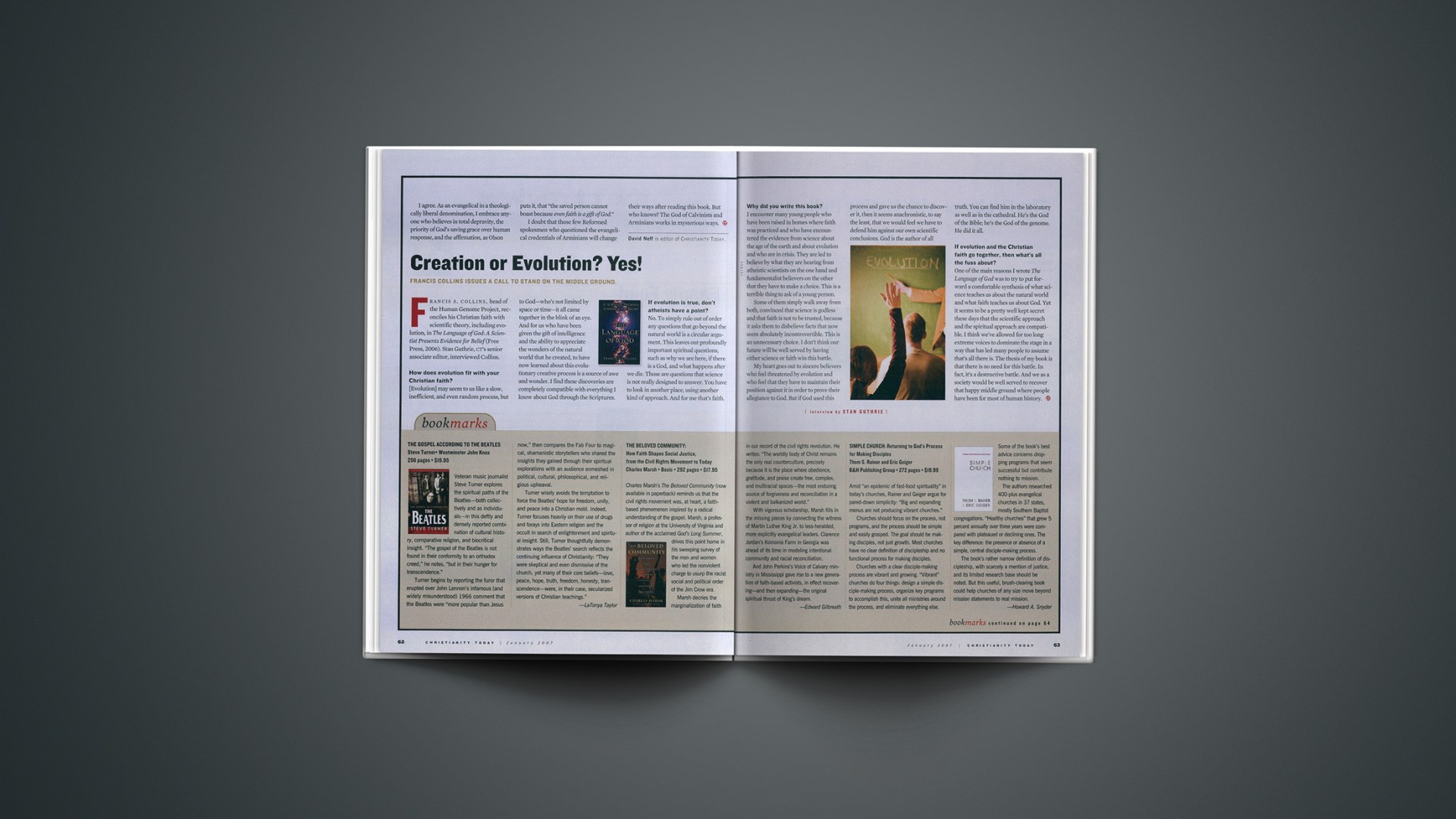

Francis S. Collins, head of the Human Genome Project, reconciles his Christian faith with scientific theory, including evolution, in The Language of God: A Scientist Presents Evidence for Belief (Free Press, 2006). Stan Guthrie, CT’s senior associate editor, interviewed Collins.
How does evolution fit with your Christian faith? [Evolution] may seem to us like a slow, inefficient, and even random process, but to God—who’s not limited by space or time—it all came together in the blink of an eye. And for us who have been given the gift of intelligence and the ability to appreciate the wonders of the natural world that he created, to have now learned about this evolutionary creative process is a source of awe and wonder. I find these discoveries are completely compatible with everything I know about God through the Scriptures.
If evolution is true, don’t atheists have a point? No. To simply rule out of order any questions that go beyond the natural world is a circular argument. This leaves out profoundly important spiritual questions, such as why we are here, if there is a God, and what happens after we die. Those are questions that science is not really designed to answer. You have to look in another place, using another kind of approach. And for me that’s faith.
Why did you write this book? I encounter many young people who have been raised in homes where faith was practiced and who have encountered the evidence from science about the age of the earth and about evolution and who are in crisis. They are led to believe by what they are hearing from atheistic scientists on the one hand and fundamentalist believers on the other that they have to make a choice. This is a terrible thing to ask of a young person.
Some of them simply walk away from both, convinced that science is godless and that faith is not to be trusted, because it asks them to disbelieve facts that now seem absolutely incontrovertible. This is an unnecessary choice. I don’t think our future will be well served by having either science or faith win this battle.
My heart goes out to sincere believers who feel threatened by evolution and who feel that they have to maintain their position against it in order to prove their allegiance to God. But if God used this process and gave us the chance to discover it, then it seems anachronistic, to say the least, that we would feel we have to defend him against our own scientific conclusions. God is the author of all truth. You can find him in the laboratory as well as in the cathedral. He’s the God of the Bible; he’s the God of the genome. He did it all.
If evolution and the Christian faith go together, then what’s all the fuss about? One of the main reasons I wrote The Language of God was to try to put forward a comfortable synthesis of what science teaches us about the natural world and what faith teaches us about God. Yet it seems to be a pretty well kept secret these days that the scientific approach and the spiritual approach are compatible. I think we’ve allowed for too long extreme voices to dominate the stage in a way that has led many people to assume that’s all there is. The thesis of my book is that there is no need for this battle. In fact, it’s a destructive battle. And we as a society would be well served to recover that happy middle ground where people have been for most of human history.
Copyright © 2007 Christianity Today. Click for reprint information.
Related Elsewhere:
The Language of God is available from ChristianBook.com and other retailers.
Christianity Today interviewed Francis Collins in “The Genome Doctor.”
ChristianityToday‘s “Science in Wonderland” discusses The Language of God, as do reviews in The Times, The New York Times, and The Washington Post.
Free Press (a division of Simon & Schuster) has an excerpt from the book.
Collins spoke at The American Scientific Affiliation on “Faith and the Human Genome.”
Francis Collins‘ professional bio is available at The Human Genome Project website.