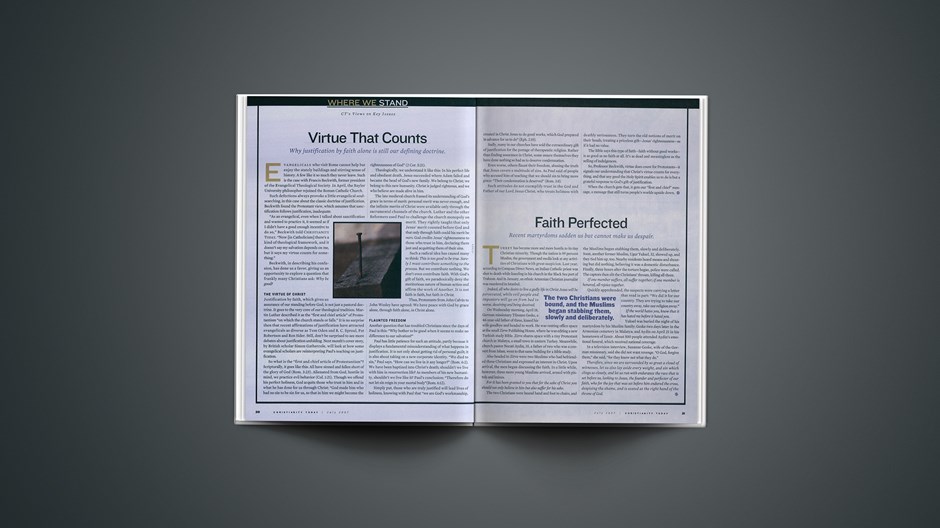
Evangelicals who visit Rome cannot help but enjoy the stately buildings and stirring sense of history. A few like it so much they never leave. Such is the case with Francis Beckwith, former president of the Evangelical Theological Society. In April, the Baylor University philosopher rejoined the Roman Catholic Church.
Such defections always provoke a little evangelical soul-searching, in this case about the classic doctrine of justification. Beckwith found the Protestant view, which assumes that sanctification follows justification, inadequate.
"As an evangelical, even when I talked about sanctification and wanted to practice it, it seemed as if I didn't have a good enough incentive to do so," Beckwith told Christianity Today. "Now [in Catholicism] there's a kind of theological framework, and it doesn't say my salvation depends on me, but it says my virtue counts for something."
Beckwith, in describing his confusion, has done us a favor, giving us an opportunity to explore a question that frankly many Christians ask: Why be good?
The Virtue of Christ
Justification by faith, which gives us assurance of our standing before God, is not just a pastoral doctrine. It goes to the very core of our theological tradition. Martin Luther described it as the "first and chief article" of Protestantism "on which the church stands or falls." It is no surprise then that recent affirmations of justification have attracted evangelicals as diverse as Tom Oden and R. C. Sproul, Pat Robertson and Ron Sider. Still, don't be surprised to see more debates about justification unfolding. Next month's cover story, by British scholar Simon Gathercole, will look at how some evangelical scholars are reinterpreting Paul's teaching on justification.
So what is the "first and chief article of Protestantism"? Scripturally, it goes like this: All have sinned and fallen short of the glory of God (Rom. 3:23). Alienated from God, hostile in mind, we practice evil behavior (Col. 1:21). Though we offend his perfect holiness, God acquits those who trust in him and in what he has done for us through Christ: "God made him who had no sin to be sin for us, so that in him we might become the righteousness of God" (2 Cor. 5:21).
Theologically, we understand it like this: In his perfect life and obedient death, Jesus succeeded where Adam failed and became the head of God's new family. We belong to Christ; we belong to this new humanity. Christ is judged righteous, and we who believe are made alive in him.
The late medieval church framed its understanding of God's grace in terms of merit: personal merit was never enough, and the infinite merits of Christ were available only through the sacramental channels of the church. Luther and the other Reformers used Paul to challenge the church monopoly on merit. They rightly taught that only Jesus' merit counted before God and that only through faith could his merit be ours. God credits Jesus' righteousness to those who trust in him, declaring them just and acquitting them of their sins.
Such a radical idea has caused many to think: This is too good to be true. Surely I must contribute something to the process. But we contribute nothing. We don't even contribute faith. With God's gift of faith, we paradoxically deny the meritorious nature of human action and affirm the work of Another. It is not faith in faith, but faith in Christ.
Thus, Protestants from John Calvin to John Wesley have agreed: We have peace with God by grace alone, through faith alone, in Christ alone.
Flaunted Freedom
Another question that has troubled Christians since the days of Paul is this: "Why bother to be good when it seems to make no difference to our salvation?"
Paul has little patience for such an attitude, partly because it displays a fundamental misunderstanding of what happens in justification. It is not only about getting rid of personal guilt; it is also about taking on a new corporate identity. "We died to sin," Paul says. "How can we live in it any longer?" (Rom. 6:2). We have been baptized into Christ's death; shouldn't we live with him in resurrection life? As members of his new humanity, shouldn't we live like it? Paul's conclusion: "Therefore do not let sin reign in your mortal body" (Rom. 6:12).
Simply put, those who are truly justified will lead lives of holiness, knowing with Paul that "we are God's workmanship, created in Christ Jesus to do good works, which God prepared in advance for us to do" (Eph. 2:10).
Sadly, many in our churches have sold the extraordinary gift of justification for the pottage of therapeutic religion. Rather than finding assurance in Christ, some assure themselves they have done nothing so bad as to deserve condemnation.
Even worse, others flaunt their freedom, abusing the truth that Jesus covers a multitude of sins. As Paul said of people who accused him of teaching that we should sin to bring more grace: "Their condemnation is deserved" (Rom. 3:8).
Article continues below
Such attitudes do not exemplify trust in the God and Father of our Lord Jesus Christ, who treats holiness with deathly seriousness. They turn the old notions of merit on their heads, treating a priceless gift—Jesus' righteousness—as if it had no value.
The Bible says this type of faith—faith without good works—is as good as no faith at all. It's as dead and meaningless as the selling of indulgences.
So, Professor Beckwith, virtue does count for Protestants—it signals our understanding that Christ's virtue counts for everything, and that any good the Holy Spirit enables us to do is but a grateful response to God's gift of justification.
When the church gets that, it gets our "first and chief" message, a message that still turns people's worlds upside down.
Nothing But the Blood | More and more evangelicals believe Christ's atoning death is merely a grotesque creation of the medieval imagination. Really? (May 1, 2006)
Sticking Points | Despite recent rapprochement, evangelicals and Catholics remain far apart on key issues. (December 2005)
The Gospel of Jesus Christ | An introduction to "The Gospel of Jesus Christ: An Evangelical Celebration."(David Neff, February 1, 2000)
Theology: Does The Gift of Salvation Sell Out the Reformation? | The recent statement from evangelical and Roman Catholic leaders on the Christian doctrine of justification "sells out" the Reformation, according to James Boice, chairman of the Alliance of Confessing Evangelicals (ACE). (April 27, 1998)
Paid in Full | The sacrifice of Calvary was not a part payment; it was a complete and perfect payment. (Charles H. Spurgeon, February 9, 1998)
Should Catholics and Evangelicals Join Ranks? | A recent document entitled Evangelicals and Catholics Together gives a resounding yes to this question. (July 18, 1994)
Also: Why I Signed it, Parts 1 and 2
Have something to add about this? See something we missed? Share your feedback here.
Our digital archives are a work in progress. Let us know if corrections need to be made.















 While we pray for peace, we need moral clarity about this war.
 As my doubts about his teachings grew, so did a secret fascination with Jesus.
 How groups like Hillsong learned to let go of the literal in favor of creative collaboration.españolPortuguês






