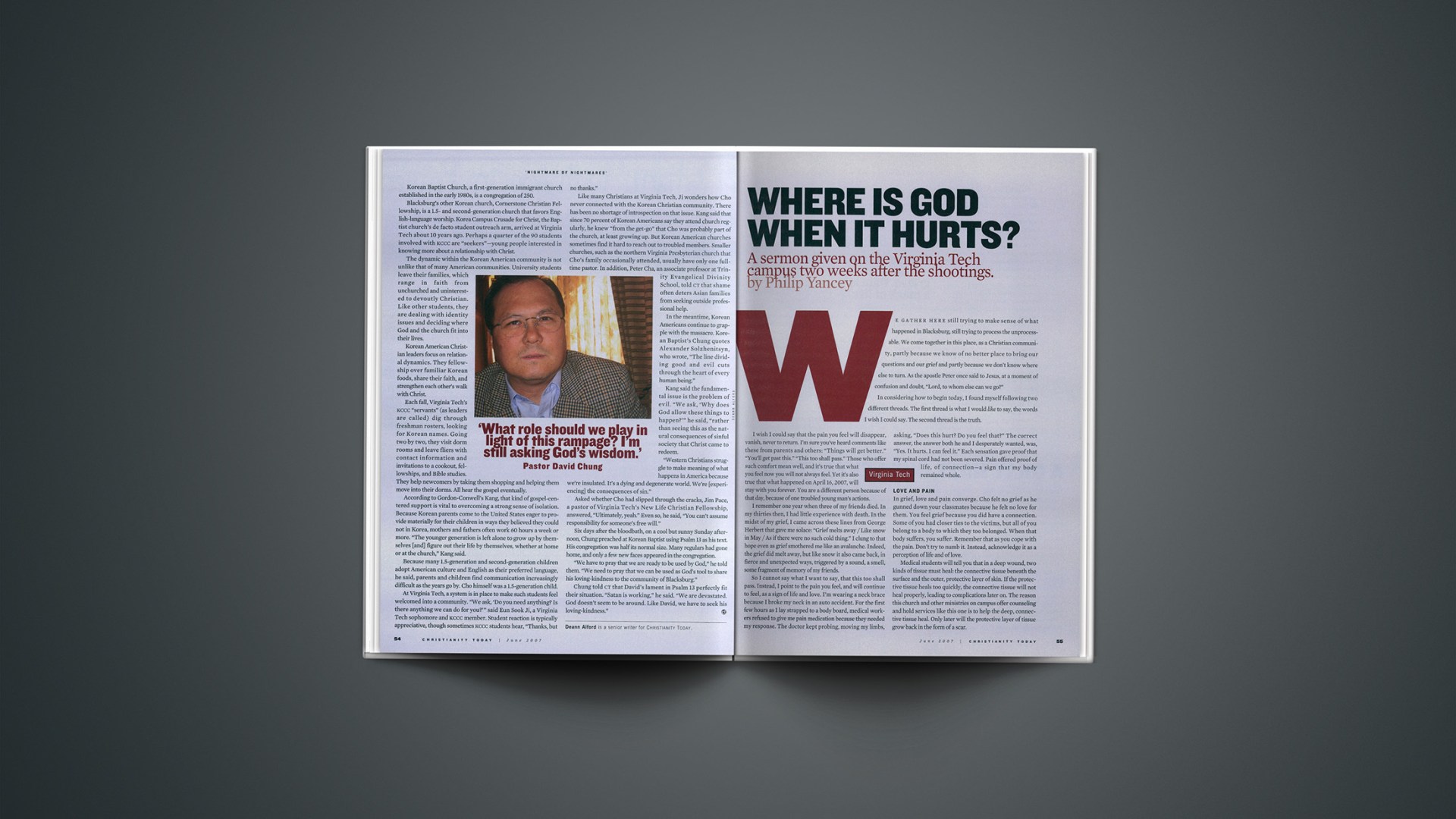

We gather here still trying to make sense of what happened in Blacksburg, still trying to process the unprocessable. We come together in this place, as a Christian community, partly because we know of no better place to bring our questions and our grief and partly because we don’t know where else to turn. As the apostle Peter once said to Jesus, at a moment of confusion and doubt, “Lord, to whom else can we go?”
|
|
In considering how to begin today, I found myself following two different threads. The first thread is what I would like to say, the words I wish I could say. The second thread is the truth.
I wish I could say that the pain you feel will disappear, vanish, never to return. I’m sure you’ve heard comments like these from parents and others: “Things will get better.” “You’ll get past this.” “This too shall pass.” Those who offer such comfort mean well, and it’s true that what you feel now you will not always feel. Yet it’s also true that what happened on April 16, 2007, will stay with you forever. You are a different person because of that day, because of one troubled young man’s actions.
I remember one year when three of my friends died. In my thirties then, I had little experience with death. In the midst of my grief, I came across these lines from George Herbert that gave me solace: “Grief melts away / Like snow in May / As if there were no such cold thing.” I clung to that hope even as grief smothered me like an avalanche. Indeed, the grief did melt away, but like snow it also came back, in fierce and unexpected ways, triggered by a sound, a smell, some fragment of memory of my friends.
So I cannot say what I want to say, that this too shall pass. Instead, I point to the pain you feel, and will continue to feel, as a sign of life and love. I’m wearing a neck brace because I broke my neck in an auto accident. For the first few hours as I lay strapped to a body board, medical workers refused to give me pain medication because they needed my response. The doctor kept probing, moving my limbs, asking, “Does this hurt? Do you feel that?” The correct answer, the answer both he and I desperately wanted, was, “Yes. It hurts. I can feel it.” Each sensation gave proof that my spinal cord had not been severed. Pain offered proof of life, of connection—a sign that my body remained whole.
Love and Pain
In grief, love and pain converge. Cho felt no grief as he gunned down your classmates because he felt no love for them. You feel grief because you did have a connection. Some of you had closer ties to the victims, but all of you belong to a body to which they too belonged. When that body suffers, you suffer. Remember that as you cope with the pain. Don’t try to numb it. Instead, acknowledge it as a perception of life and of love.
Medical students will tell you that in a deep wound, two kinds of tissue must heal: the connective tissue beneath the surface and the outer, protective layer of skin. If the protective tissue heals too quickly, the connective tissue will not heal properly, leading to complications later on. The reason this church and other ministries on campus offer counseling and hold services like this one is to help the deep, connective tissue heal. Only later will the protective layer of tissue grow back in the form of a scar.
We gather here as Christians, and as such we aspire to follow a man who came from God 2,000 years ago. Read through the Gospels, and you’ll find only one scene in which someone addresses Jesus directly as God: “My Lord and my God!” Do you know who said that? It was doubting Thomas, the disciple stuck in grief, the last holdout against believing the incredible news of the Resurrection.
In a tender scene, Jesus appeared to Thomas in his newly transformed body, obliterating Thomas’s doubts. What prompted that outburst of belief, however—”My Lord and my God!”—was the presence of Jesus’ scars. “Feel my hands,” Jesus told him. “Touch my side.” In a flash of revelation, Thomas saw the wonder of Almighty God, the Lord of the universe, stooping to take on our pain.
God doesn’t exempt even himself from pain. God joined us and shared our human condition, including its great grief. Thomas recognized in that pattern the most foundational truth of the universe: that God is love. To love means to hurt, to grieve. Pain is a mark of life.
The Jews, schooled in the Old Testament, had a saying: “Where Messiah is, there is no misery.” After Jesus, you could change that saying to: “Where misery is, there is the Messiah.” “Blessed are the poor,” Jesus said, “and those who hunger and thirst, and those who mourn, and those who are persecuted.” Jesus voluntarily embraced every one of these hurts.
So where is God when it hurts? We know where God is because he came to earth and showed us his face. You need only follow Jesus around and note how he responded to the tragedies of his day: with compassion—which simply means “to suffer with”—and with comfort and healing.
I would also like to answer the question why? Why this campus rather than Virginia Commonwealth or William and Mary? Why these 33 people? I cannot tell you, and I encourage you to resist anyone who offers a confident answer. God himself did not answer that question for Job, nor did Jesus answer why questions. We have hints, but no one knows the full answer. What we do know, with full confidence, is how God feels. We know how God looks on the campus of Virginia Tech right now because God gave us a face, a face that was streaked with tears. Where misery is, there is the Messiah.
Not everyone will find that answer sufficient. When we hurt, sometimes we want revenge. We want a more decisive answer. Frederick Buechner said, “I am not the Almighty God, but if I were, maybe I would in mercy either heal the unutterable pain of the world or in mercy kick the world to pieces in its pain.” God did neither. He sent Jesus. God joined our world in all its unutterable pain in order to set in motion a slower, less dramatic solution, one that involves us.
One day a man said to me, “You wrote a book called Where Is God When It Hurts, right?” Yes. “Well, I don’t have much time to read. Can you just answer that question for me in a sentence or two?” I thought for a second and said, “I guess I’d have to answer that with another question: ‘Where is the church when it hurts?'”
The eyes of the world are trained on this campus. You’ve seen satellite trucks parked around town, reporters prowling the grounds of your school. Last fall, I visited Amish country near the site of the Nickel Mines school shootings. As happened here, reporters from every major country swarmed the hills of Pennsylvania, looking for an angle. They came to report on evil and instead ended up reporting on the church. The Amish were not asking, “Where is God when it hurts?” They knew where God was. With their long history of persecution, the Amish weren’t for a minute surprised by an outbreak of evil. They rallied together, embraced the killer’s family, ministered to each other, and healed wounds by relying on a sense of community strengthened over centuries.
Something similar has taken place here in Blacksburg. You have shown outrage against the evil deed, yes, but you’ve also shown sympathy and sadness for the family of the one who committed it. Cho, too, has a memorial on this campus.
Life Matters
The future lies ahead, and you’re just awakening to the fact that you are an independent moral being. Until now, other people have been running your life. Your parents told you what to do and made decisions for you. Teachers ordered you around in grammar school, and the pattern continued in high school and even into college. You now inhabit a kind of halfway house on the way to adulthood, waiting for the real life of career and perhaps marriage and children to begin.
What happened in Blacksburg on April 16 demonstrates beyond all doubt that your life—the decisions you make, the kind of person you are—matters now. There are 28 students and 5 faculty members who have no future in this world.
That reality came starkly home to me nine weeks ago today when I was driving on a winding road in Colorado. Suddenly, I missed a curve and my Ford Explorer slipped off the pavement and started tumbling side to side at 60 miles per hour. An ambulance appeared, and I spent the next seven hours strapped to a body board, with duct tape across my head to keep it from moving. A cat scan showed that a vertebra high on my neck had been shattered, and sharp bone fragments were poking out next to a major artery. The hospital had a jet to fly me to Denver for emergency surgery.
I had one arm free, with a cell phone and little battery time left. I spent those tense hours calling people close to me, knowing it might be the last time I would ever hear their voices. It was an odd sensation to lie there helpless, aware that though I was fully conscious, at any moment I could die.
Samuel Johnson said when a man is about to be hanged, “it concentrates his mind wonderfully.” When you’re strapped to a body board after a serious accident, it concentrates the mind. When you survive a massacre at Virginia Tech, it concentrates the mind. I realized how much of my life focused on trivial things. During those seven hours, I didn’t think about how many books I had sold or what kind of car I drove (it was being towed to a junkyard anyway). All that mattered boiled down to four questions. Whom do I love? Whom will I miss? What have I done with my life? And am I ready for what’s next? Ever since that day, I’ve tried to live with those questions at the forefront.
I would like to promise you a long, pain-free life, but I cannot. God has not promised us that. Rather, the Christian view of the world reduces everything to this formula: The world is good. The world has fallen. The world will be redeemed. Creation, the Fall, redemption—that’s the Christian story in a nutshell.
You know that the world is good. Look around you at the blaze of spring in the hills of Virginia. Look around you at the friends you love. Though overwhelmed with grief right now, you will learn to laugh again, to play again, to climb up mountains and kayak down rivers again, to love, to rear children. The world is good.
You know, too, that the world has fallen. Here at Virginia Tech, you know that as acutely as anyone on this planet.
I ask you also to trust that the world, your world, will be redeemed. This is not the world God wants or is satisfied with. God has promised a time when evil will be defeated, when events like the shootings at Nickel Mines and Columbine and Virginia Tech will come to an end. More, God has promised that even the scars we accumulate on this fallen planet will be redeemed, as Jesus demonstrated to Thomas.
I once was part of a small group with a Christian leader whose name you would likely recognize. He went through a hard time as his adult children got into trouble, bringing him sleepless nights and expensive attorney fees. Worse, my friend was diagnosed with a rare form of cancer. Nothing in his life seemed to work out. “I have no problem believing in a good God,” he said to us one night. “My question is, ‘What is God good for?'” We listened to his complaints and tried various responses, but he batted them all away.
A few weeks later, I came across a little phrase by Dallas Willard: “For those who love God, nothing irredeemable can happen to you.” I went back to my friend. “What about that?” I asked. “Is God good for that promise?”
I would like to promise you an end to pain and grief, a guarantee that you will never again hurt as you hurt now. I cannot. I can, however, stand behind the promise that the apostle Paul made in Romans 8, that all things can be redeemed, can work together for your good. In another passage, Paul spells out some of the things he encountered, which included beatings, imprisonment, and shipwreck. As he looked back, he could see that somehow God had redeemed even those crisis events in his life.
“No, in all these things we are more than conquerors through him that loved us,” Paul concluded. “For I am convinced that neither death nor life, neither angels nor demons, neither the present nor the future, nor any powers, neither height nor depth, nor anything else in all creation, will be able to separate us from the love of God that is in Christ Jesus our Lord” (Rom. 8:37-39). God’s love is the foundational truth of the universe.
Clinging to Hope
Trust a God who can redeem what now seems unredeemable. Ten days before the shootings on this campus, Christians around the world remembered the darkest day of human history, the day in which evil human beings violently rose up against God’s Son and murdered the only truly innocent human being who has ever lived. We remember that day not as Dark Friday, Tragic Friday, or Disaster Friday—but rather as Good Friday. That awful day led to the salvation of the world and to Easter, an echo in advance of God’s bright promise to make all things new.
Honor the grief you feel. The pain is a way of honoring those who died, your friends and classmates and professors. It represents life and love. The pain will fade over time, but it will never fully disappear.
Do not attempt healing alone. The real healing, of deep connective tissue, takes place in community. Where is God when it hurts? Where God’s people are. Where misery is, there is the Messiah, and on this earth, the Messiah takes form in the shape of his church. That’s what the body of Christ means.
Finally, cling to the hope that nothing that happens, not even this terrible tragedy, is irredeemable. We serve a God who has vowed to make all things new. J. R. R. Tolkien once spoke of “joy beyond the walls of the world, poignant as grief.” You know well the poignancy of grief. As healing progresses, may you know, too, that joy, a foretaste of the world redeemed.
Philip Yancey is a CT editor at large.
Copyright © 2007 Christianity Today. Click for reprint information.
Related Elsewhere:
Philip Yancey tells about his experiences at Virginia Tech after the killings in “A Gray Haze over Everything.” “‘Nightmare of Nightmares’” focuses on the Korean Christian community’s reaction to the tragedy.
Our earlier coverage of the Virginia Tech shootings includes:
Asking Why | Christian fellowship helps survivors of the Virginia Tech shootings deal with larger issues. (April 23, 2007)
Peace in a World of Massacre | What Jesus calls us to when we’re most frightened. (April 17, 2007)
Weblog has commentary and links to other news about Virginia Tech.
Philip Yancey‘s columns are available on our website.