



David Miller is author of God at Work: The History and Promise of the Faith at Work Movement (2006). He is executive director of the Yale Center for Faith and Culture at Yale Divinity School and assistant professor of business ethics. CT editor at large Collin Hansen spoke with Miller in New Haven, Connecticut.
How did your business experience help you conceive your book?
Business is my first language, because I was in banking and finance for 16 years. Then I discerned this call to study theology, which took me to Princeton Theological Seminary, where I studied first for an M.Div., and then for a Ph.D. in ethics. That’s when I learned my second language, God talk.
Many business people are hungry to know how to integrate their faith into work. Unfortunately, most clergy don’t know how to help those parishioners, and they often show benign neglect, or even outright hostility, toward the marketplace.
I have a photograph showing myself holding a Bible in my left hand, and a Wall Street Journal in my right. One is the “Bible” of the business world, and one is the Bible of the people of God. I argue that these two Bibles have everything to do with each other.
What have we as Christians lost by not integrating faith into the workplace?
We’ve lost a whole generation of people who either go through the motions when they go to church or just don’t go to church anymore. My research shows that sermons seldom wrestle with biblical teachings and theologies of work, which is where most people in the pews are spending their time.
Why don’t pastors preach that way?
Many pastors I have interviewed will privately tell me, “You know, I’m all for trying to talk to them about their workplace, but frankly I’m intimidated by these folks. They come in a nice car and a nice suit. I don’t know their vocabulary. I don’t know their world.”
There is also a lack of attentiveness in developing a robust theology of work. Many clergy have been trained by faculty who have drunk deeply out of the well of Christian socialism or the well of liberation theology. And often, the assumed conclusion of these teachings is that the world is divided into a set of oppressors and oppressees.
And guess who the oppressors are? They’re the business people.
How can pastors better help business people in their pews?
Most pastors do hospital visits. Why not do workplace coffee visits? What a great chance to show symbolically as well as physically that you care about what parishioners do Monday through Friday. Ask, “What are some of the frustrations you face? Do you bump into any ethical or moral dilemmas?”
The second thing a pastor can do, with their parishioners’ permission, is use stories from the workplace as sermon illustrations. During a sermon, say, “Here’s a situation one of our congregation members encountered the other day.”
Or take another example. Have you ever been in a church where in the run up to April 15, the pastor says, “I’d like to pray for all the CPAs in our congregation, because we know they’re really working long hours”?
Have you ever heard a pastor say, “I’d like to pray for all you who are construction workers as you enter the winter season, when you might have less work”?
Copyright © 2007 Christianity Today. Click for reprint information.
Related Elsewhere:
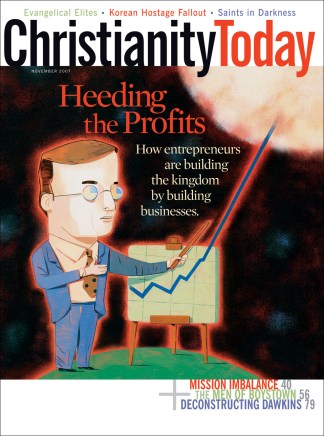
The November issue of Christianity Today also featured “The Mission Of Business” and “Work Is Our Mission.”
God at Work is available from ChristianBook.com and other retailers.
Previous Christianity Today articles on faith and business include:
From Hand Out to Hand Up | Three Arkansas entrepreneurs are helping build Rwanda’s largest bank for the poorest of the poor. (November 1, 2007)
The Good Shepherds | A small but vigorous movement believes that in farming is the preservation of the world. (October 25, 2007)
Surviving the Mortgage Crisis | Most Christian lenders remain strong during sub-prime debacle. (October 12, 2007)
Crop of Concerns | Farm bill draws out Christian reformers worried about subsidies. (August 10, 2007)
Defining Business Success | A CEO on why core values are not enough. (February 5, 2007)
Dollars and Sense | How Salem Communications makes its money. (January 26, 2007)