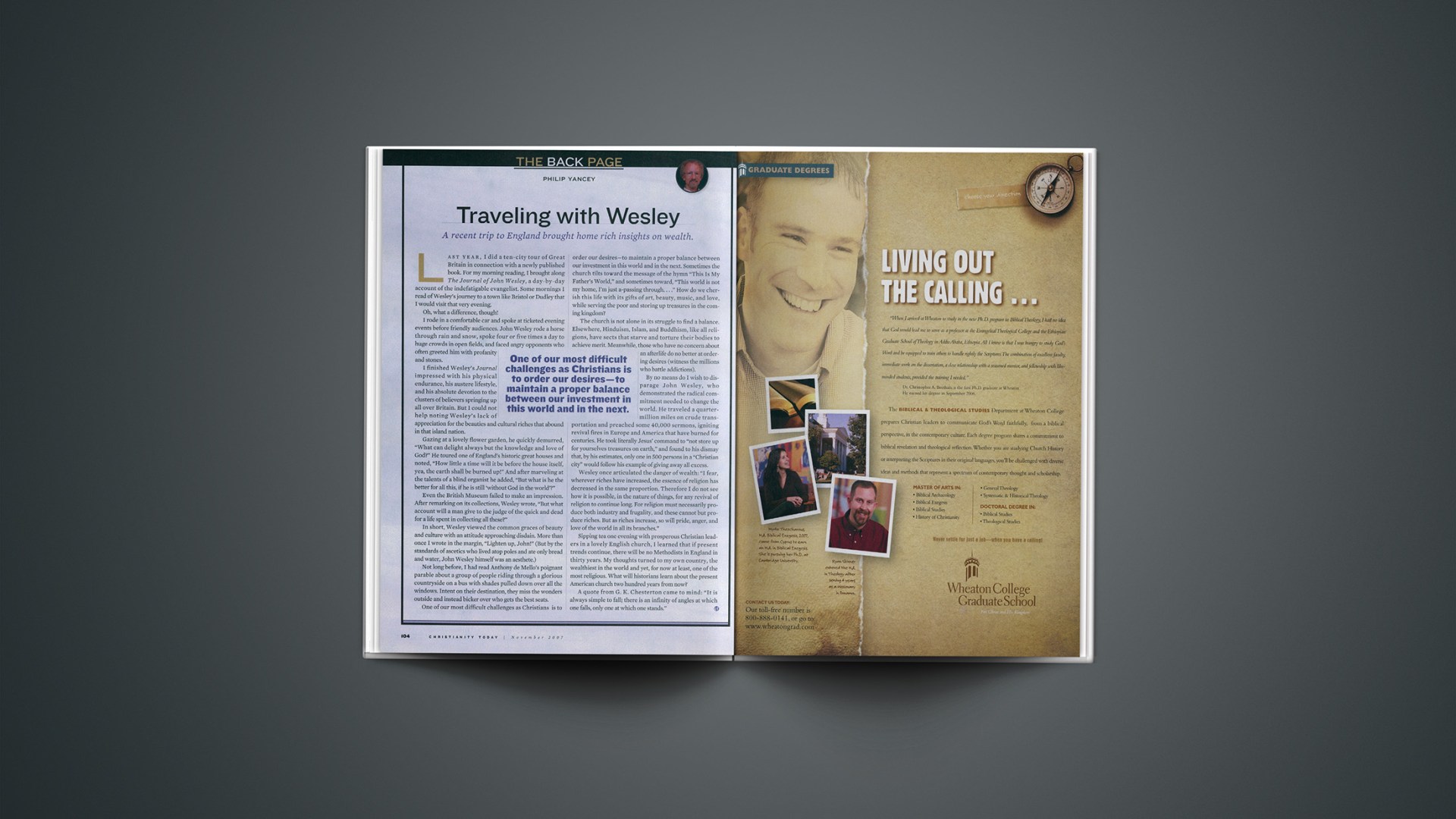
Last year, I did a ten-city tour of Great Britain in connection with a newly published book. For my morning reading, I brought along The Journal of John Wesley, a day-by-day account of the indefatigable evangelist. Some mornings I read of Wesley’s journey to a town like Bristol or Dudley that I would visit that very evening.
Oh, what a difference, though!
I rode in a comfortable car and spoke at ticketed evening events before friendly audiences. John Wesley rode a horse through rain and snow, spoke four or five times a day to huge crowds in open fields, and faced angry opponents who often greeted him with profanity and stones.
I finished Wesley’s Journal impressed with his physical endurance, his austere lifestyle, and his absolute devotion to the clusters of believers springing up all over Britain. But I could not help noting Wesley’s lack of appreciation for the beauties and cultural riches that abound in that island nation.
Gazing at a lovely flower garden, he quickly demurred, “What can delight always but the knowledge and love of God?” He toured one of England’s historic great houses and noted, “How little a time will it be before the house itself, yea, the earth shall be burned up!” And after marveling at the talents of a blind organist he added, “But what is he the better for all this, if he is still ‘without God in the world’?”
One of our most difficult challenges as Christians is to order our desires—to maintain a proper balance between our investment in this world and in the next.
Even the British Museum failed to make an impression. After remarking on its collections, Wesley wrote, “But what account will a man give to the judge of the quick and dead for a life spent in collecting all these?”
In short, Wesley viewed the common graces of beauty and culture with an attitude approaching disdain. More than once I wrote in the margin, “Lighten up, John!” (But by the standards of ascetics who lived atop poles and ate only bread and water, John Wesley himself was an aesthete.)
Not long before, I had read Anthony de Mello’s poignant parable about a group of people riding through a glorious countryside on a bus with shades pulled down over all the windows. Intent on their destination, they miss the wonders outside and instead bicker over who gets the best seats.
One of our most difficult challenges as Christians is to order our desires—to maintain a proper balance between our investment in this world and in the next. Sometimes the church tilts toward the message of the hymn “This Is My Father’s World,” and sometimes toward, “This world is not my home, I’m just a-passing through. …” How do we cherish this life with its gifts of art, beauty, music, and love, while serving the poor and storing up treasures in the coming kingdom?
The church is not alone in its struggle to find a balance. Elsewhere, Hinduism, Islam, and Buddhism, like all religions, have sects that starve and torture their bodies to achieve merit. Meanwhile, those who have no concern about an afterlife do no better at ordering desires (witness the millions who battle addictions).
By no means do I wish to disparage John Wesley, who demonstrated the radical commitment needed to change the world. He traveled a quarter-million miles on crude transportation and preached some 40,000 sermons, igniting revival fires in Europe and America that have burned for centuries. He took literally Jesus’ command to “not store up for yourselves treasures on earth,” and found to his dismay that, by his estimates, only one in 500 persons in a “Christian city” would follow his example of giving away all excess.
Wesley once articulated the danger of wealth: “I fear, wherever riches have increased, the essence of religion has decreased in the same proportion. Therefore I do not see how it is possible, in the nature of things, for any revival of religion to continue long. For religion must necessarily produce both industry and frugality, and these cannot but produce riches. But as riches increase, so will pride, anger, and love of the world in all its branches.”
Sipping tea one evening with prosperous Christian leaders in a lovely English church, I learned that if present trends continue, there will be no Methodists in England in thirty years. My thoughts turned to my own country, the wealthiest in the world and yet, for now at least, one of the most religious. What will historians learn about the present American church two hundred years from now?
A quote from G. K. Chesterton came to mind: “It is always simple to fall; there is an infinity of angles at which one falls, only one at which one stands.”
Copyright © 2007 Christianity Today. Click for reprint information.
Related elsewhere:
Yancey’s previous columns are available on our site.
John Wesley is one of Christian History & Biography‘s 131 Christians Everyone Should Know series.