See if this sounds familiar: teenage boy in England is informed by wise British elders in robes that he is “special” and that he alone can stop the evil forces bent on conquering the world. Boy is reluctant hero, but ultimately accepts the challenge: balancing world-saving with girl problems and other teenage concerns. Harry Potter? No, a lesser-known literary antecedent: The Dark Is Rising. Unfortunately, the movie version is post-Potter, which is a bad place to be if you’re a sub-par, adolescent boy-wonder fantasy film.
The film is based on (or “inspired by,” as some diehards no doubt prefer) the 1974 Newberry award-winning book by Susan Cooper—part two of a five-book series of novels for children, originally published in the 60s and 70s. Following in the footsteps of Lewis or Tolkien-esque fantasy, the books feature youths on whimsical adventures, thrust into epic battles between good and evil, with colorful characters and creatures on both sides of the struggle.

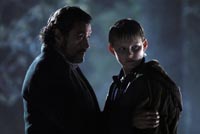
I have not read the books, and came into the film with no knowledge of the story. Still, it was pretty easy to follow what was going on. The film takes place in England, where the American Stanton family resides in a shire-esque rural town with a mysterious Arthurian vibe (it’s never really explained why they are there, but it’s a fun setup nonetheless). The youngest son in a house of seven children, the precocious Will Stanton (Alexander Ludwig) is just celebrating his fourteenth birthday as the movie opens. After his birthday, strange things start happening to him (and not puberty, as his teasing older brothers suggest). Before he knows it, Will is the centerpiece in an epic time-traveling quest to save the world.
Evidently, as a “seventh son of a seventh son,” Will is the last in a line of something called “The Old Ones.” These “old” ones—which include great British actors like Ian McShane, James Cosmo and Tim Piddock, as well as the formidable thespian, Francis Conroy—are immediately convened to tell Will who he is (“The Sign Seeker”) and what he must do. “The dark is rising,” we are told, “and Will must restore the light.” To do so, he must first collect six “signs” that are hidden across time (Will has the ability to time-travel when he senses a sign). He must collect all the signs (which are small physical objects) in order to defeat the Dark, which is led by a black rider (decidedly Lord of the Rings-esque). As he gains more signs, the Dark feels increasingly threatened and becomes more aggressive. It should all sound very familiar to anyone who read the last three Harry Potter books (can anyone say horcruxes?).
Indeed, this film seems in some ways to be a “Christian alternative” to the Potter franchise. The changing of the title to The Seeker may even be a veiled attempt to trick youngsters into seeing a film that sounds like it will be all about Quidditch. Directed by David Cunningham (To End All Wars) and financed by Walden Media (the Narnia movies), it is clear that this film aims to be a harmless adventure story and little more. I suspect that the books have a slightly darker tinge to them, but the “evil” of the film version is—for the most part—pretty harmless. Embodied in the typical fantasy images (crows, black clouds, shrouded figures), the villainous “Dark” musters everything from snakes to snowstorms to crush the spirits of his enemies. But no one ever dies or is particularly violently injured. We all know good will triumph in the end; it’s just a matter of getting through the 94 minutes of mid-level sorcery and horcrux/sign-seeking to get there.
This, actually, is the film’s biggest stylistic fault. It is so short (a good thing for some, I imagine) that a supposed “epic” story becomes little more than a comic book episode. Who knew the earth could be saved in the time it takes to go to the grocery store? For such a seemingly large-scale thing as a doomsday good vs. evil showdown, this film operates on a suspiciously small scale. Why are all the “signs” hidden only in this little town (albeit in different periods of its history)? And why—if the collection of six small doo-dads spells the end of the evil darkness—is it so darn easy for little Will to find them? Shouldn’t it be a BIT harder? Frodo and Sam were on their journey for what, like about a year?

Certainly, the kid-oriented, bite-sized nature of this film precludes anything from being drawn out or meticulously explored. Sadly this means that none of the characters get any sort of development. As Will Stanton, Ludwig tries to inject some adolescent angst and all-too-familiar “I’m not a hero” moments of self-doubt into his performance. It’s hard to buy, however, because what 14-year-old is going to complain about having superpowers and the ability to traverse time? But perhaps I’m just missing a lot of things that were lost in adaptation. Or perhaps the filmmakers needed Will to doubt himself so they could interject noble quotables like “even the smallest light shines in the darkness.” A true statement, certainly, but not one that carries much weight in a film so cautious and featherweight.
Lest I begin to sound like a scrooge, I must admit that I love fantasy and sci-fi films (even kid-oriented). That is, I love them when they are done well. Unfortunately The Seeker does not pack the punch that its source material no doubt does. It is too quick, too slight, and too cliched to make a splash in the company of such high-quality adaptations like LOTR and Harry Potter. It might win new fans to the franchise, but unfortunately far fewer than it could have.
Talk About It
Discussion starters- What is the value in fantasy stories like this? What does this story, for example, tell us about the nature of good and evil?
- Some characters in the film appear to be good, but turn out to be evil. What does this say about how the devil operates?
- If you were suddenly confronted with the task/responsibility to save the world, what would you do? How would you respond?
- Can you identify any Christian allegorical or symbolic elements in this film? Discuss.
The Family Corner
For parents to considerThe Seeker is rated PG for fantasy action and some scary images. It’s a film meant for children, young adults, and whole families. Apart from a few scary images and a general mood of dread, there is nothing objectionable, though some scenes might be scary for very young children. There is also a bit of magic and other “spooky” activity. There aren’t any wizards or witches per se, but “the Old Ones” are a mysterious (and apparently immortal) group that might as well be called wizards.
Photos © Copyright Fox/Walden
Copyright © 2007 Christianity Today. Click for reprint information.