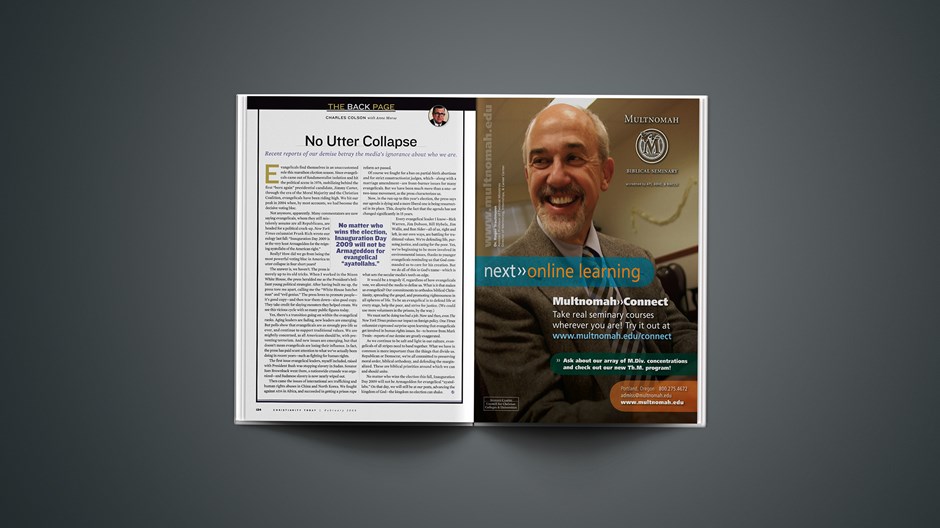
Evangelicals find themselves in an unaccustomed role this marathon election season. Since evangelicals came out of fundamentalist isolation and hit the political scene in 1976, mobilizing behind the first "born again" presidential candidate, Jimmy Carter, through the era of the Moral Majority and the Christian Coalition, evangelicals have been riding high. We hit our peak in 2004 when, by most accounts, we had become the decisive voting bloc.
Not anymore, apparently. Many commentators are now saying evangelicals, whom they still mistakenly assume are all Republicans, are headed for a political crack-up. New York Times columnist Frank Rich wrote our eulogy last fall: "Inauguration Day 2009 is at the very least Armageddon for the reigning ayatollahs of the American right."
Really? How did we go from being the most powerful voting bloc in America to utter collapse in four short years?
The answer is, we haven't. The press is merely up to its old tricks. When I worked in the Nixon White House, the press heralded me as the President's brilliant young political strategist. After having built me up, the press tore me apart, calling me the "White House hatchet man" and "evil genius." The press loves to promote people—it's good copy—and then tear them down—also good copy. They take credit for slaying monsters they helped create. We see this vicious cycle with so many public figures today.
Yes, there's a transition going on within the evangelical ranks. Aging leaders are fading, new leaders are emerging. But polls show that evangelicals are as strongly pro-life as ever, and continue to support traditional values. We are mightily concerned, as all Americans should be, with preventing terrorism. And new issues are emerging, but that doesn't mean evangelicals are losing their influence. In fact, the press has paid scant attention to what we've actually been doing in recent years—such as fighting for human rights.
The first issue evangelical leaders, myself included, raised with President Bush was stopping slavery in Sudan. Senator Sam Brownback went there, a nationwide crusade was organized—and Sudanese slavery is now nearly wiped out.
Then came the issues of international sex trafficking and human rights abuses in China and North Korea. We fought against aids in Africa, and succeeded in getting a prison rape reform act passed.
Of course we fought for a ban on partial-birth abortions and for strict constructionist judges, which—along with a marriage amendment—are front-burner issues for many evangelicals. But we have been much more than a one- or two-issue movement, as the press characterizes us.
Now, in the run-up to this year's election, the press says our agenda is dying and a more liberal one is being resurrected in its place. This, despite the fact that the agenda has not changed significantly in 15 years.
Every evangelical leader I know—Rick Warren, Jim Dobson, Bill Hybels, Jim Wallis, and Ron Sider—all of us, right and left, in our own ways, are battling for traditional values. We're defending life, pursuing justice, and caring for the poor. Yes, we're beginning to be more involved in environmental issues, thanks to younger evangelicals reminding us that God commanded us to care for his creation. But we do all of this in God's name—which is what sets the secular media's teeth on edge.
It would be a tragedy if, regardless of how evangelicals vote, we allowed the media to define us. What is it that makes us evangelical? Our commitments to orthodox biblical Christianity, spreading the gospel, and promoting righteousness in all spheres of life. To be an evangelical is to defend life at every stage, help the poor, and strive for justice. (We could use more volunteers in the prisons, by the way.)
We must not be doing too bad a job. Now and then, even The New York Times praises our impact on foreign policy. One Times columnist expressed surprise upon learning that evangelicals get involved in human rights issues. So—to borrow from Mark Twain—reports of our demise are greatly exaggerated.
As we continue to be salt and light in our culture, evangelicals of all stripes need to band together. What we have in common is more important than the things that divide us. Republican or Democrat, we're all committed to preserving moral order, biblical orthodoxy, and defending the marginalized. These are biblical priorities around which we can and should unite.
No matter who wins the election this fall, Inauguration Day 2009 will not be Armageddon for evangelical "ayatollahs." On that day, we will still be at our posts, advancing the kingdom of God—the kingdom no election can shake.
Christianity Today's January editorial "What We Really Want" said that despite media rumors evangelicals would not be on the sidelines this coming election.
Have something to add about this? See something we missed? Share your feedback here.
Charles Colson was the founder of Prison Fellowship Ministries, an outreach to convicts, victims of crime, and justice officers. Colson, who converted to Christianity before he was indicted on Watergate-related charges, became one of evangelicalism's most influential voices. His books included Born Again and How Now Shall We Live? A Christianity Today columnist since 1985, Colson died in 2012.















 While we pray for peace, we need moral clarity about this war.
 As my doubts about his teachings grew, so did a secret fascination with Jesus.
 How groups like Hillsong learned to let go of the literal in favor of creative collaboration.españolPortuguês






