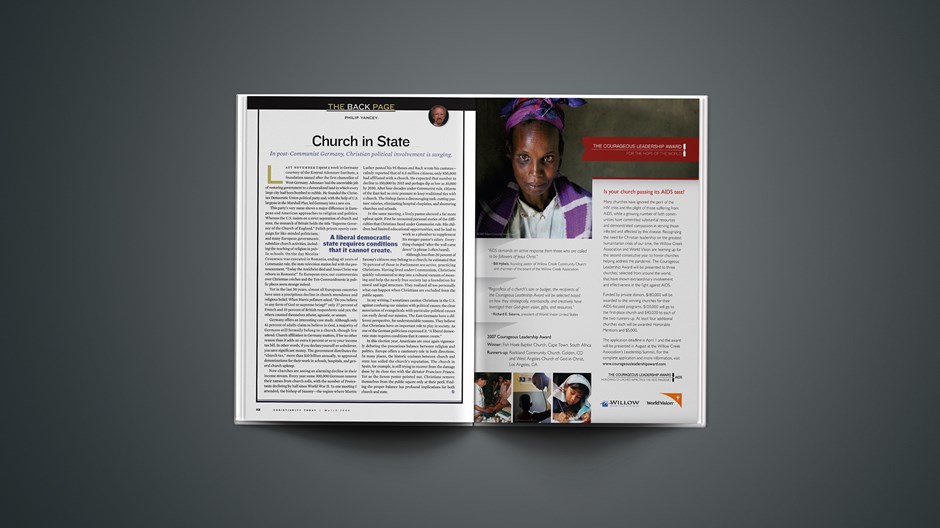
Last November I spent a week in Germany courtesy of the Konrad Adenauer Institute, a foundation named after the first chancellor of West Germany. Adenauer had the unenviable job of restoring government to a demoralized land in which every large city had been bombed to rubble. He founded the Christian Democratic Union political party and, with the help of U.S. largesse in the Marshall Plan, led Germany into a new era.
This party's very name shows a major difference in European and American approaches to religion and politics. Whereas the U.S. insists on a strict separation of church and state, the monarch of Britain holds the title "Supreme Governor of the Church of England," Polish priests openly campaign for like-minded politicians, and many European governments subsidize church activities, including the teaching of religion in public schools. On the day Nicolae Ceausescu was executed in Romania, ending 45 years of Communist rule, the state television station led with the pronouncement, "Today the Antichrist died and Jesus Christ was reborn in Romania!" To European eyes, our controversies over Christmas crèches and the Ten Commandments in public places seem strange indeed.
Yet in the last 50 years, almost all European countries have seen a precipitous decline in church attendance and religious belief. When Harris pollsters asked, "Do you believe in any form of God or supreme being?" only 27 percent of French and 35 percent of British respondents said yes; the others counted themselves atheist, agnostic, or unsure.
Germany offers an interesting case study. Although only 41 percent of adults claim to believe in God, a majority of Germans still formally belong to a church, though few attend. Church affiliation in Germany matters, if for no other reason than it adds an extra 8 percent or so to your income tax bill. In other words, if you declare yourself an unbeliever, you save significant money. The government distributes the "church tax," more than $10 billion annually, to approved denominations for their work in schools, hospitals, and general church upkeep.
Now churches are seeing an alarming decline in their income stream. Every year some 300,000 Germans remove their names from church rolls, with the number of Protestants declining by half since World War II. In one meeting I attended, the bishop of Saxony—the region where Martin Luther posted his 95 theses and Bach wrote his cantatas—calmly reported that of 4.5 million citizens, only 850,000 had affiliated with a church. He expected that number to decline to 350,000 by 2015 and perhaps dip as low as 30,000 by 2030. After four decades under Communist rule, citizens of the East feel no civic pressure to keep traditional ties with a church. The bishop faces a discouraging task: cutting pastors' salaries, eliminating hospital chaplains, and shuttering churches and schools.
In the same meeting, a lively pastor showed a far more upbeat spirit. First he recounted personal stories of the difficulties that Christians faced under Communist rule. His children had limited educational opportunities, and he had to work as a plumber to supplement his meager pastor's salary. Everything changed "after the wall came down" (a phrase I often heard).
Although less than 20 percent of Saxony's citizens may belong to a church, he estimated that 70 percent of those in Parliament are active, practicing Christians. Having lived under Communism, Christians quickly volunteered to step into a cultural vacuum of meaning and help the newly free society lay a foundation for moral and legal structure. They realized all too personally what can happen when Christians are excluded from the public square.
In my writing, I sometimes caution Christians in the U.S. against confusing our mission with political causes; the close association of evangelicals with particular political causes can easily derail our mission. The East Germans have a different perspective, for understandable reasons. They believe that Christians have an important role to play in society. As one of the German politicians expressed it, "A liberal democratic state requires conditions that it cannot create."
In this election year, Americans are once again vigorously debating the precarious balance between religion and politics. Europe offers a cautionary tale in both directions. In many places, the historic coziness between church and state has soiled the church's reputation. The church in Spain, for example, is still trying to recover from the damage done by its close ties with the dictator Francisco Franco. Yet as the Saxon pastor pointed out, Christians remove themselves from the public square only at their peril. Finding the proper balance has profound implications for both church and state.
Philip Yancey is editor at large of Christianity Today and cochair of the editorial board for Books and Culture. Yancey's most recent book is What Good Is God?: In Search of a Faith That Matters. His other books include Prayer (2006), Rumors of Another World (2003), Reaching for the Invisible God (2000), The Bible Jesus Read (1999), What's So Amazing About Grace? (1998), The Jesus I Never Knew (1995), Where is God When It Hurts (1990), and many others. His Christianity Today column ran from 1985 to 2009.















 While we pray for peace, we need moral clarity about this war.
 As my doubts about his teachings grew, so did a secret fascination with Jesus.
 How groups like Hillsong learned to let go of the literal in favor of creative collaboration.españolPortuguês






