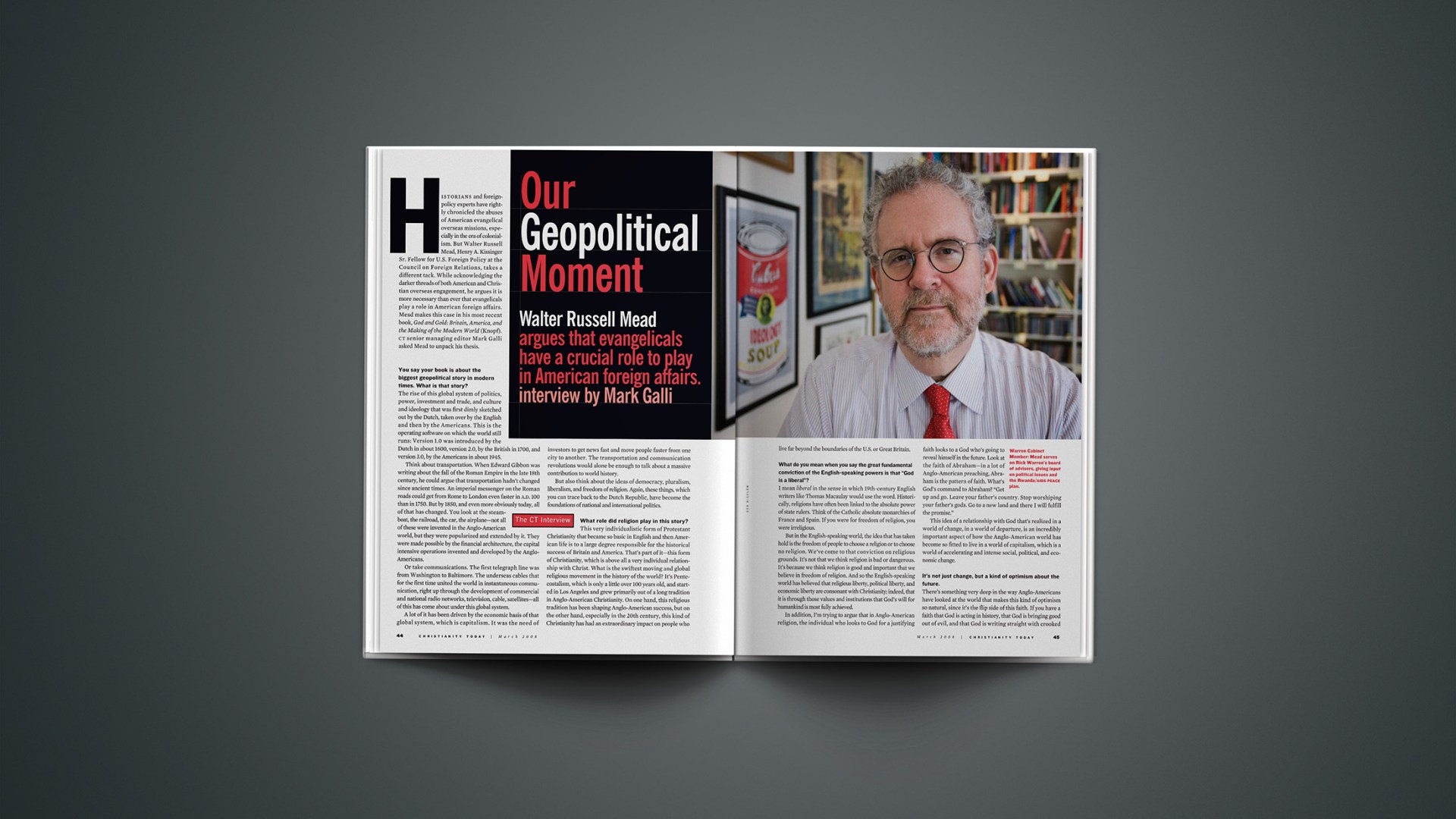

Historians and foreign-policy experts have rightly chronicled the abuses of American evangelical overseas missions, especially in the era of colonialism. But Walter Russell Mead, Henry A. Kissinger Sr. Fellow for U.S. Foreign Policy at the Council on Foreign Relations, takes a different tack. While acknowledging the darker threads of both American and Christian overseas engagement, he argues it is more necessary than ever that evangelicals play a role in American foreign affairs. Mead makes this case in his most recent book, God and Gold: Britain, America, and the Making of the Modern World (Knopf). CT senior managing editor Mark Galli asked Mead to unpack his thesis.
You say your book is about the biggest geopolitical story in modern times. What is that story?
The rise of this global system of politics, power, investment and trade, and culture and ideology that was first dimly sketched out by the Dutch, taken over by the English and then by the Americans. This is the operating software on which the world still runs: Version 1.0 was introduced by the Dutch in about 1600, version 2.0, by the British in 1700, and version 3.0, by the Americans in about 1945.
Think about transportation. When Edward Gibbon was writing about the fall of the Roman Empire in the late 18th century, he could argue that transportation hadn’t changed since ancient times. An imperial messenger on the Roman roads could get from Rome to London even faster in A.D. 100 than in 1750. But by 1850, and even more obviously today, all of that has changed. You look at the steamboat, the railroad, the car, the airplane—not all of these were invented in the Anglo-American world, but they were popularized and extended by it. They were made possible by the financial architecture, the capital intensive operations invented and developed by the Anglo-Americans.
Or take communications. The first telegraph line was from Washington to Baltimore. The underseas cables that for the first time united the world in instantaneous communication, right up through the development of commercial and national radio networks, television, cable, satellites—all of this has come about under this global system.
A lot of it has been driven by the economic basis of that global system, which is capitalism. It was the need of investors to get news fast and move people faster from one city to another. The transportation and communication revolutions would alone be enough to talk about a massive contribution to world history.
But also think about the ideas of democracy, pluralism, liberalism, and freedom of religion. Again, these things, which you can trace back to the Dutch Republic, have become the foundations of national and international politics.
What role did religion play in this story?
This very individualistic form of Protestant Christianity that became so basic in English and then American life is to a large degree responsible for the historical success of Britain and America. That’s part of it—this form of Christianity, which is above all a very individual relationship with Christ. What is the swiftest moving and global religious movement in the history of the world? It’s Pentecostalism, which is only a little over 100 years old, and started in Los Angeles and grew primarily out of a long tradition in Anglo-American Christianity. On one hand, this religious tradition has been shaping Anglo-American success, but on the other hand, especially in the 20th century, this kind of Christianity has had an extraordinary impact on people who live far beyond the boundaries of the U.S. or Great Britain.
What do you mean when you say the great fundamental conviction of the English-speaking powers is that “God is a liberal”?
I mean liberal in the sense in which 19th-century English writers like Thomas Macaulay would use the word. Historically, religions have often been linked to the absolute power of state rulers. Think of the Catholic absolute monarchies of France and Spain. If you were for freedom of religion, you were irreligious.
But in the English-speaking world, the idea that has taken hold is the freedom of people to choose a religion or to choose no religion. We’ve come to that conviction on religious grounds. It’s not that we think religion is bad or dangerous. It’s because we think religion is good and important that we believe in freedom of religion. And so the English-speaking world has believed that religious liberty, political liberty, and economic liberty are consonant with Christianity; indeed, that it is through those values and institutions that God’s will for humankind is most fully achieved.
In addition, I’m trying to argue that in Anglo-American religion, the individual who looks to God for a justifying faith looks to a God who’s going to reveal himself in the future. Look at the faith of Abraham—in a lot of Anglo-American preaching, Abraham is the pattern of faith. What’s God’s command to Abraham? “Get up and go. Leave your father’s country. Stop worshiping your father’s gods. Go to a new land and there I will fulfill the promise.”
This idea of a relationship with God that’s realized in a world of change, in a world of departure, is an incredibly important aspect of how the Anglo-American world has become so fitted to live in a world of capitalism, which is a world of accelerating and intense social, political, and economic change.
It’s not just change, but a kind of optimism about the future.
There’s something very deep in the way Anglo-Americans have looked at the world that makes this kind of optimism so natural, since it’s the flip side of this faith. If you have a faith that God is acting in history, that God is bringing good out of evil, and that God is writing straight with crooked lines, then that kind of faith can very easily shift gears and become an optimism about the future. You understand God’s plan completely, and you can see that God is about to complete his plan with you.
The optimism of the Anglo-American world of faith is basically a positive quality. But one of the temptations we have to constantly guard against is to let our faith turn into a belief that we understand God’s providence, we are the instruments of God’s providence, and we’re about to accomplish his will once and for all.
Our history shows that this optimism has not always been justified.
We Americans look at the last 300 years of history, and we basically see a world that’s getting better and better. The rule of freedom expands. The economy develops. We have risen to become the world’s greatest power. The American people are extraordinarily comfortable, affluent, and secure. It’s easy for us to make the argument that God’s purpose is being fulfilled through history and through the rise of American power. And to some degree, it probably is.
But suppose you are a sincere and pious Muslim. What you see in 1700 marks the beginning of the rise of England and America, the beginning of the great decline and collapse of the Ottoman Empire. Ultimately it will be divided into little pieces. The English are beginning to challenge the great Islamic empire of India. The Persians are beginning to lose their greatness. Over the next 300 years, it just gets uglier and uglier. The Muslims are driven out of Europe and in many cases, ethnically cleansed or persecuted. The English stopped the expansion of Islam in Nigeria. The Spanish colonials stopped the expansion of Islam into the Philippines. What you see is a history that’s gone wrong, a very different attitude about the modern era and the values that have shaped it.
That’s just the tip of the iceberg. As many have convincingly argued, democratic capitalism has often been exploitive and unjust. This does not sound like a great story.
If you’re someone who believes, as I do, that humanity is fallen and warped in various ways, it’s not surprising that there’s no such thing as a perfect social system that produces perfect human beings. The Anglo-Americans have exploited their power. They have often treated weaker or poorer peoples with great injustice. In the book, I look at the way the British treated the Irish. You also could look at India, Africa, what happened to the Indians in the U.S., or the Aborigines in Australia.
These critiques of the liberal economic and social system are not new. They were being articulated by Catholic critics of Protestant England in France in the 18th century. And you can find writers for Napoleon who sound almost exactly like Noam Chomsky as they critique the way England’s cruel mercantile power depressed the living standards of people in Africa and other parts of the world in order to maintain England’s heartless glory and wealth.
But I look at the results over these hundreds of years, too. What we see is that human beings have longer life spans than they used to. There are many more possibilities for people. The parts of the developing world today that are integrating most quickly into the system—places like China and India—have seen a dramatic rise in living standards and a fall in poverty rates. Increasingly people who study development and work in places like Africa are coming to the conclusion that the greatest problem the poor face is not the existence of a capitalist economic system, but their lack of access to it. The idea is not to abolish capitalism and replace it with something else, but to find ways that capitalism can start working better for the poor.
That’s something that all Americans and especially American Christians need to be thinking a good deal about.
Why do you argue that evangelicals have a crucial role to play in this democratic capitalist order?
We’re seeing now, and have been seeing for the last generation, a remarkable rise in the influence and numbers of active evangelical believers in the U.S., to the point where the evangelical vote is a major factor in American politics. When we think about how America can exercise its responsibility and develop a foreign policy that works for us, but also works for other people and promotes world stability and peace—it’s hard to see that happening without a serious engagement of American evangelicals, especially its intellectuals. They understand the way conservative Christians of all stripes instinctively look at certain issues, and can develop and describe American foreign policy in ways that make sense to people and can command support. That’s part of it.
It’s also the evangelical commitment to engage in a much deeper way with issues like world poverty. One of the most exciting things you are seeing today is the increase in serious American evangelical interest in building new kinds of people-to-people connections, whether it’s in Africa or Asia or Latin America—of trying to make a better world for people out there, who increasingly are fellow Christians.
More than that, though, one of the great values that the Anglo-American world has brought to world politics is this idea of faith in the future and optimism, a willingness to embrace change and even stimulate change to make a better world. But what we see over and over again is that this tends to turn into postmillennial optimism, where we’re going to be creating utopia now. We need to understand that even if we’re not creating utopia now, we still need to persevere in trying to make the world a better place. It’s a rooted and grounded activism in the world that understands and is comfortable with the idea that humanity is imperfect, that perfection will come only from God, and in God’s time and in God’s way—not as the result of human political endeavors. At the same time, that’s no excuse to stop political endeavors to make the world better and to do a better job.
Many have argued that evangelicals are too simplistic or moralistic when it comes to geopolitics. What makes you think they now have a constructive role to play?
Some of these criticisms have been a little unfair at times. Secular people have often underestimated the sophistication and thoughtfulness of religious people. Also, the world of American evangelicals is changing, making evangelicals a group that is more able to exercise the responsibilities that are being thrust upon them.
For example, I don’t think we should underestimate the importance of the change in American evangelicals’ attitudes about race. Many white evangelicals, particularly in the South, were at one point among the most resistant people to racial integration and equality. That’s been discarded; you now have a celebration in the American evangelical world of Christian multiculturalism. It’s understood that people can be evangelicals while they have a Hispanic or African American or white Southern or Northern suburban culture—or, for that matter, Kenyan or Malawian or Guatemalan culture. American evangelicals today are far better placed to understand the kind of world we live in.
I finished God and Gold this summer in Rwanda. I was there at Rick Warren’s invitation to observe what he and Saddleback Church are doing in Rwanda. These Southern Baptists from Southern California were really much better at [avoiding] the colonial sense of superiority or racial barriers that might have been factors two generations ago. These folks were working very hard, and were very comfortable with the idea of learning to engage with people in Rwanda on the Rwandans’ terms.
And yet most evangelicals across the world—especially Pentecostals—are known for helping people come into a personal relationship with Jesus Christ, not for a sophisticated understanding of geopolitics.
In terms of creating American soft power, this is extraordinary. If you travel around a lot of the developing world, what you see is the extraordinary progress of Christian missions and evangelization. Christianity in general leads people in many cases to have very positive feelings about the United States and American foreign policy. Polls taken, say, among Pentecostals in Nigeria, showed great support for America’s war on terror at a time when, in a lot of the world, that policy was profoundly unpopular. Polling evidence shows that in places like Kenya, Nigeria, and other African countries where Christianity has become a very vibrant presence, people are optimistic about their future; they actually are glad to see American values playing a larger role in their countries.
Or look at Brazil. What is the difference between [America-friendly President] Lula, a man who comes out of the Brazilian political left and led a populist coalition, and Chavez, the Venezuelan leader, who’s very anti-American in his leftist populism? An important part of Lula’s coalition is Brazilian Pentecostals and evangelicals. In some of the same ways that in British history the early Methodists were a stabilizing political force (arguing for moderation and peaceful change and opposed to class-struggle politics), in Brazil evangelicals have helped to moderate some of the traditional left-right divides.
At the same time, many Muslims equate Christianity with American foreign policy, and their judgment is violently negative.
Exactly right. This is something we have to really be thinking about. I’ve spent a lot of time since September 11 in the Islamic world. I find a tremendous curiosity out there about the role of evangelicalism and Christianity in general and in American life. Is it anti-Islamic? What does it stand for? I think one of the things that we really need to try to promote is a deeper encounter between Muslims, especially in the Middle East, and American evangelicals.
How do your ideas about evangelicals’ role in the world fare among your colleagues in foreign affairs?
There is a greater acceptance and understanding. Look at what we’re doing at the Council on Foreign Relations. People like Rick Warren and Richard Land have been elected as life members in the Council on Foreign Relations. That would have been very unlikely a generation ago, or maybe even 10 years ago. People like this feel comfortable in a place like the council, and the council feels that these are the kinds of people who ought to be our members.
Here at the council we’re trying to open up our events to people in the religious world. I’ve been running a program on religion and foreign policy with the help of Tim Shaw, who has a Ph.D. from Harvard and a deep grounding in the faith community. Richard Haass, our president, has appointed a religious advisory board that includes a substantial number of evangelicals. We had a symposium last fall on evangelicals and American foreign policy.
On the religious side, a lot of people were surprised to find that religious issues were getting such a sympathetic and serious hearing at a place like the council. On the council’s side, we have continued to discover just how sophisticated and thoughtful a lot of the discourse is among religious people. We’re finding that things like nuance and subtlety are very much a part of the intellectual toolkit that evangelical scholars are bringing to their work. There’s mutual discovery on both sides. The secular establishment and the evangelical world have far more ability to work together than either one would have predicted five years ago.
You say that evangelicals need a strong dose of Reinhold Niebuhr. What do they need from Niebuhr and why?
Niebuhr’s notion of original sin and of America needing to act as a fallen people in a fallen world is a very rich concept. He brought original sin into discussion among people who didn’t want to believe in a literal interpretation of Genesis. He made the Fall respectable among mainline Protestants.
We are not perfect, and we need to understand that we are not perfect, and that others who are angry at us often have good grounds for their anger. At the same time, our critics are not perfect, and to simply say, Whatever they say about us must be right, and so we must do the opposite of what we’ve done—Niebuhr was a very trenchant critic of that thinking.
He helps us realize that living in an imperfect world, it’s not about building utopia. Niebuhr argued very clearly that the Western liberal capitalist system wasn’t a utopia. Some of the decisions that you make and things that you do will be wrong; some of the courses you have to follow are going to be necessarily imperfect courses. You’re not going to be a hundred percent in the right in every war that you fight. Nevertheless, you have to fight the war.
The optimism that is so much a part of the Anglo-American tradition needs to be liberally and frequently salted with Niebuhrian skepticism. At the same time, Niebuhr reminds us that this can’t be an excuse for inaction and passivity. We have to be engaged. These ideas can contribute enormously to the intellectual and social formation of a new generation of American leaders whose roots are in faith communities.
Copyright © 2008 Christianity Today. Click for reprint information.
Related Elsewhere:
Walter Russell Mead commented on the benefits of division in “Why Culture War May Never End“
God and Gold: Britain, America, and the Making of the Modern World is available from Amazon.com and other retailers.
Foreign Affairs published Mead’s 2006 article about evangelicals and foreign affairs.
The Winter 2006 issue of The Review of Faith & International Affairs was devoted to Mead’s original Foreign Affairs article, and included responses from Galli, Richard Land, Ron Sider, Jim Skillen, and others.