
Our posture is our learned but unconscious default position, our natural stance. It is the position our body assumes when we aren’t paying attention, the basic attitude we carry through life. Often it’s difficult for us to discern our own posture—as an awkward, gangly teenager I subconsciously slumped to minimize my height, something I would never have noticed if my mother hadn’t pointed it out. Only by a fair amount of conscious effort did my posture become less self-effacing and more confident.
Now, in the course of a day I may need any number of bodily gestures. I will stoop down to pick up the envelopes that came through the mail slot. I will curl up in our oversized chair with my daughter to read a story. I will reach up to the top of my shelves to grab a book. If I am fortunate I will embrace my wife; if I am unfortunate I will have to throw up my hands to ward off an attack by an assailant. All these gestures can be part of the repertoire of daily living.
Over time, certain gestures may become habit—that is, become part of our posture. I’ve met former Navy SEALS who walk through life in a half-articulated crouch, ready to pounce or defend. I’ve met models who carry themselves, even in their own home, as if they are on a stage. I’ve met soccer players who bounce on the balls of their feet wherever they go, agile and swift. And I’ve met teenage video-game addicts whose thumbs are always restless and whose shoulders betray a perpetual hunch toward an invisible screen. What began as an occasional gesture, appropriate for particular opportunities and challenges, has become a basic approach to the world.
Gestures Toward Culture
Something similar, it seems to me, has happened at each stage of American Christians’ engagement with culture. Appropriate gestures toward particular cultural goods have become, over time, part of the posture Christians unconsciously adopt toward every cultural situation and setting. Indeed, the appeal of the various postures of condemning, critiquing, copying, and consuming is that each of these responses to culture is, at certain times and with specific cultural goods, a necessary gesture.
Condemning culture. Some cultural artifacts can only be condemned. The international web of violence and lawlessness that sustains the global sex trade is culture, but there is nothing to do with it but eradicate it as quickly and effectively as we can. The only Christian thing to do is to reject it. Likewise, Nazism, a self-conscious attempt to enthrone a particular culture and destroy others, was another wide-ranging cultural phenomenon that demanded Christian condemnation, as Karl Barth, Dietrich Bonhoeffer, and other courageous Christians saw in the 1930s. It would not have been enough to form a “Nazi Christian Fellowship” designed to serve the spiritual needs of up-and-comers within the Nazi party. Instead, Barth and Bonhoeffer authored the Barmen Declaration, an unequivocal rejection of the entire cultural apparatus that was Nazi Germany.
Among cultural artifacts around us right now, there are no doubt some that merit condemnation. Pornography is an astonishingly large and powerful industry that creates nothing good and destroys many lives. Our economy has become dangerously dependent on factories in far-off countries where workers are exploited and all but enslaved. Our nation permits the murder of vulnerable unborn children and often turns a blind eye as industrial plants near our poorest citizens pollute the environment of born children. The proper gesture toward such egregious destruction of the good human life is an emphatic Stop! backed with all the legitimate force we can muster.
Critiquing culture. Some cultural artifacts deserve to be critiqued. Perhaps the clearest example is the fine arts, which exist almost entirely to spark conversation about ideas and ideals, to raise questions about our cultural moment, and to prompt new ways of seeing the natural and cultural world. At least since the Renaissance, artists in the Western tradition want the rest of us to critique their work, to make something of what they have made. Indeed, the better the art, the more it drives us to critique. We may watch a formulaic blockbuster for pure escapism, laugh ourselves silly, and never say a word about it after we leave the theater. But the more careful and honest the filmmaking, the more we will want to ask one another, “What did you make of that?”
By the same token, other “gestures” toward art are almost always beside the point. Serious works of art are not made to be consumed—slotted unthinkingly into our daily lives—nor, by law in fact, may they be simply copied and appropriated for Christian use. Of all the possible gestures toward culture, condemnation, in particular, almost always ends up sounding shrill and silly when applied to art. It is difficult to think of a single instance where condemnation of a work of art has produced any result other than heightened notoriety for the work and the artist.
Consuming culture. There are many cultural goods for which by far the most appropriate response is to consume. When I make a pot of tea or bake a loaf of bread, I do not condemn it as a worldly distraction from spiritual things, nor do I examine it for its worldview and assumptions about reality. I drink the tea and eat the bread, enjoying them in their ephemeral goodness, knowing that tomorrow the tea will be bitter and the bread will be stale. The only appropriate thing to do with these cultural goods is to consume them.
Copying culture. Even the practice of copying cultural goods, borrowing their form from the mainstream culture and infusing them with Christian content, has its place. When we set out to communicate or live the gospel, we never start from scratch. Even before church buildings became completely indistinguishable from warehouse stores, church architects were borrowing from “secular” architects. Long before the Contemporary Christian Music industry developed its uncanny ability to echo any mainstream music trend, Martin Luther and the Wesleys were borrowing tunes from bars and dance halls and providing them with Christian lyrics. Why shouldn’t the church borrow from any and every cultural form for the purposes of worship and discipleship? The church, after all, is a culture-making enterprise itself, concerned with making something of the world in the light of the story that has taken us by surprise and upended our assumptions about that world. Copying culture can even be, at its best, a way of honoring culture, demonstrating the lesson of Pentecost that every human language, every human cultural form, is capable of bearing the Good News.
When Gestures Become Postures
The problem is not with any of these gestures. All of them can be appropriate responses to particular cultural goods. Indeed, each of them may be the only appropriate response to a particular cultural good. But the problem comes when these gestures become too familiar, become the only way we know how to respond to culture, become etched into our unconscious stance toward the world, and become postures.
Because while there is much to be condemned in human culture, the posture of condemnation leaves us closed off from the beauty and possibility as well as the grace and mercy in many forms of culture. It also makes us into hypocrites, since we are hardly free of culture ourselves. The culture of our churches and Christian communities is often just as lamentable as the “secular” culture we complain about, something our neighbors can see perfectly well. The posture of condemnation leaves us with nothing to offer even when we manage to persuade our neighbors that a particular cultural good should be discarded. And most fundamentally, having condemnation as our posture makes it almost impossible for us to reflect the image of a God who called the Creation “very good” and, even in the wake of the profound cultural breakdown that led to the Flood, promised never to utterly destroy humankind and human culture again. If we are known mostly for our ability to poke holes in every human project, we will probably not be known as people who bear the hope and mercy of God.
Similarly, there is much to be said for critiquing particular cultural goods. But when critique becomes a posture, we end up strangely passive, waiting for culture to deliver us some new item to talk about. Critique as a posture, while an improvement over condemnation, can leave us strangely unable simply to enjoy cultural goods, preoccupied with our interrogation of their “worldview” and “presuppositions.” The posture of critique also tempts us toward the academic fallacy of believing that once we have analyzed something, we have understood it. Often true understanding requires participation—throwing ourselves fully into the enjoyment and experience of someone or something without reserving an intellectual, analytical part of ourselves outside of the experience like a suspicious and watchful librarian.
Cultural copying, too, is a good gesture and a poor posture. It is good to honor the many excellences of our cultures by bringing them into the life of the Christian community, whether that is a group of Korean American chefs serving up a sumptuous church supper of bulgogi and ssamjang, or a dreadlocked electric guitarist articulating lament and hope through a vintage tube amp.
But when copying becomes our posture, a whole host of unwanted consequences follows. Like the critics, we become passive, waiting to see what interesting cultural good will be served up next for our imitation and appropriation. In fast-changing cultural domains those whose posture is imitation will find themselves constantly slightly behind the times, so that church worship music tends to be dominated by styles that disappeared from the scene several years before. Any embarrassment about being cultural laggards is mitigated by the fact that our copy-culture by definition will never be seen by the vast majority of the mainstream culture. And in this way, when all we do is copy culture for our own Christian ends, cultural copying fails to love or serve our neighbors.
The greatest danger of copying culture, as a posture, is that it may well become all too successful. We end up creating an entire subcultural world within which Christians comfortably move and have their being without ever encountering the broader cultural world they are imitating. We breed a generation that prefers facsimile to reality, simplicity to complexity (for cultural copying, almost by definition, ends up sanding off the rough and surprising edges of any cultural good it appropriates), and familiarity to novelty. Not only is this a generation incapable of genuine creative participation in the ongoing drama of human culture making, it is dangerously detached from a God who is anything but predictable and safe.
Finally, consumption is the posture of cultural denizens who simply take advantage of all that is offered up by the ever-busy purveyors of novelty, risk-free excitement, and pain avoidance. It would not be entirely true to say that consumers are undiscerning in their attitude toward culture, because discernment of a kind is at the very heart of consumer culture. Consumer culture teaches us to pay exquisite attention to our own preferences and desires. Someone whose posture is consumption can spend hours researching the most fashionable and feature-laden cell phone; can know exactly what combination of espresso shots, regular and decaf, whole and skim, amaretto and chocolate, makes for their perfect latte; can take on extraordinary commitments of debt and commuting time in order to live in the right community. But while all of this involves care and work—we might even say “cultural engagement”—it never deviates from the core premise of consumer culture: We are most human when we are purchasing something someone else has made.
Of all the possible postures toward culture, consumption is the one that lives most unthinkingly within a culture’s preexisting horizons of possibility and impossibility. The person who condemns culture does so in the name of some other set of values and possibilities. The whole point of critique is becoming aware of the horizons that a given culture creates, for better or worse. Even copying culture and bringing it into the life of the Christian community puts culture to work in the service of something believed to be more true and lasting. But consumption, as a posture, is capitulation: letting the culture set the terms, assuming that the culture knows best and that even our deepest longings (for beauty, truth, love) and fears (of loneliness, loss, death) have some solution that fits comfortably within our culture’s horizons, if only we can afford to purchase it.
Artists and Gardeners
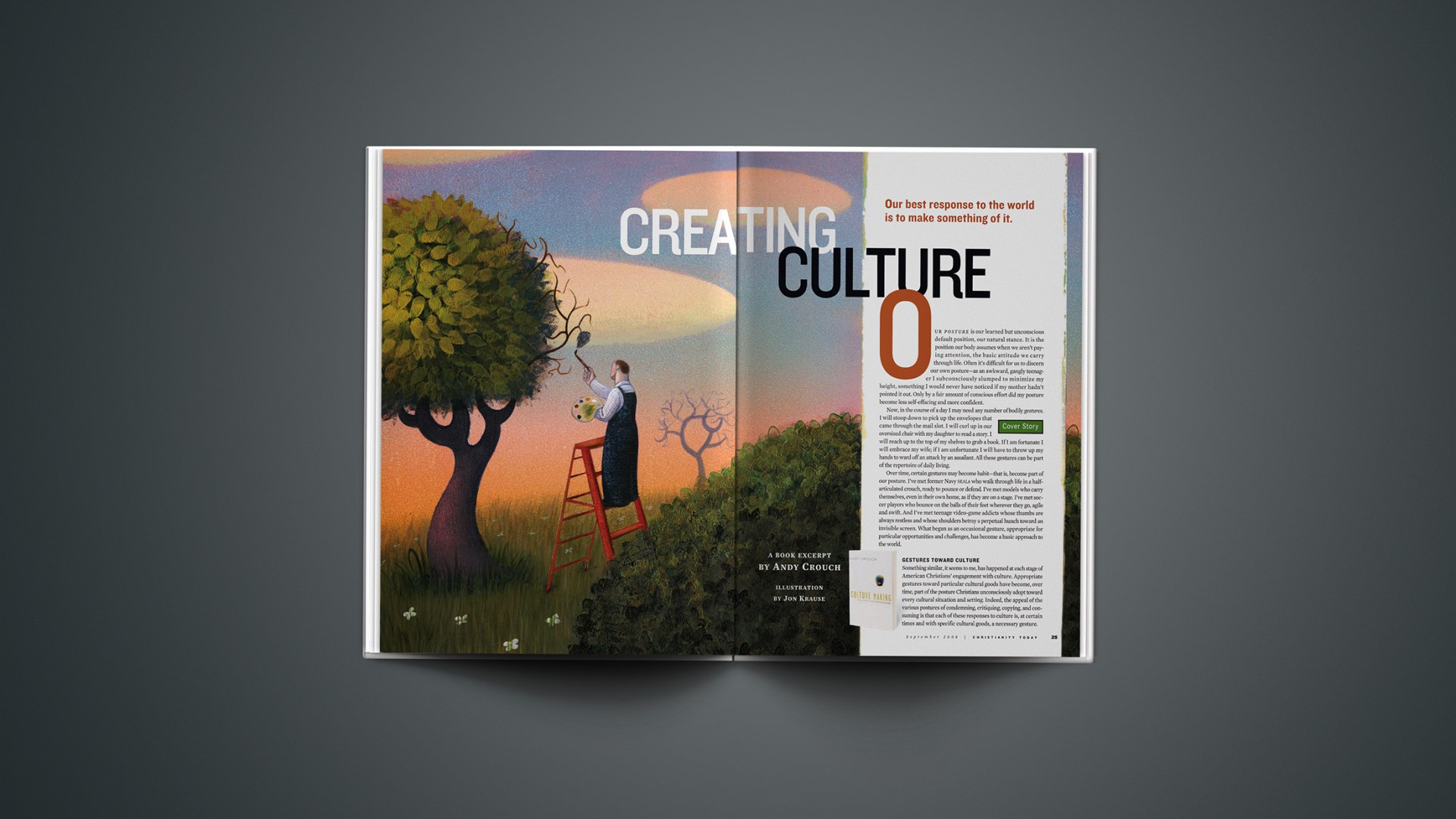
What is missing from our repertoire, I’ve come to believe, are the two postures that are most characteristically biblical but have been least explored by Christians in the last century. They are found at the very beginning of the human story, according to Genesis: like our first parents, we are to be creators and cultivators. Or to put it more poetically, we are artists and gardeners.
The postures of the artist and the gardener have a lot in common. Both begin with contemplation, paying close attention to what is already there. The gardener looks carefully at the landscape; the existing plants, both flowers and weeds; the way the sun falls on the land. The artist regards her subject, her canvas, her paints with care to discern what she can make with them.
And then, after contemplation, the artist and the gardener both adopt a posture of purposeful work. They bring their creativity and effort to their calling. The gardener tends what has gone before, making the most of what is beautiful and weeding out what is distracting or useless. The artist can be more daring: she starts with a blank canvas or a solid piece of stone and gradually brings something out of it that was never there before. They are acting in the image of One who spoke a world into being and stooped down to form creatures from the dust. They are creaturely creators, tending and shaping the world that original Creator made.
I wonder what we Christians are known for in the world outside our churches. Are we known as critics, consumers, copiers, condemners of culture? I’m afraid so. Why aren’t we known as cultivators—people who tend and nourish what is best in human culture, who do the hard and painstaking work to preserve the best of what people before us have done? Why aren’t we known as creators—people who dare to think and do something that has never been thought or done before, something that makes the world more welcoming and thrilling and beautiful?
The simple truth is that in the mainstream of culture, cultivation and creativity are the postures that confer legitimacy for the other gestures. People who consider themselves stewards of culture, guardians of what is best in a neighborhood, an institution, or a field of cultural practice gain the respect of their peers. Even more so, those who go beyond being mere custodians to creating new cultural goods are the ones who have the world’s attention. Indeed, those who have cultivated and created are precisely the ones who have the legitimacy to condemn—whose denunciations, rare and carefully chosen, carry outsize weight. Cultivators and creators are the ones who are invited to critique and whose critiques are often the most telling and fruitful.
Cultivators and creators can even copy without becoming mere imitators, drawing on the work of others yet extending it in new and exciting ways—think of the best of hip-hop’s culture of sampling, which does not settle for merely reproducing the legends of jazz and R & B but places their work in new sonic contexts. And when they consume, cultivators and creators do so without becoming mere consumers. They do not derive their identity from what they consume but from what they create.
If there is a constructive way forward for Christians in the midst of our broken but also beautiful cultures, it will require us to recover these two biblical postures of cultivation and creation. And that recovery will involve revisiting the biblical story itself, where we discover that God is more intimately and eternally concerned with culture than we have yet come to believe.
Andy Crouch is editorial director of the Christian Vision Project at Christianity Today International. This article is adapted from Culture Making by Andy Crouch. Copyright ©2008 by Andy Crouch. Used by permission of InterVarsity Press, P.O. Box 1400, Downers Grove, IL 60515.
Copyright © 2008 Christianity Today. Click for reprint information.
Related Elsewhere:
Culture Making is available from ChristianBook.com and other retailers.
Crouch spoke with CT about culture making on a local scale.
David Neff wrote more about Crouch’s views on Christianity and culture in September’s “Inside CT“.