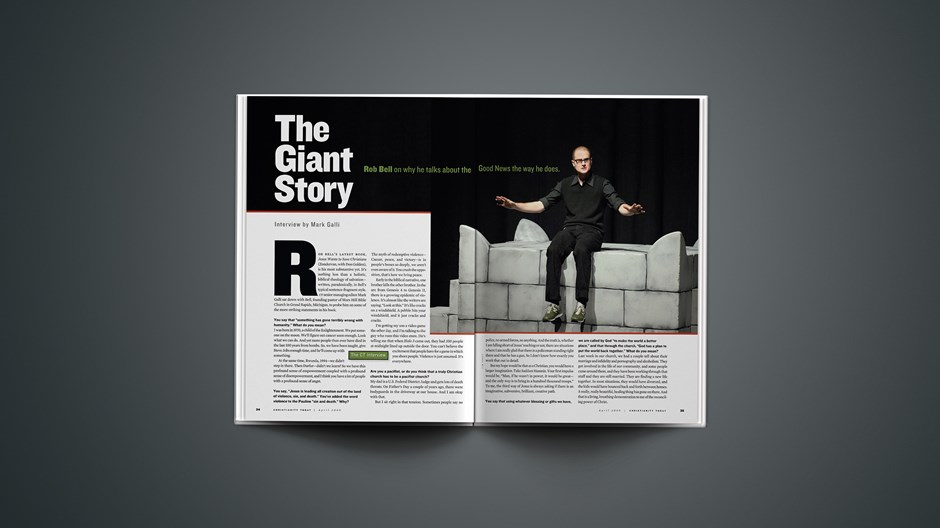
Rob Bell's latest book, Jesus Wants to Save Christians (Zondervan, with Don Golden), is his most substantive yet. It's nothing less than a holistic, biblical theology of salvation—written, paradoxically, in Bell's typical sentence-fragment style. CT senior managing editor Mark Galli sat down with Bell, founding pastor of Mars Hill Bible Church in Grand Rapids, Michigan, to probe him on some of the more striking statements in his book.
You say that "something has gone terribly wrong with humanity." What do you mean?
I was born in 1970, a child of the Enlightenment. We put someone on the moon. We'll figure out cancer soon enough. Look what we can do. And yet more people than ever have died in the last 100 years from bombs. So, we have been taught, give Steve Jobs enough time, and he'll come up with something.
At the same time, Rwanda, 1994—we didn't step in there. Then Darfur—didn't we learn? So we have this profound sense of empowerment coupled with a profound sense of disempowerment, and I think you have a lot of people with a profound sense of angst.
You say, "Jesus is leading all creation out of the land of violence, sin, and death." You've added the word violence to the Pauline "sin and death." Why?
The myth of redemptive violence—Caesar, peace, and victory—is in people's bones so deeply, we aren't even aware of it. You crush the opposition, that's how we bring peace.
Early in the biblical narrative, one brother kills the other brother. In the arc from Genesis 4 to Genesis 11, there is a growing epidemic of violence. It's almost like the writers are saying, "Look at this." It's like cracks on a windshield. A pebble hits your windshield, and it just cracks and cracks.
I'm getting my son a video game the other day, and I'm talking to the guy who runs this video store. He's telling me that when Halo 3 came out, they had 350 people at midnight lined up outside the door. You can't believe the excitement that people have for a game in which you shoot people. Violence is just assumed. It's everywhere.
Are you a pacifist, or do you think that a truly Christian church has to be a pacifist church?
My dad is a U.S. Federal District Judge and gets lots of death threats. On Father's Day a couple of years ago, there were bodyguards in the driveway at our house. And I am okay with that.
But I sit right in that tension. Sometimes people say no police, no armed forces, no anything. And the truth is, whether I am falling short of Jesus' teaching or not, there are situations where I am really glad that there is a policeman standing right there and that he has a gun. So I don't know how exactly you work that out in detail.
But my hope would be that as a Christian, you would have a larger imagination. Take Saddam Hussein. Your first impulse would be, "Man, if he wasn't in power, it would be great—and the only way is to bring in a hundred thousand troops." To me, the third way of Jesus is always asking if there is an imaginative, subversive, brilliant, creative path.
You say that using whatever blessing or gifts we have, we are called by God "to make the world a better place," and that through the church, "God has a plan to put the world back together." What do you mean?
Last week in our church, we had a couple tell about their marriage and infidelity and pornography and alcoholism. They got involved in the life of our community, and some people came around them, and they have been working through that stuff and they are still married. They are finding a new life together. In most situations, they would have divorced, and the kids would have bounced back and forth between homes. A really, really beautiful, healing thing has gone on there. And that is a living, breathing demonstration to me of the reconciling power of Christ.
But in the book, this statement is set in the context of social justice. Do you really believe the church can make the world a better place, given its track record?
I know that in lots of places, this can work in the other direction: "I had hope for humanity until I got around this church." In my experience, I've seen people across the spectrum, from hating the church to being passionately involved in churches doing great acts of healing and restoration.
I was in a remote village in Africa, and we were walking through these slums. Our guide was showing us how this church was the only group of people who were willing to go in and care for people in these shacks, people dying of AIDS and, in their last moments, give them a dignified death. In that non-Western, almost premodern context, we were sitting in these dirt-floor shacks, watching these people care for people who were taking their last breaths. And they do this because they believe in a Jesus who says, "Go to everybody who is forgotten." So, I believe in that church.
I also happen to live in 2009, in a Western hyper-churched, over-churched culture, where the flag and the cross have held hands in such a way that you have a waning Christendom at the heart of the empire. We are in this very unusual convergence of power and church and religion and Jesus, where a Christian pastor is saying a prayer at the [President's] inauguration. I mean, what?
Article continues below
This is a weird little thing, where we see all the distorted, loopy versions of church and say, "I don't know." And then you get yourself in some setting where you say, "Oh my word. This is beautiful!" So I've bounced back and forth between those two settings. In spite of all the filters that I have to be cynical, that's a really beautiful thing right there.
You say, "Jesus wants to save us from making the Good News about another world and not this one." What do you mean?
The story is about God's intentions to bring about a new heaven and a new earth, and the story begins here with shalom—shalom between each other and with our Maker and with the earth. The story line is that God intends to bring about a new creation, this place, this new heaven and earth here. And that Jesus' resurrection is the beginning, essentially, of the future; this great Resurrection has rushed into the present.
The evacuation theology that says, "figure out the ticket, say the right prayer, get the right formula, and then we'll go somewhere else" is lethal to Jesus, who endlessly speaks of the renewal of all things.
All well and good, but how is this good news to people with no earthly hope? If I'm dying of aids or cancer, I probably don't give a rip about the renewal of all things. I want to know if my sins are forgiven, and when I die, if am I going to see Jesus or not.
Yes, and I would say that central to that new creation is the problem with the first creation—death. The Resurrection is about God dealing with the death problem. And central to this giant cosmic hope is a very intimate, yes, you can trust this Jesus. You can trust this new creation. You can trust being with him when you die, when you leave this life, however you want to put it. Yes, there is an intensely personal dimension to this giant story that you and I get to be a part of.
You're essentially reframing the gospel—at least the gospel you inherited, the gospel we have known as the gospel in North America for the last couple hundred years.
I am leery of people who have very clear ideas of what they're doing from outside of themselves: "You have to understand that I'm doing this and doing this." I would say that for 10 years, I have tried to invite people to trust Jesus. You can trust this Jesus. You can trust him past, present, future; sins, mistakes, money, sexuality. I think this Jesus can be trusted.
Article continues below
I often put it this way: If there is a God, some sort of Divine Being, Mind, Spirit, and all of this is not just some random chance thing, and history has some sort of movement to it, and you have a connection with Whatever—that is awesome. Hard and awesome and creative and challenging and provoking.
And there is this group of people who say that whoever that being is came up among us and took on flesh and blood—Andrew Sullivan talks about this immense occasion the world could not bear. So a church would be this odd blend of swagger—an open tomb, come on—and humility and mystery. The Resurrection accounts are jumbled and don't really line up with each other—I really relate to that. Yet something momentous has burst forth in the middle of history. You just have to have faith, and you get caught up in something.
I like to say that I practice militant mysticism. I'm really absolutely sure of some things that I don't quite know.
How would you present this gospel on Twitter?
I would say that history is headed somewhere. The thousands of little ways in which you are tempted to believe that hope might actually be a legitimate response to the insanity of the world actually can be trusted. And the Christian story is that a tomb is empty, and a movement has actually begun that has been present in a sense all along in creation. And all those times when your cynicism was at odds with an impulse within you that said that this little thing might be about something bigger—those tiny little slivers may in fact be connected to something really, really big.
Not quite down to 140 characters.
Well, you can't really tweet the gospel. I'm convinced that I am not doing anything new. I am hoping that I'm in a long tradition.

















 While we pray for peace, we need moral clarity about this war.
 A Christian reconciliation group in Israel and Palestine warned that war would come. Now the war threatens their relevance.españolالعربيةFrançaisрусскийУкраїнська
 How groups like Hillsong learned to let go of the literal in favor of creative collaboration.españolPortuguês






