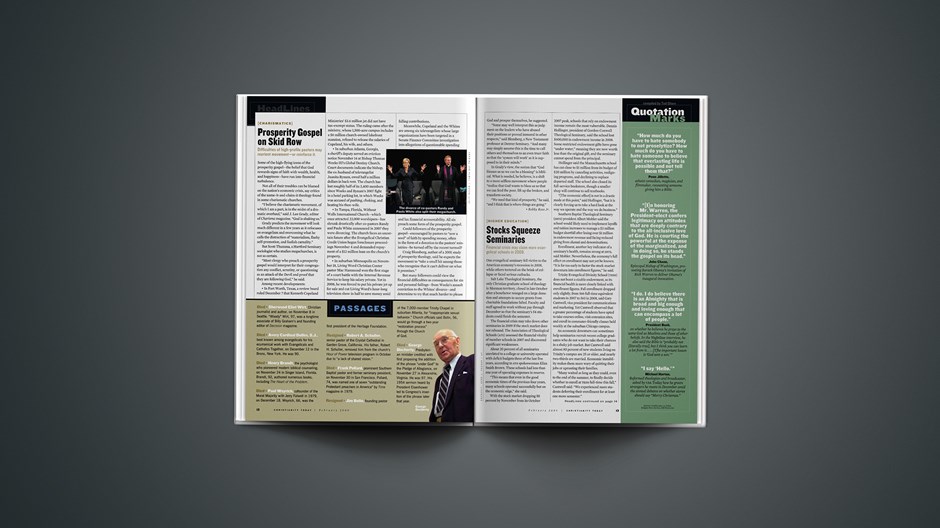
One evangelical seminary fell victim to the American economy's recession in 2008, while others teetered on the brink of collapse or faced serious cutbacks.
Salt Lake Theological Seminary, the only Christian graduate school of theology in Mormon territory, closed in late October after a benefactor reneged on a large donation and attempts to secure grants from charitable foundations failed. Faculty and staff agreed to work without pay through December so that the seminary's 54 students could finish the semester.
The financial crisis may take down other seminaries in 2009 if the stock market does not rebound. The Association of Theological Schools (ATS) assessed the financial vitality of member schools in 2007 and discovered significant weaknesses.
About 20 percent of all seminaries unrelated to a college or university operated with deficit budgets three of the last five years, according to ATS spokeswoman Eliza Smith Brown. These schools had less than one year of operating expenses in reserve.
"This means that even in the good economic times of the previous four years, many schools operated successfully but on the economic edge," she said.
With the stock market dropping 50 percent by November from its October 2007 peak, schools that rely on endowment income remain the most vulnerable. Dennis Hollinger, president of Gordon-Conwell Theological Seminary, said the school lost $600,000 in endowment income in 2008. Some restricted endowment gifts have gone "under water," meaning they are now worth less than the original gift, and the seminary cannot spend from the principal.
Hollinger said the Massachusetts school has cut close to $1 million from its budget of $20 million by canceling activities, realigning programs, and declining to replace departed staff. The school also closed its full-service bookstore, though a smaller shop will continue to sell textbooks.
"[The economic effect] is not in a drastic mode at this point," said Hollinger, "but it is clearly forcing us to take a hard look at the way we operate and the way we do business."
Southern Baptist Theological Seminary (SBTS) president Albert Mohler said the school would likely need to implement layoffs and tuition increases to manage a $3 million budget shortfall after losing over $1 million in endowment revenue and facing reduced giving from alumni and denominations.
Enrollment, another key indicator of a seminary's health, remains strong at SBTS, said Mohler. Nevertheless, the economy's full effect on enrollment may not yet be known. "It is far too early to factor the stock-market downturn into enrollment figures," he said.
Trinity Evangelical Divinity School (TEDS) does not boast a sizable endowment, so its financial health is more closely linked with enrollment figures. Fall enrollment dropped only slightly, from 566 full-time equivalent masters students in 2007 to 563 in 2008, said Gary Cantwell, vice president for communications and marketing. Yet Cantwell observed that a greater percentage of students have opted to take courses online, visit extension sites, and enroll in commuter-friendly classes held weekly at the suburban Chicago campus.
An economic downturn can sometimes help seminaries recruit recent college graduates who do not want to take their chances in a shaky job market. But Cantwell said almost 80 percent of new students living on Trinity's campus are 25 or older, and nearly two-thirds are married. Economic instability makes them more wary of quitting their jobs or uprooting their families.
"Many waited as long as they could, even to the end of the summer, to finally decide whether to enroll at TEDS full-time this fall," Cantwell said. "We experienced more students deferring their enrollment for at least one more semester."
Looking forward, Mohler's greatest concern is inflation. The largest seminaries can make enough cuts to survive declining revenues, but a long-term trend of rising costs may take more seminaries the way of Salt Lake.

















 While we pray for peace, we need moral clarity about this war.
 We’ve got little information on Jesus’ appearance and personality. But that’s the way God designed it.españolFrançais
 How groups like Hillsong learned to let go of the literal in favor of creative collaboration.españolPortuguês






