"As for our common defense," said Barack Obama in his January 20 inaugural address, "we reject as false the choice between our safety and our ideals." The President did not get specific, but his remarks signaled his intentions: He believes that the President is not above the law. He must pursue national security without resorting to extralegal means or violating human rights. He understands that whether the issue is the torture of detainees, due process for American citizens suspected of terrorism, or eavesdropping on our private communications without appropriate judicial warrants, the President of the United States is bound by law.
That view stands in contrast to arguments advanced during the Bush years, mainly by members of the Justice Department's Office of Legal Counsel (OLC) and Vice President Dick Cheney. This contrast is not a matter of conservatives versus liberals. George Will, Paul Weyrich, John Dean, Mickey Edwards, and other conservative icons joined the chorus of those who warned against putting the presidency above the law.
To put these issues in context, though, we need to go back a few centuries and look at the Christian roots of the rule of law as outlined by Reformer John Calvin.
God's Law Limits God's Rulers
I never thought I'd be writing about Dick Cheney and John Calvin in the same sentence. But both men are political theorists and political agents. Both are controversial. And both addressed the question: How much power should we entrust to a ruler?
People haven't always been able to ask that question. For most of recorded history, power was something that rulers had, not something the people entrusted to them. But at key historical moments, that began to change. Calvin lived in one of those turning-point eras. In his time, it was still unthinkable that those who do the governing derive their legitimacy from those who are governed. Nearly everyone in Calvin's time believed that it was God who ordains rulers. They derived this idea from Scripture (e.g., Rom. 13:1-7).
But Calvin began to ask a crucial question: If God puts those who rule into office, does not God's revealed law impose limits on those rulers? To be raised up by God to govern does not mean being handed unlimited power. It means ruling by the principles of God's law.
In his 2008 book The Reformation of Rights, legal historian John Witte summarizes Calvin's views:
Political rulers must govern the earthly kingdom by written political laws, not by personal fiat. Their laws must encompass the biblical principles of love of God and neighbor, but they must not embrace biblical laws per se. Instead, "equity alone must be the goal and rule and limit of all laws," a term which Calvin used both in the classic Aristotelian sense of correcting defects in individual rules if they work injustice in a particular case, and in his own sense of adjusting each legal system to the changing circumstances and needs of the local community. Through such written, equitable laws, political rulers must serve to promote peace and order in the earthly kingdom …
Calvin adopted the "Two Kingdoms" theory of Martin Luther, his elder colleague in the Reformation. God ordains church and government as parallel institutions with distinct responsibilities for ordering society and the lives of the people. Each kingdom has its own sphere of operation, and neither should interfere with the other. This way of thinking contrasted with the earlier Roman Catholic doctrine of the "Two Swords"—that is, God has only one kingdom, but that kingdom has two swords, one wielded by the state, the other by the church. Both were to govern in all spheres of life.
Calvin used the Reformation idea of church and state as separate and distinct spheres to foster liberty. For every duty God imposes, whether spiritual or temporal, there is a corresponding freedom that is required. If we are commanded to give our families material support, for example, economic freedom and the right to private property are essential. If we are to rest on the Sabbath, we must have the liberty to stop working and not be perpetually at the beck of employers. Each duty implies a corresponding liberty, and it is the duty of rulers to protect those liberties.
Because these duties come from God, religious liberty is a fundamental aspect of political liberty. Witte continues: "Political liberty and political authority 'are constituted together,' said Calvin. … When political officials respect the duties and limits of their office, believers enjoy ample political liberty to give 'public manifestation of their faith.'?"
But what about the unfaithful political leader? Calvin wrote that "dictatorships and unjust authorities are not governments ordained by God." They are no longer "God's ministers" if they "practice blasphemous tyranny."
What a striking phrase: "blasphemous tyranny"! And how apt. When rulers place their own goals ahead of protecting God-given laws and liberties, they are not only being tyrannical, they are also blaspheming.
Article continues below
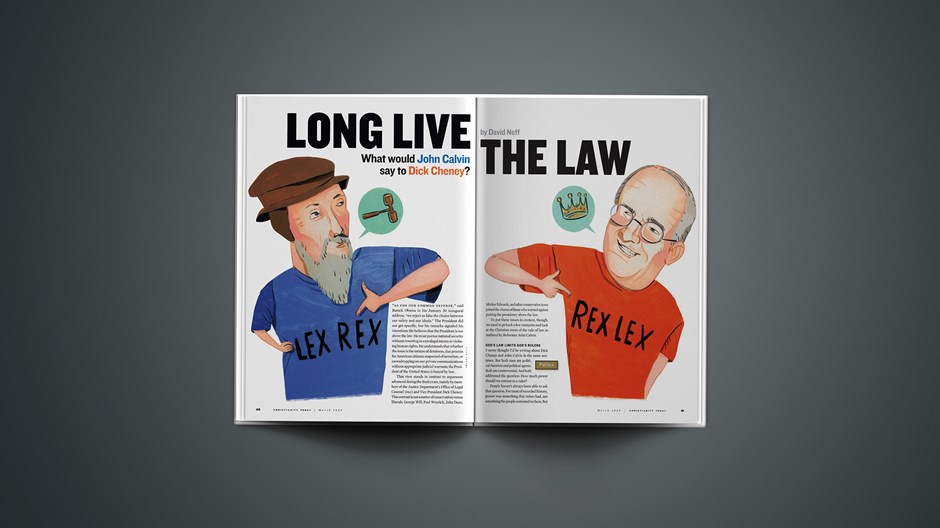
Lex Rex
Later religious thinkers who followed in Calvin's train had to face just such blasphemous tyranny. In the 1600s, England was caught between those who supported an unlimited notion of the king's executive power and those who thought that power was limited by the balancing wills of the people and the nobility.
King James I denied that he was in any way accountable to the laws of Parliament, but this did not sit well with many. The eventual result was a bloody civil war. In the midst of that war, one Samuel Rutherford, a Scots Presbyterian theologian deeply influenced by Calvin, wrote a treatise that redefined the argument, saying Lex Rex ("the law is king"). Rutherford's book is generally recognized as the first modern attempt to give the rule of law a theoretical foundation.
Rutherford drew from Scripture the principle that kingship was based on a covenant with the people. 2 Samuel says, "All the elders of Israel came to the king at Hebron, and King David made a covenant with them at Hebron before the Lord, and they anointed David king over Israel" (5:3, esv). Rutherford found that notion repeated throughout Scripture, and argued cogently that it should be the foundation of English civil order.
Indeed, Rutherford believed that when a duly appointed king turns to tyranny, the people retain their power of government and may depose him. The power of government is natural to the people as a whole, and they are unable to give it away completely.
The religious arguments that Calvin, Rutherford, and others made were secularized by Enlightenment thinkers like Montesquieu and Thomas Paine. But today we should remember that the idea that rulers are subject to law is based on biblical reasoning.
The issue has not been completely solved in the American setting. The bigger canvas, which stretches back to the Civil War, is carefully painted by Pulitzer Prize-winning journalist Charlie Savage in Takeover: The Return of the Imperial Presidency and the Subversion of American Democracy. Presidents Abraham Lincoln, Theodore Roosevelt, and Franklin Delano Roosevelt all tested the limits of executive power, but it remained for Harry Truman to assert that despite the Constitution assigning war-making powers to Congress, he as Commander in Chief had the inherent power to take us to war in Korea. Truman then appealed to those same powers to take control of the nation's steel industry in order to avoid a strike.
Article continues below
Dwight Eisenhower further expanded presidential power by fighting the intrusive investigations of Senator Joseph McCarthy by claiming an "executive privilege" to withhold from Congress any executive branch documents he chose. During the Cuban missile crisis, John F. Kennedy blockaded Cuba and threatened imminent war without consulting Congress. And Lyndon Johnson claimed the inherent power of the presidency to keep us at war in Vietnam without congressional approval. This trend was finally broken following the Nixon administration's abuses that culminated in the Watergate scandal and the President's resignation.
But one young staffer in the Nixon administration, future Vice President Dick Cheney, became a champion of expansive executive power. Serving in Congress and in subsequent administrations, Cheney helped promote the theory of the "Unitary Executive," the idea that, in Savage's words, the White House should exercise complete control over everything in the executive branch, which could be conceived of as a unitary being with the President as its brain. Attorney General Ed Meese, then-Representative Dick Cheney, and others pushed that notion in order to reclaim the de facto presidential powers that were squandered by Nixon's overreach.
But after 9/11, the push to consolidate presidential power over national security issues took on new momentum. Sometimes Cheney's rhetoric has gone to extremes. For example, he told Fox News's Chris Wallace that because the President always has at his side a military aide carrying the nuclear "football," and because the President therefore has the ability to launch a nuclear attack at any time without checking with Congress, he is free of any responsibility to check with Congress in exercising his national security duties.
This is clearly an example of category confusion—mistaking ability for authority, confusing capability for constitutional powers.
This nuclear argument is a huge leap along a trajectory outlined in earlier arguments Cheney made. For example, in his 1990 conversations with President George H. W. Bush, he argued that the President did not need congressional authorization to go to war in order to drive Saddam Hussein out of Kuwait. Indeed, Cheney later said that despite the fact that Bush sought congressional approval, if Congress had said no, he would have urged the President to launch Desert Storm over Congress's objections.
Article continues below
Despite the Constitution granting war-making power to Congress, Cheney has argued that Congress is essentially deliberative in nature, and therefore unsuited to deal with national security, something that always requires swift action. "The legislative branch is ill equipped to handle many of the foreign policy tasks it has been taking upon itself lately," he wrote. The executive branch, by contrast, was characterized by "decision, activity, secrecy, and dispatch," and therefore far better suited to deal with national security.
Nixon White House lawyer John Dean noted the flaws in Cheney's argument: "Cheney seems to be oblivious to the fact that the type of government he advocates is not, in fact, the government our Constitution provides. … His argument also assumes that a more agile, energetic, and fast-acting chief executive is the better system, but history does not support that contention. Presidential leadership has consistently shown itself less wise and less prudent than the slower but more deliberative nature of the system that we have."
Much of Cheney's perspective was summed up in a confidential memo written by former Deputy Assistant Attorney General John Yoo. He argued that the President's wartime powers give him, the CIA, and the military the discretion to do whatever he thinks is necessary, including coercive interrogation techniques that most experts consider to be torture. The President has a completely free hand, Yoo argued, simply by claiming national self-defense. Congress and the courts should have no say. The executive branch is not accountable.
This expansion of presidential power at the expense of the legislative and judicial branches has worried conservatives every bit as much as it has worried liberals. After all, it is a core conservative principle to mistrust concentrations of government power, especially at the federal level.
Gabriel Schoenfeld, a friendly critic and senior editor of the neoconservative magazine Commentary, defended the counterterrorism actions of the Bush administration, but uttered warnings against the "rickety legal arguments" employed "without regard to political costs." He approvingly cited the judgments of Jack Goldsmith, former head attorney at the OLC, that "by failing to put its counterterrorism policies on a sound legal footing, and therefore on a sound political footing, the administration … not only committed serious errors in interpreting the law but sacrificed key objectives (fighting al Qaeda) to a subsidiary one (asserting executive power)."
Article continues below
A Christian Concern
All this is more than a matter of constitutional or political theory. It is a Christian concern.
Calvin understood the need to adjust old laws in new circumstances. No one should argue that the law is inflexible in times of emergency. People of goodwill disagree about many of the presidential examples above, as to whether the assertion of executive power was justified given the circumstances. Only time can give us the perspective that leads us to approve of Lincoln suspending habeas corpus while frowning at Franklin Delano Roosevelt herding Japanese Americans into detention camps.
Nevertheless, the principles of Calvin, Rutherford, and their spiritual heirs must ground how we govern. It's not a matter of abstract political theory. It is about the protection of our fundamental liberties. The expansion of the executive branch's power, like the expansion of government in general, is something Christians must be wary of. If history shows anything, it demonstrates that people flourish most when they enjoy their God-given liberties. This is especially true of the church in free societies. This is why we, among all citizens, champion these principles: mutual accountability among the branches of government; rule by law, not by the raw assertion of power; and government actions limited by the nature of the liberties government is called to protect.
We are grateful that the new administration seems to understand this. But power has a way of corrupting. It shouldn't surprise us if this or future administrations are also tempted to expand their powers unreasonably. Regardless of who is in power, American Christians do well to guard jealously the biblically based principles of liberty and limited government. As Calvin wrote: "Those who desire that every individual should preserve his rights, and that all men may live free from injury, must defend the political order [against tyranny] to the utmost of their ability."
David Neff is editor in chief of the Christianity Today Media Group and moderator of the Christian History blog at christianitytodayblogs.com/history.

















 While we pray for peace, we need moral clarity about this war.
 But let’s not mistake it for calling.
 Why Wayne Grudem’s interpretation of Ephesians 5:21 is untenable.简体中文繁體中文