
The 21st thesis of Luther’s Heidelberg Disputation makes the audacious claim that “a theology of glory calls evil good and good evil. A theology of the cross calls the thing what it actually is.” By these standards, 2008 was the year of the cross. Brutal, often savage honesty became the watchword in the arts. Critics heralded Roberto Bolaño’s posthumous epic, 2666, with its shattering litany of rape and murder of Mexican border women, the best novel of the year. Heath Ledger’s unyielding portrayal of anarchic evil as the Joker in The Dark Knight propelled the film to blockbuster status. Even Christian novelist William P. Young built The Shack, his best-selling depiction of a man’s reconciliation with the Trinity, upon the bloody disappearance of his daughter. Clearly, artists and audiences longing to “call the thing what it actually is” are lifting the veil of postmodern ambiguity.

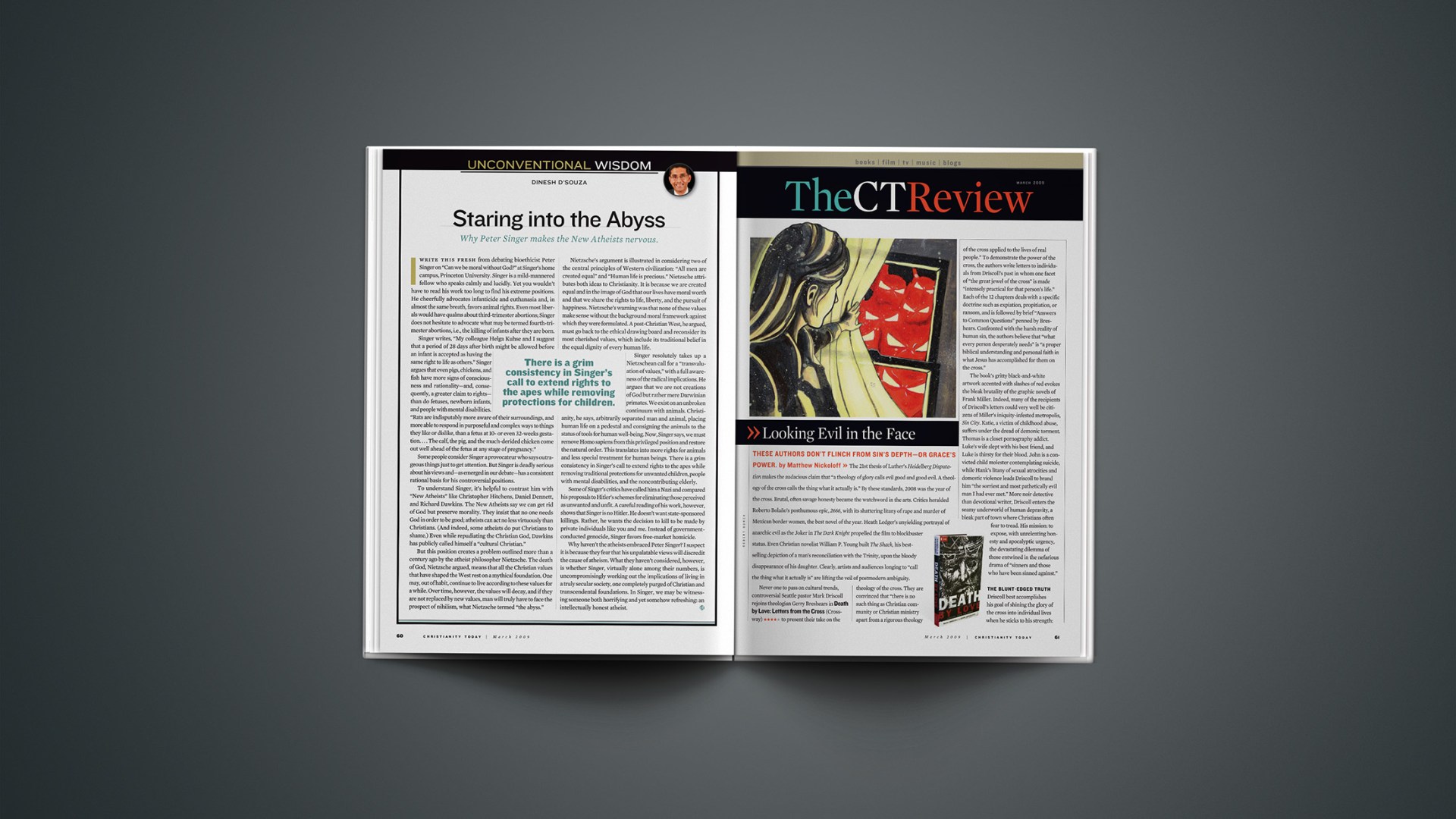
Never one to pass on cultural trends, controversial Seattle pastor Mark Driscoll rejoins theologian Gerry Breshears in Death by Love: Letters from the Cross (Crossway) to present their take on the theology of the cross. They are convinced that “there is no such thing as Christian community or Christian ministry apart from a rigorous theology of the cross applied to the lives of real people.” To demonstrate the power of the cross, the authors write letters to individuals from Driscoll’s past in whom one facet of “the great jewel of the cross” is made “intensely practical for that person’s life.” Each of the 12 chapters deals with a specific doctrine such as expiation, propitiation, or ransom, and is followed by brief “Answers to Common Questions” penned by Breshears. Confronted with the harsh reality of human sin, the authors believe that “what every person desperately needs” is “a proper biblical understanding and personal faith in what Jesus has accomplished for them on the cross.”
The book’s gritty black-and-white artwork accented with slashes of red evokes the bleak brutality of the graphic novels of Frank Miller. Indeed, many of the recipients of Driscoll’s letters could very well be citizens of Miller’s iniquity-infested metropolis, Sin City. Katie, a victim of childhood abuse, suffers under the dread of demonic torment. Thomas is a closet pornography addict. Luke’s wife slept with his best friend, and Luke is thirsty for their blood. John is a convicted child molester contemplating suicide, while Hank’s litany of sexual atrocities and domestic violence leads Driscoll to brand him “the sorriest and most pathetically evil man I had ever met.” More noir detective than devotional writer, Driscoll enters the seamy underworld of human depravity, a bleak part of town where Christians often fear to tread. His mission: to expose, with unrelenting honesty and apocalyptic urgency, the devastating dilemma of those entwined in the nefarious drama of “sinners and those who have been sinned against.”
The Blunt-Edged Truth
Driscoll best accomplishes his goal of shining the glory of the cross into individual lives when he sticks to his strength: storytelling. In helping Katie combat feelings of abandonment by her negligent father, Driscoll adapts the warfare imagery of the battle between Jesus and the Dragon in Revelation to illustrate the doctrine of Christus Victor. The drama ends in Katie’s liberation by Jesus, who stands over the fallen body of Satan with Driscoll proclaiming, “You were finally known. You were finally loved. You were finally safe.” For Mary, a victim of rape, Driscoll shares the tale of a man who bought his adulterous wife a new white robe; he urges her to remember Christ as her expiation each time she washes, bathes, and wears white. And he commends Luke’s righteous anger at his wife’s adultery as an image of God’s justice, yet urges him to remember the forgiveness bought with Jesus’ new covenant sacrifice.
Even amid such moments of tenderness, Driscoll can be shockingly brutal in confronting sin. After warning Thomas that “this letter will be painfully pointed,” Driscoll proceeds to “launch into a series of heavy blows of truth,” confronting him about the devastating effect his addiction to porn is having on his family. In another letter, Driscoll tells David, a self-righteous, negligent father, “You are a very religious man, but I’m not sure you are a Christian.” Countering the propensity of the church to overemphasize God’s love, Driscoll shoots from the hip out of the conviction that “God feels angry because God hates sin.” For Driscoll, “the blunt-edged truth is that God both loves and hates some sinners.” In one of the book’s more bizarre moments, Driscoll offers a letter to his 1-year-old son, Gideon, telling him that “if you were ever to promote false doctrines, I would also vigorously oppose you with tears of grief.”
Driscoll draws sharp lines. While some will find this disconcerting, it is rare to find someone willing to follow his beliefs to their logical conclusion. It is perhaps only in light of this consistency that his final words to Thomas have such power: “You are more evil than you have ever feared, and more loved than you have ever hoped.”
Yet Driscoll’s infamous candidness is a double-edged sword that too often cuts at the integrity of his important message. Immersing himself in the drama of sin, he often shares his own redemption story with his addressee. These confessions occasionally temper his harshness, but more often come off as self-righteous, comparative, and condemning. They also reflect Driscoll’s obsession with sordid details, implying that not even the healer is immune to the temptations of curiosity. (For instance, he shares with Katie that “the thought of you being in your bedroom naked with a boy while your father knocks on the door without stepping in to liberate you haunts me.”) Driscoll is clearly no choir boy, and like another Seattle native, Kurt Cobain, prefers grunge and grit to glam and gaiety. But when he compares the symbol of the cross to “a junkie’s needle or a pervert’s used condom,” one suspects that this theology of the cross has surpassed reasonable limits.
Still, and sometimes in spite of himself, Driscoll offers an important example of a church leader willing to “call a thing what it is.” As a seminarian at a mainline institution, I have recommended Death by Love to several colleagues. It creatively employs doctrine to confront the deadly reality of sin we so often try to explain away. Sadly, Driscoll and Breshears too often become mired in relentless proof-texting, cheap shots against “flaccid church guys,” and obsessive branding of non-Reformed theologians as heretics. Yet even so, they bravely follow Christ in his descent to hell to preach to those who are held captive by sin and death. Despite their faults, the authors take their stand at the foot of the cross as witnesses to the power of the gospel in a dark, despairing world.
More and more Christians can count on their fingers the number of times they have heard a pastor address tough issues like pornography, adultery, rape, domestic violence, and the wrath of God. To those of us entangled in therapeutic ambiguity, here is an imperfect yet compelling example of what it means to risk being a theologian of the cross today.
Matthew Nickoloff, an M.Div. student at Duke Divinity School
Copyright © 2009 Christianity Today. Click for reprint information.
Related Elsewhere:
Death by Love: Letters from the Cross is available at ChristianBook.com and other book retailers.
Collin Hansen also wrote about Death by Love for Theology in the News. Hansen also wrote a profile on Mark Driscoll for CT.