



Protestant churches at the turn of the century asked themselves, How can we continue to build lavish buildings when there are people in need and missionaries to support? Like the rising modernists, they argued that ornamentation was frivolous and costly, and that they could do much more with much less. However, few churches saw modernism as a solution to their concerns, and they abandoned innovative design.
If churches then had seen what they had in common with modernism, they could have allied their sense of responsibility with cutting-edge design. Instead, churches, which were the architectural focal points of early American settlements, left the conversation of progressive architecture. But in the past few years, missions-minded Protestant churches have begun to rediscover architecture.
The following churches decided that their buildings were an important part of their ministry, not merely afterthoughts. And while many churches are moving toward traditional design, these churches believe there is still something to be said for a contemporary approach. They believe that buildings can express the values of congregations, bringing new meaning to the act of stewardship in architecture.
First Presbyterian Church
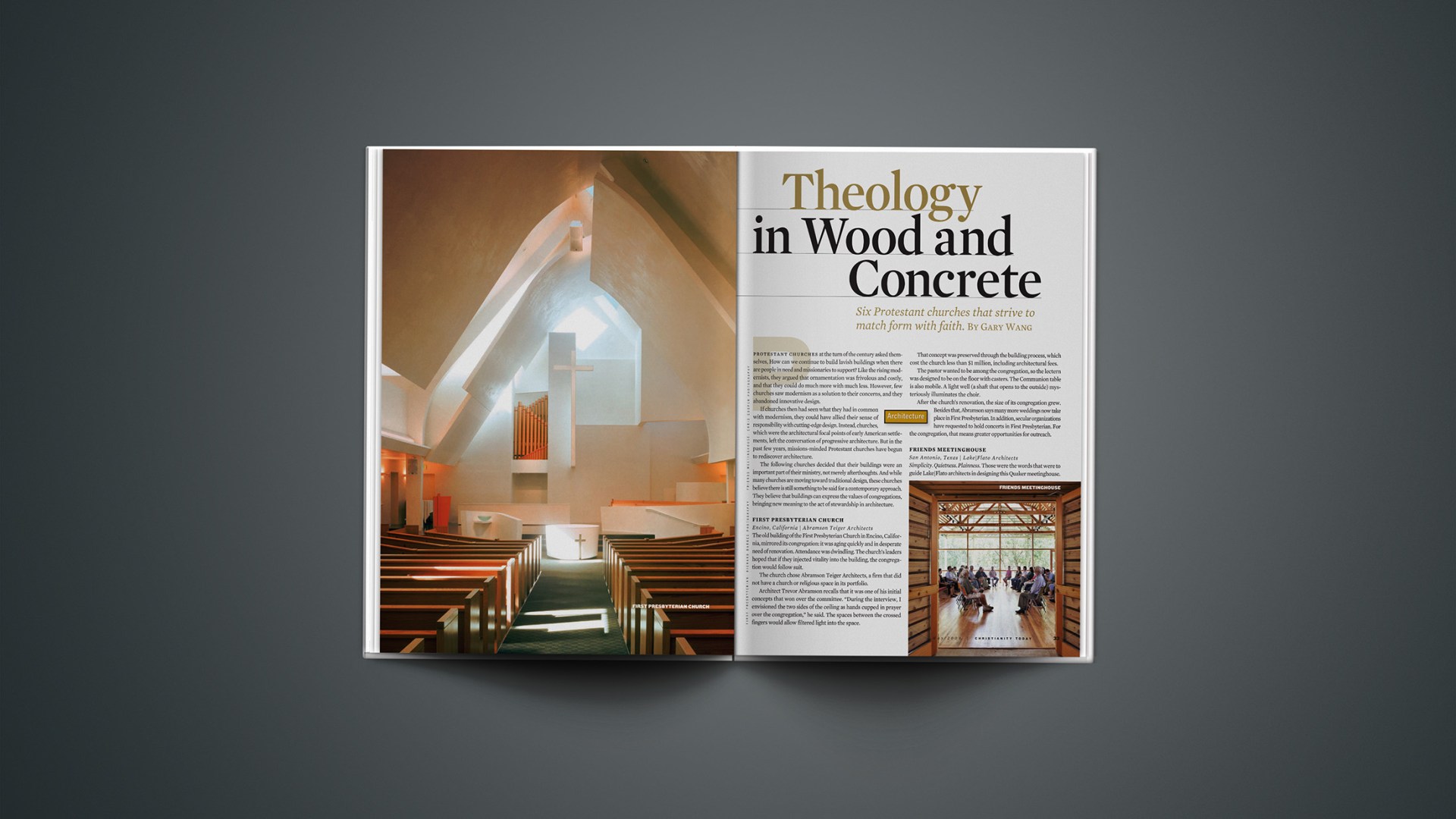
Encino, California | Abramson Teiger ArchitectsThe old building of the First Presbyterian Church in Encino, California, mirrored its congregation: it was aging quickly and in desperate need of renovation. Attendance was dwindling. The church’s leaders hoped that if they injected vitality into the building, the congregation would follow suit.
The church chose Abramson Teiger Architects, a firm that did not have a church or religious space in its portfolio.
Architect Trevor Abramson recalls that it was one of his initial concepts that won over the committee. “During the interview, I envisioned the two sides of the ceiling as hands cupped in prayer over the congregation,” he said. The spaces between the crossed fingers would allow filtered light into the space.
That concept was preserved through the building process, which cost the church less than $1 million, including architectural fees.
The pastor wanted to be among the congregation, so the lectern was designed to be on the floor with casters. The Communion table is also mobile. A light well (a shaft that opens to the outside) mysteriously illuminates the choir.
After the church’s renovation, the size of its congregation grew. Besides that, Abramson says many more weddings now take place in First Presbyterian. In addition, secular organizations have requested to hold concerts in First Presbyterian. For the congregation, that means greater opportunities for outreach.
Friends Meetinghouse
San Antonio, Texas | Lake| Flato ArchitectsSimplicity. Quietness. Plainness. Those were the words that were to guide Lake|Flato architects in designing this Quaker meetinghouse. Before a new space was built, the San Antonio Friends owned what they thought was the perfect site, a beautiful piece of land ideal for contemplation. After negotiating with the church, architect Bob Harris began site analyses and preliminary proposals.
The few people living next door protested the project. Out of respect for their neighbors, the Friends decided to move elsewhere. They eventually chose a site far from perfect. It was semi-urban and faced a beauty salon and a drainage ditch.
Harris flattened the sloping land and created a plateau to look out over the drainage ditch. The Friends planted trees and greenery between the ditch and the church—a sanctuary for birds and wildlife amid busy streets.
On the plateau is the main gathering space that Harris designed for quiet contemplation. Rustic and unadorned, it displays an authentic expression of natural materials in the tradition of early Quakers. But, as Harris says, the Quakers’ taste for plainness isn’t nostalgia or a rejection of contemporary design. “They do not want architecture to take on a meaning of its own, but to be simple, beautiful, and background,” he says.
The San Antonio Friends say that construction cost less than a one-bedroom condominium in many major cities. Lake|Flato showed that good design does not necessarily mean expensive design, even when hiring a nationally recognized firm.
Korean Church of Boston
Boston, Massachusetts | Brian Healy ArchitectsThe Korean Church of Boston (KCB) was founded in 1953 as the first Korean church in New England. To celebrate its 50th anniversary, KCB launched an unusual fundraising campaign: to create a children’s chapel and community center.
Architect Brian Healy divided the building into sacred and secular spaces. The chapel—a sacred component—is tucked behind the sanctuary and faces a residential community. The community center’s coffee shop, a secular component that is a vehicle for outreach, faces a busy Boston street. KCB also offers language programs and other cultural events.
The jewel of the new building is the children’s center. Skylights dance playfully across the ceiling. Seating is less rigid and formal than in KCB’s former chapel, allowing children to walk, stand, or sit on benches all around the stage. Negative space creates the cross at the front, which is a reference to architect Tadao Ando’s celebrated Church of the Light in Osaka, Japan.
Healy says KCB wants its children to have a different kind of church experience, one that engages the world right outside.
Churches and community centers
Bolivia and Honduras | Jae Cha, Light Inc.Jae Cha has the mind of an artist, the heart of a missionary, and the spirit of a nomad. Although architects are typically rooted in one place, Cha says she goes to wherever the Spirit calls her, spreading the Good News. Her design firm, Light Inc., is based in Washington, D.C., but her work has been produced in Latin America and Africa. Unlike most global architectural firms, Light Inc. is a nonprofit.
Cha’s church buildings break away from the old church archetype. Traditional churches are usually cruciform or rectangular and often have a tower to show authority. Cha believes that the body of Christ is nonhierarchical, and that therefore the church building should not be either.
Cha’s churches show Christ as the center of community. It is the spirit of the community rather than the building that reaches up to the heavens. Thus, her buildings are always bold, symmetrical shapes, and flat on top. Her church in Bolivia is a circle within a circle; the Honduran church is two layers of squares. These layers let in natural light and allow the congregation—and fresh air—to move freely in and out.
Cha says her architectural inspiration comes in part from studying fashion. The sheathing of the building is like an evenly draped fabric on skin, covering the body of Christ.
Antioch Baptist Church
Perry County, Alabama | Rural Studio, Auburn UniversityThe late architect Sam Mockbee believed that only a fraction of Americans live and work in well-designed buildings. Reasoning that everyone deserves thoughtful design and that architects should be available to serve more than just the wealthy, he made Hale County—a poor, rural area in western Alabama—a case study for social justice through architecture. As a first step, Mockbee and colleague D. K. Ruth founded the Rural Studio program at Auburn University in 1993.
The Rural Studio spent years designing and building contemporary, practical solutions for the local community in Alabama, having architecture students design and construct projects as one-year thesis studies.
Antioch Baptist Church approached Rural Studio. When its leaders came to dream about their new building, says architect Jared Fulton, “The congregation didn’t want any old church … these people said over and over that they wanted the Cadillac of churches!”
Fulton was one of four students on this project, and he made a new building for Antioch Baptist his thesis. Many in the black, rural congregation were skeptical that a few students would be capable of demolishing, designing, and constructing their church building within one year.
The Rural Studio’s plan called for the existing building to be carefully disassembled so that approximately 80 percent of the materials could be reused for the new structure. The church raised about $10,000. The Rural Studio donated the most expensive components of the building process, design fees, and labor.
The final plan alluded to Cadillacs, but incorporated a spiritual metaphor much more strongly: Antioch Baptist’s concrete walls, which represent death, flank the church cemetery. As members emerge from the concrete baptistery, they cross over the threshold into a sanctuary clad in wood, which represents life.
The Greater Boston Vineyard
Cambridge, Massachusetts | CBT ArchitectsOur Lady of Pity Church was designed by Charles Greco and dedicated in 1923 as a French Catholic church in Cambridge. It operated until the late ’90s, when the Archdiocese of Boston closed it due to financial hardship.
The building now has a new life as the home of a Vineyard church. The Greater Boston Vineyard is one of a number of new Protestant congregations that have re-inhabited and renewed discarded Catholic buildings.
When church leaders bought the building, they knew there was a problem. Lead pastor Dave Schmeltzer says that while the church’s aesthetics did not conflict with the Vineyard’s mission, its building plan did. The doors of the original church’s sanctuary opened directly outside. “You went to service,” Schmeltzer says, “and when service was over, it shooed you away, out to the street.”
To alleviate this problem, the Vineyard hired CBT Architects in Boston. Although CBT typically does large-scale corporate work, two of its employees, Glenn Knowles and Chris Brown, were active in the Vineyard congregation and local church community.
The architects flipped the church’s orientation 180 degrees: The new entrance is where the old sanctuary’s sacristy and preparation space once were. The entry now leads into a lobby with a soaring and ornate dome, which was once the apse. A large glass wall where the altar had been now separates the lobby from the sanctuary.
Although the building’s glass wall is elegant, the most striking additions to the building are the acoustic clouds suspended from the ceiling. Whereas the previous congregation had only organ and vocals, the Vineyard uses multimedia projection, video, and performance-style worship music.
Gary Wang is a senior designer at Machado and Silvetti in Boston. His work can be seen at WangArchitects.com.
Copyright © 2009 Christianity Today. Click for reprint information.
Related Elsewhere:
This article was published today with “Keeping Holy Ground Holy.”
Our sister publication Your Church offers several articles on architecture, including:
The Master’s Plan | Laying the groundwork for God’s vision of your ministry space. (May/June 2008)
iChurch | What if Steve Jobs designed your next ministry space? (May/June 2008)
Your Building Code | Currently accepted ideas about design and construction are not always best for growing churches. (March/April 2007)