



We all have been there before: We walk out of the movie theater with a sense of elation and challenge. Could our life change to reflect something of the life that was just portrayed?
We’ve all been here too: We are reading up on John Wesley and learn of his accomplishments: 250,000 miles traveled on horseback, 30,000 pounds sterling given away to the poor, more than 40,000 sermons preached. And we are not only flabbergasted but deflated: Why have we been unwilling to make such extreme sacrifices of our time and comfort? How can we ever hope to measure up to such a giant?
Perhaps we’ve been here as well: Reading about an outstanding figure in our own field of work or ministry, we begin to think prideful thoughts: I could do what she’s done! I could even surpass her! And then they’ll be writing my biography!
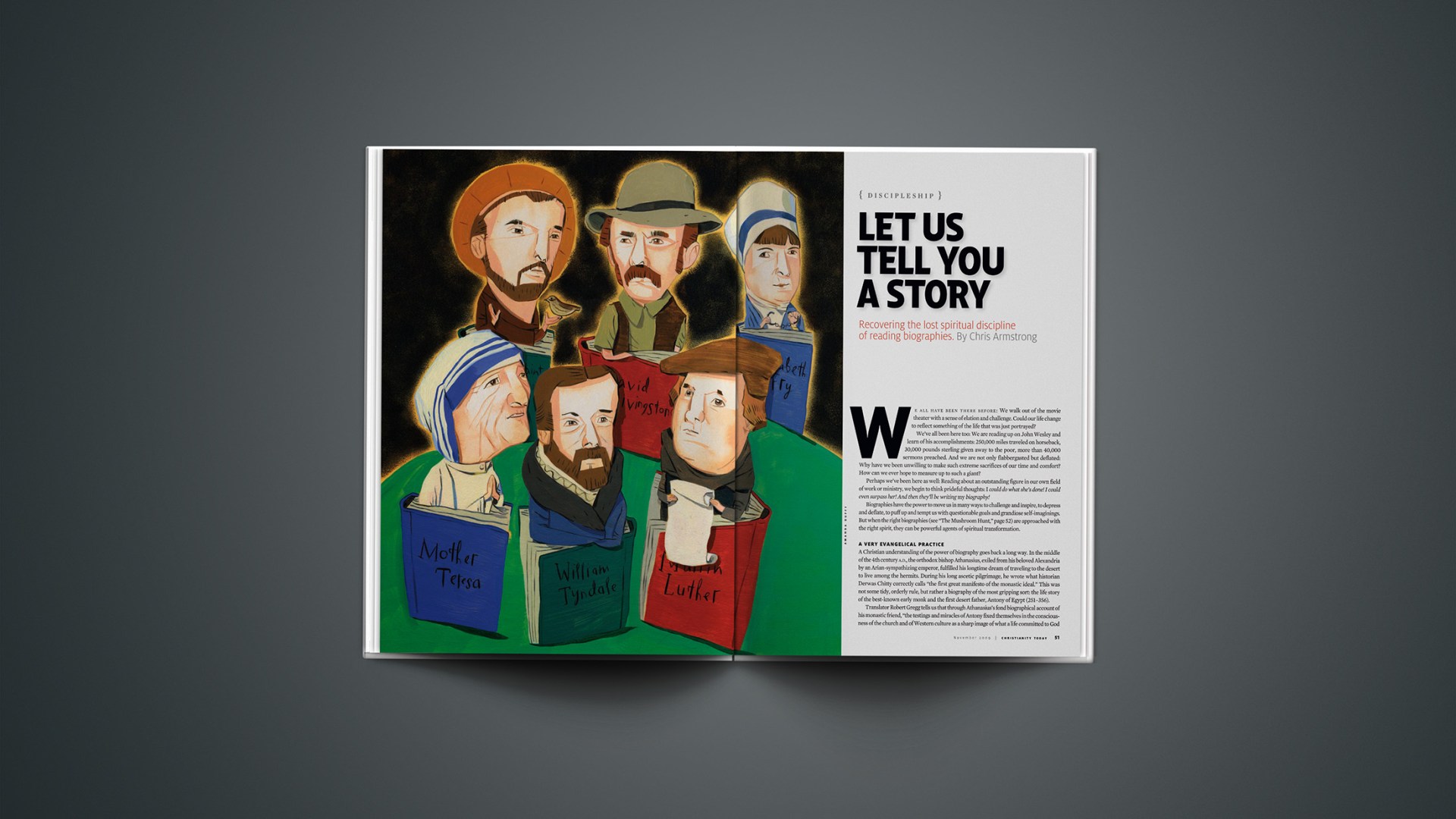
Biographies have the power to move us in many ways: to challenge and inspire, to depress and deflate, to puff up and tempt us with questionable goals and grandiose self-imaginings. But when the right biographies (see “The Mushroom Hunt,” page 52) are approached with the right spirit, they can be powerful agents of spiritual transformation.
A Very Evangelical Practice
A Christian understanding of the power of biography goes back a long way. In the middle of the 4th century A.D., the orthodox bishop Athanasius, exiled from his beloved Alexandria by an Arian-sympathizing emperor, fulfilled his longtime dream of traveling to the desert to live among the hermits. During his long ascetic pilgrimage, he wrote what historian Derwas Chitty correctly calls “the first great manifesto of the monastic ideal.” This was not some tidy, orderly rule, but rather a biography of the most gripping sort: the life story of the best-known early monk and the first desert father, Antony of Egypt (251-356).
Translator Robert Gregg tells us that through Athanasius’s fond biographical account of his monastic friend, “the testings and miracles of Antony fixed themselves in the consciousness of the church and of Western culture as a sharp image of what a life committed to God demands and promises.” The Egyptian monk’s life set the pattern for all subsequent saints’ lives and became the touchstone for monastic foundations and monastic reforms since.
One person transformed by Antony’s life story was eminent Western theologian Augustine of Hippo. Today we remember the part of Augustine’s conversion story when he goes out to a garden, hears a child’s voice repeating the phrase “take up and read,” and picks up a Bible and reads a passage from Romans, which brings him to Christ. But what really set Augustine’s heart on fire? What drove him out to the garden in the first place, frantic with shame and grief and desperate to find peace in God? It was hearing a friend tell of how two soldiers had committed their lives to Christ after reading Athanasius’s Life of Antony. Such is the power of biography.
In the modern era, John Wesley’s early Methodists, the Wesleyan holiness folk, and Pentecostals and charismatics share a particularly intense emphasis on “giving one’s testimony.” What is the purpose of standing in a church meeting or small group to relate one’s testimony? Not to present a moral example—as if the testifier were a spiritual athlete to be applauded and imitated—but rather, to testify to God’s amazing grace. This is the emphasis of the traditional title for the Book of Acts: “the Acts of the Holy Spirit.”
As evangelicals of all stripes believe, hearing someone’s spiritual narrative can give the Holy Spirit an opening to direct our affections—our thoughts, feelings, and will—toward holy things. It can imbue in us a new resolve—not the moralistic resolve to pull ourselves up by our own bootstraps, but the spiritual resolve of compunction or “piercing of the heart,” which Peter’s hearers experienced in Acts 2:37 (“When the people heard this, they were cut to the heart and said to Peter and the other apostles, ‘Brothers, what shall we do?’ “). Hearing a fellow believer’s testimony can redouble our yearning for God, our taste for prayer, and our resonance with God’s holiness. It can set our hearts in an upward trajectory toward a gracious Father.
And what is a believer’s biography but an elaboration of his or her testimony? Long before Oprah’s testimony-meeting-style tv show and biography-laden book club, evangelicals recognized the power of biography. (I would argue, in fact, that Oprah’s formats wouldn’t succeed nearly as well as they do if it weren’t for evangelicalism’s influence on American culture.)
How to Read a Biography
As noted above, biographies do not automatically lead to virtue, and can in fact move us in the reverse direction. So how do we read them rightly? With the same spirit of humility and openness that becomes us when we meet people face to face.
Note what happens when you read biography from a stance of humility: You do not become discouraged upon learning that the subject has accomplished astounding things. Sure, Wesley was a ministry whirlwind. But he was gifted in a particular way, for his own time and for God’s own purposes. Your time and place are different; God, therefore, has gifted you differently.
Also, you are not inclined to envy Wesley, because humility has taught you, as it did Paul, to be content in whatever situation you face. Finally, you remember that Wesley had his flaws and difficulties: he tended to be autocratic, for example, and did not have a happy marriage. You wisely decide that you will not jump to desire others’ gifts, since every strength comes with its own obverse weakness, and since with great responsibility, so often, comes great difficulty.
And look at what happens if you read with spiritual openness: When you discover the subject’s struggles and character flaws, you are reminded that, no matter how many flaws and faults you see in your own makeup, you too can be changed by grace and used for greatness in the kingdom. The kind of life you live is not the only kind. There is a luminous possibility for you, something beyond life as usual.
Even better, you don’t have to be pure as the driven snow to attain this life. Your current condition, with its all-too-obvious blemishes, will not prevent our loving God from moving you deeper and higher in his purposes. Since “nothing is too difficult for him”—he makes camels go through needles and rich men enter the kingdom of heaven—you can be used by God in wonderful ways, even in ways as exciting as some of the ones you are reading about.
A Spiritual Exercise
I cannot tell you how much you might grow from reading biography. For me, encountering the 6th-century pope Gregory the Great—one who struggled to continue his monastic devotions when administrative work swamped him—helped to steer me through similar (but much smaller) struggles as a busy seminary professor. And discovering that Dorothy Sayers, the brilliant 20th-century religious playwright, essayist, and Dante translator, fell into sexual sin, kept a resulting illegitimate child from public view, and enjoyed her food and wine a bit too much—well, this encouraged me. None of these flaws kept God from using Sayers to write beautiful, edifying things that inspired thousands. Maybe God can use my imperfect life and pen, too.
Of this I am convinced: Biographical narratives have power. They carry the potential to bring deep transformation. But today, we have lost some of our forebears’ sense of the power of life stories. I think this began happening at the beginning of the 20th century.
The Victorians were passionately in love with stories, in the form of novel, history, and biography. But the dawn of the past century brought the values of efficiency, objectivity, and tough-mindedness to the forefront of American culture. Reading novels and biographies suddenly seemed marginal in a technocratic age of rugged individualism. Stories were ghettoized to the realm of entertainment: you could still read biographies, but more as a genteel amusement than a spiritual exercise.
I hope a change is coming, and that Christians, at least, will lead the way in recapturing the power of biography. To be sure, the genre has its characteristic pitfalls. But Christians through the ages have known its power, and we need to rediscover it in this challenging day.
Chris Armstrong is associate professor of church history at Bethel Seminary in St. Paul, Minnesota, and author most recently of Patron Saints for Postmoderns: Ten from the Past Who Speak to Our Future (InterVarsity Press).
Copyright © 2009 Christianity Today. Click for reprint information.
Related Elsewhere:
Christianity Today also posted a story today on how to find a good biography.
The books referred to in this piece are available from ChristianBook.com and other book retailers: Life of Antony and Patron Saints for Postmoderns: Ten from the Past Who Speak to Our Future.
Previous Christianity Today articles on spiritual discipline and biographies include:
Man of His Time for All Times | W. Robert Godfrey paints popular portrait of Calvin as pilgrim and pastor. (May 18, 2009)
Spiritual Formation Agenda | Three priorities for the next 30 years. (February 4, 2009)
Out of Africa | Thomas Oden reminds us of classical Christianity’s debt to Africa in How Africa Shaped the Christian Mind. (February 29, 2008)
Previous articles by Chris Armstrong for CT include:
The Future Lies in the Past | Why evangelicals are connecting with the early church as they move into the 21st century. (February 8, 2008)
Sharing Stories from the Heart | The lessons of history are fair game for use today. (December 9, 2005)
Christian History Corner: The Bible Alone? Not for John Calvin! | When we seek answers to churchly and societal issues in the Bible alone, citing the Reformation principle of sola scriptura, we are actually contradicting the Reformers. (October 1, 2004)