A few years ago, an African-American friend and I were discussing a popular black pastor whose doctrine of the Trinity just wasn’t orthodox. My colleague thought Christianity Today should give the man a pass. After all, he was doing good ministry and the fine points of the Trinity were just more of that dead-white-European-male baggage.
I hadn’t thought of it before that moment, but suddenly I had a flash: Athanasius, the architect of Trinitarian orthodoxy, was African, not European. (So, of course, was Arius, the heretic who drove Athanasius to distraction.)
I took the opportunity to remind my colleague that orthodoxy arose out of the African context.
Indeed, many of the shapers of Christian orthodoxy were African. Names like Augustine, Tertullian, Origen, Clement, Anthony, and Pachomius were familiar from my undergraduate church-history survey. But my professor had not presented them as Africans ministering and teaching in the context of an African culture.
That common omission is what theologian Thomas C. Oden wants to address with the Early African Christianity Project as well as with his book, How Africa Shaped the Christian Mind (IVP, 2007).
The title of Oden’s book suggests a parallel to Tom Cahill’s How the Irish Saved Civilization. That’s unfortunate, because readers may expect Oden to play the raconteur in the Cahill manner. Instead, How Africa Shaped the Christian Mind is an outline and an agenda for research. (The agenda genre is classic forward-thinking Oden, who has devoted other books to outlining where theologians should be turning their attention.)
Classical African Christianity, claims Oden, has been ignored — or treated as something other than African. Augustine, Athanasius, Tertullian, and others have been treated as Europeans in disguise.
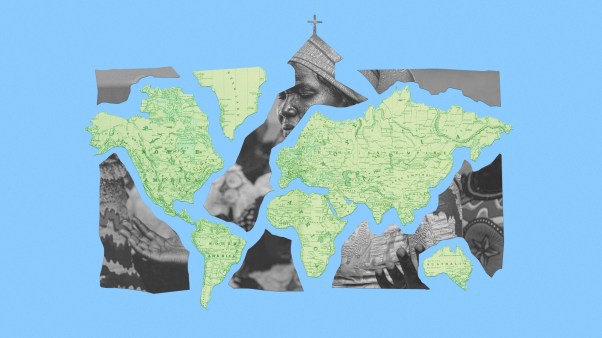
The story of Christian theology has been told from a European perspective. Oden wants to tell that story differently: classical Christian theology was heavily shaped by Africans. The language we use to worship the Trinity, the received definitions of the Christ’s two natures, the early church’s methods for restoring repentant sinners, the basic patterns of monastic life, our fundamental approach to biblical interpretation, the church’s devotion to its martyrs — all of these things have their roots in African theological debate, African prayer, and African biblical study.
The movement was from south to north. Concepts hatched in Alexandria or Carthage were appropriated in Constantinople, Rome, or Milan. Eventually, Arab Islamic expansion across north Africa drove many Christians from their native soil. The result is that some of what Cahill’s Irish monks preserved was in fact African. Writes Oden:
There is little doubt that Irish Christianity sustained strong African and monastic motifs in its piety, hagiography and temperament. This can be seen visually in its crosses, funerary objects, décor, calendars and art forms, as well as literarily in poetry, song and preaching.
Oden theorizes that as the scholarly monks who followed the rules of Pachomius and Augustine were driven out of Africa by the Vandal and Arab invasions, they migrated to Sicily and the little island of Lérins off the coast of France. From there came the influences that shaped Irish monasticism. That monasticism, as Cahill tells the story, eventually shaped European Christianity, which in turn sent missionaries back to Africa.
But even before the seventh-century Muslim conquest, the influence flowed from south to north. Not only theologians like Athanasius, but influential rhetors (the Greek term for professional orators) like Augustine and Tertullian brought distinctly African patterns of argument to Rome. Throughout this book, Oden asserts the significance of the African context for the contributions of these key figures. Then he repeatedly appeals to African scholars to document and analyze the material in its African context.
Those repeated appeals may grow tiresome for the general reader, but Oden’s focused audience is African scholars who need to take up the outlines of his agenda, document the broad strokes with all the historical detail, and above all, demonstrate just how socially and culturally African our orthodoxy is.
Why is Oden so urgent? Part of his motivation fits broadly into his program to redeem theology from liberalism. It was northern European liberalism (Adolf von Harnack is the chief villain in Oden’s narrative) that dismissed the significance of the African context and tried to label many ideas of classical Christianity as Greek philosophy, alien to biblical thought.
But the urgency derives even more from the current sub-Saharan struggle between Christianity and Islam. As Oden writes:
The rising charismatic and Pentecostal energies in Africa are stronger emotively than intellectually. They may not sufficiently sustain African Christians through the Islamic challenge unless fortified by rigorous apologetics.
That rigorous apologetic can clearly come from Africa’s own history, but only if African theologians reclaim the history of Africa’s north for the entire continent. That reclamation is at the heart of Oden’s agenda.
Copyright © 2008 Christianity Today. Click for reprint information.
Related Elsewhere:
This review originally appeared on David Neff’s Ancient Evangelical Future blog.
For a special treat, see the literary timeline of early African Christianity included among the appendices of How Africa Shaped the Christian Mind. A similar feature can be found on the Center for Early African Christianity website.