Steven Curtis Chapman opens up about losing his daughter, their family's arduous journey, and a new album of songs chronicling the path of pain and hope.
It's been a year and a half since Steven Curtis Chapman lost his youngest daughter, 5-year-old Maria Sue, to a tragic accident at the family's Tennessee home. Maria's death rocked her father's world, causing Steven and his wife, Mary Beth, to question God and their faith, while also clinging to the hope of things to come. The grieving process brought Steven, like King David, to his knees, simultaneously shouting at God while also desperately grasping for hope. Chapman journaled the journey, which he likens to penning his own Psalms—and not surprisingly, many of them turned into songs, and now his first album since Maria's passing, Beauty Will Rise.
Chapman spoke with CT about losing his daughter, the "black hole" of pain and despair, and the glimmers of life they've clung to through the last 18 months—including the opening of Maria's Big House of Hope, a healing home in China for special needs children. The Chapmans had already adopted two Chinese girls before Maria, so returning to China over the summer to open Maria's Big House was a bittersweet time to both mourn Maria yet again, but to celebrate her life and legacy.
I don't think I've ever encountered a piece of art where hope and pain are so beautifully intertwined. You've said it didn't feel so much like making a record, as you were just being David recording your personal psalms.
Yeah, I was hiding out in the valley of the shadow of death, just crying out to God. Man, I've never been so thankful for the Psalms. I'm not sure I really even got the Psalms until I walked through this. Obviously the Psalms were a great comfort before walking through the valley, but all of a sudden, I'm just so thankful for God's honesty to us, to allow us to look into the heart of a schizophrenic worshiper like David, because that's what I've found myself to be. To go in the same breath, How long, O Lord. Where are you, God? Are you doing anything about this? Do you even hear me? to But I'll trust you. Your love is better than life. I worship you. I praise you. How can you do that? But I have, and my family has.
I almost get this image of David beating on his chest when he's saying, "Why are you so downcast within me?" He's thinking, Heart, come on. Get with it. You know what's true. Hope in God. It's like that for me, where my heart and mind are going into this dark abyss. But then I say, Wait a minute. Come back. Come back to your senses. For me, that's where these songs came from.
What else was non-typical about making this album?
I ignored every rule that I've ever had for myself for making records. I've always been a rule follower. Even when I was a kid, I tried to do everything by the book. Over the years writing songs, I've developed some rules—always thinking of the listener and always putting myself on their side of the speakers and going, Okay, my job is to try and put this thought in a way that they're going to be able to grab hold of and stick in their own pocket in their own life, in their own heart and experience.
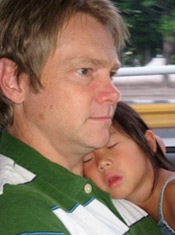
Chapman and Maria, shortly after her adoption
I've done it so long, these things just come automatically. But here, I ignored the rules. This wasn't me writing songs. This was me just screaming and crying out to God. Nobody heard these songs, not even my wife till most of them were recorded. No record guys. No managers. I am prone to reshape and refashion things to try and please as many people as I can, to get as many nods or smiles out of as many people as possible. But this was such a completely different thing. It was important that it's coming straight out of my gut and out of my heart. That was a strange, scary process, but it was important that whatever it is—good, bad, ugly—it's true and it's real.
What reactions are you getting so far?
People have said the songs are almost at times unbearably hard to listen to, and yet they say, "I somehow they walk away with a sense of this incredible hope that obviously has sustained you guys through this." And I'm like, okay, glory to God on that.
Besides writing these songs, how else have you dealt with your pain?
I read a handful of really good, encouraging books. We received a lot of books from well-meaning folks, but grief is so unique. Our pain is as unique as our DNA, very specific the way you're going to work through this. But there were a handful of things that really grabbed my heart in a dark place and bring me back.
Jerry Sittser's book, A Grace Disguised, was very helpful. He went through an incredible loss of his own—his wife, daughter, and mother, all killed in an accident. He's professor of theology at Whitworth College, so he's got a deep theological understanding of death and hope and grief. But all that went out the window for him, and this is his real journey. I think it helped us because it was so painfully honest but also so incredibly hopeful.
How did you decide on the title, Beauty Will Rise?
We were in China last May when the earthquake hit [the 2008 Sichuan quake that killed 70,000], though we were sitting in the Shanghai airport when it happened, so we didn't feel it. But when we came home, we heard about all the devastation. And then two weeks later, our earthquake hit [when Maria was killed]. And that was a real connection for me, in a way, to pray. In a lot of ways it was one of the ways we survived. When I turned everything inward, with the pain, questions, and devastation in our own family, I felt like I was going to cave in. But when I could pray for other people, when I could say, God, these people are feeling the same thing. Please give them the comfort that we are finding in your promises and the fact that we're going to see our little girl again. We know that hope. These people don't; they're in a more desperate place than we are, because they don't know. Let us share that with them.
Article continues below
As I thought of that, I had this desire to go back to China—which we did this summer—to the earthquake zone and sing over these people the hope that has sustained us. I was connecting our day of loss and destruction to theirs and saying, You know, today the world went wrong. But out of this, if I really believe God's Word and God's promises, God will bring beauty out of these ashes. And this is our hope. This is our comfort. And as I wrote that song [the title track], it just captured the heart of what I would say in this album. That this is the promise, God. Beauty will rise out of this. I'm not going to pretend to know what that's going to look like. There's going to be a lot of it that we won't even see until heaven. But this is what I know to be true.
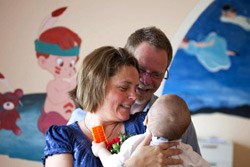
Steven and Mary Beth with a baby at Maria's Big House
One of the most tangible ways you've seen beauty rise is with Maria's Big House of Hope [a new healing home in China for special-needs kids, named for Maria]. I can't imagine how that makes you and Mary Beth feel, to see that facility as part of Maria's legacy.
Maria's Big House of Hope and Show Hope [the Chapmans' adoption aid agency], that's the tangible of all of that for us, because it represents so much pain and hope mixed together. When we walked through the doors of that place to do the grand opening, we stood there and just wept for the longest time, because there's some part of you going, I never wanted a Maria's Big House of Hope to exist. I want Maria here, and I want her at home in my home. So much of what makes it so profoundly special and important is the fact that it cost so much for it to have this impact. Even the impact it's having in China has been big. All these Chinese government officials came, and they know why it's named Maria's Big House. They know we've lost a daughter, and they know she's Chinese.
Article continues below
The next morning I'm walking down the streets of Luoyang, China, and they have these newspaper stands where you can read the daily paper. And every one of them, front and center, has the story of Maria's Big House of Hope and me standing there singing. They've got the whole story of why it is there, what it's doing, and even the lyrics to the song "Yours" that I sang at the opening—including the verse about how we've walked the valley of death's shadow, the verse I wrote after Maria went to heaven.
But yeah, Maria's Big House has been an incredible gift from God for us, a place that we've been able to pour our hearts into—a tangible thing that we get to see and touch and feel and taste that God is doing out of this.
The song "Faithful" includes the line "I am choosing to believe." That's a hard choice, especially when you're wondering where God is through this. Did you and Mary Beth ever shake your fists at God, or even consider turning your backs on him?
Gosh, how to do justice to the depth of that question. I could talk about it for two years and not even scratch the surface. But I'll refer again to the Psalms, specifically those where David is crying out, God, how long before you take away this pain, before you right these wrongs? And then almost in mid-despair, you get this sense of David literally making the choice, again, in saying to his own soul, Why are you so downcast within me? Remember this. Hope in God. Trust in God. This is your anchor. I've used that analogy, too, so many times—having this hope as an anchor.
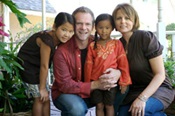
The Chapmans have two older adopted Chinese girls, Shaohannah and Stevey Joy
We've come to realize dropping that anchor has been, and will continue to be, a daily, sometimes an hourly, process. It's not a one time thing: I've dropped that anchor. It's, man, wait a minute, I'm getting blown away here by the hurricane of grief and questions and doubt. What am I going to do? Am I just going to drift out to sea? Or am I going to drop the anchor again?
We have absolutely questioned God and had our doubts and said, "Is this whole thing true? Is this real?" I sat on our tour bus last summer and called Scotty Smith, my pastor, after spending a very difficult night of wrestling with God. We were getting ready to go do an interview with People magazine or Larry King or somebody, and I was just in tears, calling my pastor and saying, "Is it really true? Is it really true? Can God be trusted?" I'm getting ready to drive this stake in the ground again with people and say it, but I really …
Article continues below
Ain't feeling it.
Right. Ain't feeling it at all. I'm just not sure. I needed to hear my pastor speak truth again to me. I needed to hear somebody say again, here's what's true.
That has been an important process, the whole thing of taking every thought captive and saying, God, this is what I choose to believe. Because I've found myself, especially in the first few days and weeks after Maria went to heaven—and there's still moments of this—that I could almost feel myself being sucked into this black hole of doubt and despair. Of saying, "God, if I let myself keep going in this direction, there seems to be no bottom, no end to this, and I'll never be able to escape from it."
At the hospital at Vanderbilt, literally within an hour of knowing that my little girl was in heaven with Jesus, I found myself having to make a choice, when I would start to feel myself and everything in me being sucked into this place, this abyss. I would begin to say, "Blessed be the name of the Lord. You give. You take away. But, God, I trust you. I trust you. You are faithful. You are good. I trust you. I trust you." And as I would say that, literally just choose to make that declaration in the midst of this, I would almost physically feel myself being pulled back from that place. And I'd start to breathe again.
But it wouldn't be long before I would go, "But, God, what? How could this happen? How are we ever going to survive?" And it's like here I go back into that black, dark place.
But there was a grace to even recognize that you were falling into that place.
Yes. That is the grace and the gift of God to be able, in that process, to make that choice. That's the crazy theology of all that—to even be able to make that choice to say, "God, I trust you," that is a gift of grace. But we're making that choice over and over again.
Read more about Steven Curtis Chapman at his official website, and about their adoption aid agency, Show Hope, here. Read more about Maria here.
The plan would organize UMC churches in four global regions, with each given more leeway around same-sex marriage and other theological issues.
Yonat Shimron – Religion News Service
Rising from the Valley of Death
1 of 3
Chapman and Maria, shortly after her adoptionSteven and Mary Beth with a baby at Maria's Big HouseThe Chapmans have two older adopted Chinese girls, Shaohannah and Stevey Joy












 While we pray for peace, we need moral clarity about this war.
 As my doubts about his teachings grew, so did a secret fascination with Jesus.
 The plan would organize UMC churches in four global regions, with each given more leeway around same-sex marriage and other theological issues.