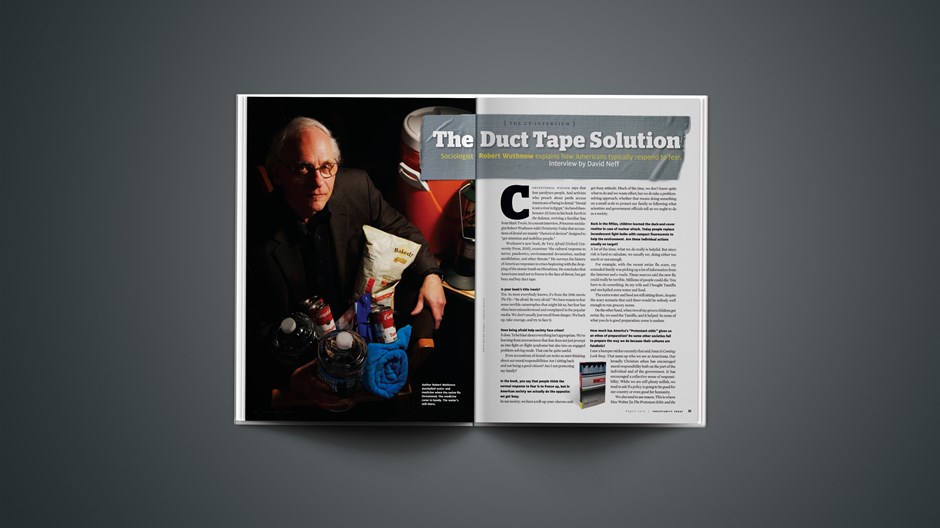
Conventional wisdom says that fear paralyzes people. And activists who preach about perils accuse Americans of being in denial. "Denial is not a river in Egypt," declared then-Senator Al Gore in his book Earth in the Balance, reviving a familiar line from Mark Twain. In a recent interview, Princeton sociologist Robert Wuthnow told Christianity Today that accusations of denial are mainly "rhetorical devices" designed to "get attention and mobilize people."
Wuthnow's new book, Be Very Afraid (Oxford University Press, 2010), examines "the cultural response to terror, pandemics, environmental devastation, nuclear annihilation, and other threats." He surveys the history of American responses to crises beginning with the dropping of the atomic bomb on Hiroshima. He concludes that Americans tend not to freeze in the face of threat, but get busy and buy duct tape.
Is your book's title ironic?
Yes. As most everybody knows, it's from the 1986 movie The Fly—"Be afraid. Be very afraid." We have reason to fear some terrible catastrophes that might hit us, but fear has often been misunderstood and overplayed in the popular media. We don't usually just recoil from danger. We buck up, take courage, and try to face it.
Does being afraid help society face crises?
It does. To be blasé about everything isn't appropriate. We're learning from neuroscience that fear does not just prompt us into fight-or-flight syndrome but also into an engaged problem-solving mode. That can be quite useful.
Even accusations of denial can make us start thinking about our moral responsibilities: Am I sitting back and not being a good citizen? Am I not protecting my family?
In the book, you say that people think the normal response to fear is to freeze up, but in American society we actually do the opposite: we get busy.
In our society, we have a roll-up-your-sleeves-and-get-busy attitude. Much of the time, we don't know quite what to do and we waste effort, but we do take a problem-solving approach, whether that means doing something on a small scale to protect our family or following what scientists and government officials tell us we ought to do as a society.
Back in the fifties, children learned the duck-and-cover routine in case of nuclear attack. Today people replace incandescent light bulbs with compact fluorescents to help the environment. Are these individual actions usually on target?
A lot of the time, what we do really is helpful. But since risk is hard to calculate, we usually err, doing either too much or not enough.
For example, with the recent swine flu scare, my extended family was picking up a lot of information from the Internet and e-mails. Those sources said the new flu could really be terrible. Millions of people could die. You have to do something. So my wife and I bought Tamiflu and stockpiled extra water and food.
The extra water and food are still sitting there, despite the scary scenario that said there would be nobody well enough to run grocery stores.
On the other hand, when two of my grown children got swine flu, we used the Tamiflu, and it helped. So some of what you do is good preparation; some is useless.
How much has America's "Protestant ethic" given us an ethos of preparation? Do some other societies fail to prepare the way we do because their cultures are fatalistic?
I saw a bumper sticker recently that said Jesus Is Coming: Look Busy. That sums up who we are as Americans. Our broadly Christian ethos has encouraged moral responsibility both on the part of the individual and of the government. It has encouraged a collective sense of responsibility. While we are still plenty selfish, we tend to ask if a policy is going to be good for our country or even good for humanity.
We also tend to use reason. This is where Max Weber [in The Protestant Ethic and the Spirit of Capitalism] was on target. We take a practical approach to issues. That's one reason we trust science as much as we do. And in comparison with some societies—especially those with a strong sense of evil spirits that need to be counteracted by ritual—we are more skeptical toward what we call superstition.
That also gets at a theological point. Looking at titles at the Library of Congress, within the past 25 years there have been over a thousand books with Armageddon or apocalypse in the title. So we could ask whether Americans by and large think about really scary potential catastrophes in terms of statements from the biblical apocalypse. Frankly, no. If you ask the right poll questions you might get 25 percent of the people saying they think the end of the world is coming soon. But in the meantime, they're going about their day-to-day business.
Article continues below
After 9/11 many Americans began to treat Islam itself, not just terrorists, as a major threat. How does our society's post-9/11 response to Islam compare to historic reactions to "foreign" religions?
The way in which it is similar is the theological concern, such as concerns Protestants had about Catholics trying to take over and not understanding the Bible the way Protestants do. Some of what you hear Christians saying about Muslims is similar to that. But as religious leaders talk and write more about the Abrahamic faiths, that is broadening the tent in the same way previous discussions between Protestants and Catholics and between Christians and Jews worked it out. But I think we're in for a long, difficult period of figuring out our relationship both as a nation and as Christians with Islam.
Does the Internet—and particularly social media—simply hand a megaphone to extremists, or is society actually becoming more fearful?
Well, the Internet does help to hand the megaphone to folk in odd ways. Somebody writes something outrageous on a blog, and the other side of the political spectrum talks about it on a television program, and so it gets amplified.
But the Internet also makes it a lot easier to organize people. If you live in New Jersey and you don't know anybody else in your town who feels the way you do, but you're upset and you feel you ought to go to Trenton and carry a banner in front of the state capitol, the Internet and social media make it pretty easy to find another hundred people in the state willing to get together and do that.
We're learning from neuroscience that fear does not just prompt us into fight-or-flight syndrome but also into an engaged problem-solving mode.
We get angry when government agencies like the CIA or the Food and Drug Administration miss a threat. To a lot of people it symbolizes the failure of big government. But doesn't it require fairly high-level authority to track and manage these threats?
Big government is a whipping post for a lot of the frustration that taxpayers feel when government seems to be getting bigger and not accomplishing as much.
But let's say you're running a church committee of three people. It's fairly easy to coordinate those three. If you have 30 people, it's a lot harder. And if you have 300 people, it gets even harder.
I grew up where there were maybe 50 people per square mile. You could get by with fairly limited government. I now live where there are 23 times as many people per square mile. It's just a lot more complicated. It's not surprising that a society with 300 million people has huge government overhead. Whether it's dealing with threats or with a lot of day-to-day business, it's a lot more complicated than the society of 75 million people we had a hundred years ago.
Article continues below
Churches are mediating institutions very close to the grassroots. Do they have a special calling to help people respond to a crisis?
They do, depending on the nature of the crisis. For instance, in terms of making sure that people have access to swine flu vaccines, in some communities the church may be one of the few available public buildings where that can happen. Or maybe they have an outreach program in a lower income community or among the elderly, or they have a van that can pick people up. The other way that churches play a very positive role is through the discussions they have. They can talk about the nature of a perceived threat and emergency preparedness. Increasingly we've seen churches talk about climate change, bringing in a speaker or a film and saying, "Let's talk about it." As a grassroots organization, the church has a positive role to play.
You write that the costs of crises fall disproportionately on the poor, as happened after Hurricane Katrina, for example, and the recent earthquake in Haiti. What is the role of churches in helping the poor in their communities meet crises?
One role churches have played is to bring justice language into the picture. It may be one thing to look out, as many middle-class people would, and say, "None of this affects me very much." Or if it's a health crisis, "I can find a doctor." But justice thinking focuses on, let's say, the fact that some people live in a Love Canal-type community or downstream from a copper mine and are suffering from health problems. They probably don't have the means to go up against a huge company with a lawsuit or even to go to Washington and make their claims known. That's where churches interested in promoting social justice really can play a role.
What is the role and responsibility of media to shape people's perception of threats, whether that's Islam, HIV/AIDS, or nuclear weapons?
I'll give you some encouraging news from a survey I did several years ago. We've looked at those data to see which Christians really care in an altruistic way about what's going on in other parts of the world, and which ones hold altruistic social policies. Whether they read religious periodicals is definitely a really important factor. Religious periodicals make a difference. Christianity Today and others are able to be out there quickly with information that is helpful to those who are facing something as sudden and unexpected as, say, 9/11.
Article continues below
For journalists, it's not like, "Oh, who do we talk to now?" They've been doing this for a while; they know who to talk to. That's helpful because there is so much nonsense out there, especially because of the blogosphere. The really valuable thing about respected religious journalism is you can usually trust it.



















 While we pray for peace, we need moral clarity about this war.
 As my doubts about his teachings grew, so did a secret fascination with Jesus.
 The government plans to close its porous border with Myanmar to boost security, separating ethnic groups that straddle the boundary.






