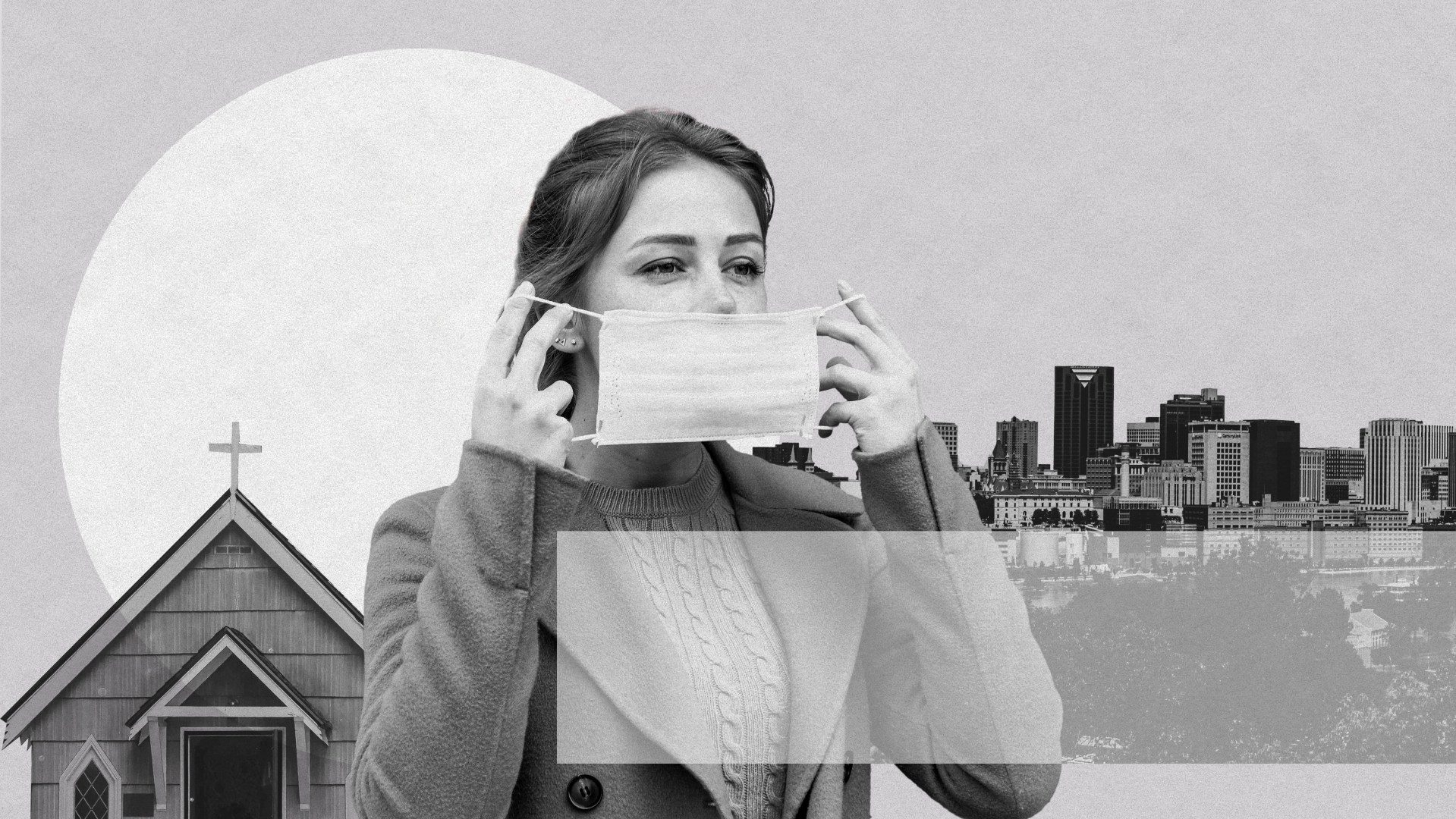
I can't decide which better reflects the current contradictions of American life: last week's media hype over the swine flu, or the media hype about the media hype.
Last week, we were treated to a plethora of headlines that seemed designed to scare the virus out of us:
- World Health Organization Raises Swine Flu Alert Level
- Asking for More Funding, U.S. Steps Up Flu Response
- Swine Flu Vaccine May Be Months Away, Experts Say
And these are from the reserved New York Times. Look at less responsible papers, and it seemed that the end times were at hand. But even in careful reporting, the event had a vocabulary that instilled anxiety—mutate, pandemic, H1N1, and "level 5"—all of which have an ominous feel.
These stories, in turn, raised a pandemic of responses. It wasn't a day or two into the week before media naysayers were condemning their own kind. By Tuesday of last week, Howard Kurtz of The Washington Post noted the "fever pitch" of coverage, and that "the sheer volume of media attention suggested a full-blown crisis." The point was made, less judiciously, by bloggers across the world.
I'm hardly the first to note the 24/7 news cycle that encourages the hyping of such stories, which prompts media-hype-critiques, which prompts what's-wrong-with-the-media articles—all of which prompt excitement and readership. It makes one wonder if in this we're not seeing a lot of informal but mutual back scratching between the media, pharmaceutical concerns, and government health service bureaucracies—all of whose "business models" thrive at such times.
So the first contradiction is this: It is democratic capitalism that has made 24/7 news possible, and it is 24/7 news that is making democratic capitalism a difficult thing to manage with wisdom. We've gotten to the point where the President of the United States has to spend chunks of his day just managing perceptions of his handling of the crises because, as a New York Times story put it, "political management of a crisis, and of public expectations, can be as important as the immediate response."
* * *
The media would not be tempted to overhype the swine flu if it didn't believe people were genuinely worried about it. But it's hard to understand why the swine flu elicited such fear. Even when we are told that flu viruses kill some 36,000 Americans annually, and that the swine flu has yet to kill five—well, it doesn't seem to calm us.
That may be because the "normal" flu tends to kill only infants and the elderly, while the swine flu can kill perfectly healthy people in the middle of life—people like us! While we pride ourselves on our compassion for the defenseless (i.e., infants and the elderly), this hints at another contradiction: We can live comfortably with the fact that viruses kill tens of thousands annually—as long as the victims are infants and elderly. We only panic when we hear that people like us are threatened, even if only a few dozen of us.
* * *
Christians believe that our faith helps us live bravely in the face of fear. Still, it is not easy to do so, and it's no surprise that among the people who irrationally panic in face of pandemics, many are Christians. But we do have resources that can help us to transcend fear and to experience a different type of contradiction.
In The Rise of Christianity , sociologist Rodney Stark describes those dark times in Roman history when city-wide epidemics wiped out whole sections of the population. The empire would do its best to quarantine sections of cities, and those remaining were abandoned to a slow and painful death. The only people willing to risk life to care for these suffering souls were Christians. Many of them flocked to the areas most infected and literally gave their lives to care for the dead and dying. This heroic example was one reason the empire took a second look at this outlandish sect.
Last I heard, some churches were creating preparedness plans in the case of a flu pandemic. One 3,000-word plan I read tended to focus on institutional survival. It encouraged churches to answer questions like: Will staff come into the office? How will the church communicate with members if public gatherings are forbidden by the government? If the church does meet for worship, how should members share in the bread and wine of the Lord's Supper? And so on.
It's all well and good, but I wonder if churches would be better served by asking its members to read Stark's account. That would be the most crucial form of preparedness, no? That would prompt us to start thinking about the discipleship choices that will face us in a real pandemic: Who should visit the sick and dying, and who should not? Should clergy protect themselves from the disease at all costs to guarantee ongoing leadership, or is effectual leadership at such times to model sacrifice? If vaccines are in limited supply, as news reports indicate, should entire churches forgo their right to a vaccine so that others can be protected?
Christians at their best concern themselves less with the church's institutional survival, or even their own survival, and more with the welfare of the suffering. We live with a host of contradictions that give us courage in the midst of a culture of panic. We've learned that in weakness there is strength, that in giving we receive, and that in losing our lives, we save them—all because of history's greatest contradiction, that story about a suffering God whose death brings life.
Mark Galli is senior managing editor of Christianity Today. He is author of A Great and Terrible Love: A Spiritual Journey into the Attributes of God (Baker).
Copyright © 2009 Christianity Today. Click for reprint information.
Related Elsewhere:
Previous SoulWork columns are available on our site.
Imago Fidei, CT's image blog, noted a clash between Egypt's Christians and police over swine flu.