Christians have been transnational since Pentecost. But world events create new possibilities. Spanish missionaries followed closely on the heels of Columbus, and Danish and British missionaries capitalized on trade relations with India. Today, globalized economic and communications networks create new possibilities for American congregations, says Princeton University's Robert Wuthnow in his most recent book, Boundless Faith: The Global Outreach of American Churches.
Since 2000, for instance, 12 percent of active churchgoers reported having gone overseas on a short-term mission while in their teen years. That is up from 5 percent in the 1990s, 4 percent in the 1980s, and only 2 percent before that. Currently, this represents about 100,000 congregations (or one-third of all congregations) every year sending teams that average about 18 members.
The rise in short-term missions accompanies a rise in giving to transnational ministry. U.S. church donations to both humanitarian and evangelistic transnational ministry now total about $4 billion annually. We see a similar rise in direct connections to congregations in the developing world, as modern travel and communications technology allow congregations to bypass denominational channels.
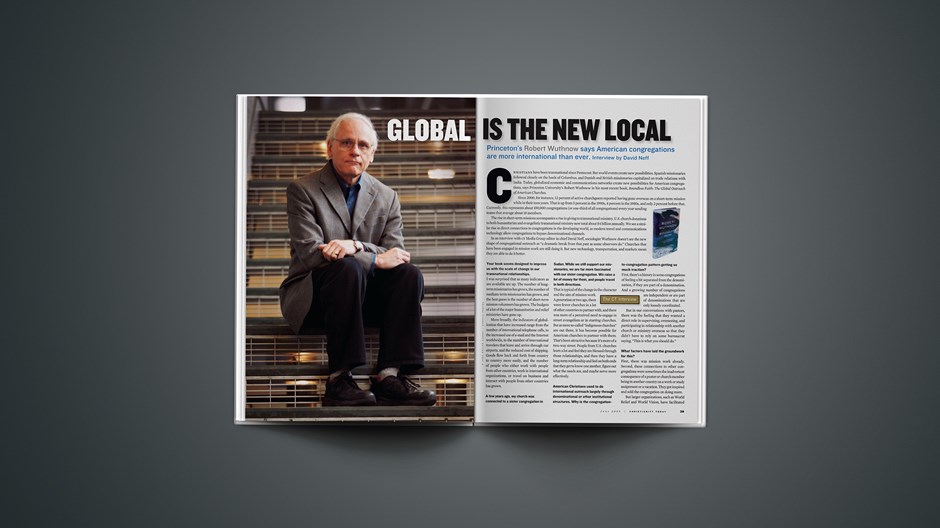
In an interview with CT Media Group editor in chief David Neff, sociologist Wuthnow doesn't see the new shape of congregational outreach as "a dramatic break from that past as some observers do." Churches that have been engaged in mission work are still doing it. But new technology, transportation, and markets mean they are able to do it better.
Your book seems designed to impress us with the scale of change in our transnational relationships.
I was surprised that as many indicators as are available are up. The number of long-term missionaries has grown, the number of medium-term missionaries has grown, and the best guess is the number of short-term mission volunteers has grown. The budgets of a lot of the major humanitarian and relief ministries have gone up.
More broadly, the indicators of globalization that have increased range from the number of international telephone calls, to the increased use of e-mail and the Internet worldwide, to the number of international travelers that leave and arrive through our airports, and the reduced cost of shipping. Goods flow back and forth from country to country more easily, and the number of people who either work with people from other countries, work in international organizations, or travel on business and interact with people from other countries has grown.
A few years ago, my church was connected to a sister congregation in Sudan. While we still support our missionaries, we are far more fascinated with our sister congregation. We raise a lot of money for them, and people travel in both directions.
That is typical of the change in the character and the aim of mission work. A generation or two ago, there were fewer churches in a lot of other countries to partner with, and there was more of a perceived need to engage in street evangelism or in starting churches. But as more so-called "indigenous churches" are out there, it has become possible for American churches to partner with them. That's been attractive because it's more of a two-way street. People from U.S. churches learn a lot and feel they are blessed through those relationships, and then they have a long-term relationship and feel on both ends that they get to know one another, figure out what the needs are, and maybe serve more effectively.
American Christians used to do international outreach largely through denominational or other institutional structures. Why is the congregation-to-congregation pattern getting so much traction?
First, there's a history in some congregations of feeling a bit separated from the denomination, if they are part of a denomination. And a growing number of congregations are independent or are part of denominations that are only loosely coordinated.
But in our conversations with pastors, there was the feeling that they wanted a direct role in supervising, overseeing, and participating in relationship with another church or ministry overseas so that they didn't have to rely on some bureaucrat saying, "This is what you should do."
What factors have laid the groundwork for this?
First, there was mission work already. Second, these connections to other congregations were sometimes the inadvertent consequence of a pastor or church member being in another country on a work or study assignment or a vacation. They got inspired and sold the congregation on doing more.
But larger organizations, such as World Relief and World Vision, have facilitated those arrangements, understanding that if churches got involved in partnering, there might be a more long-term relationship.
Another factor is that as a society, we are host to a very large number of recent immigrants. My congregation in Princeton has an ongoing relationship with a church and a school in Guatemala. It started because some of our church people got acquainted with a Guatemalan family in town.
Article continues below
What have congregations learned from taking this approach?
First, they learn that there is no one-size-fits-all model. They're learning to tailor their programs to local needs by listening better—unlike the example that's in my book where somebody complained that we sent a team to plant corn in Africa just like they do in Iowa and expected it to work just as well.
Second, churches have learned that they are just one of many organizations, and so they have to carve out a niche. For example, a church sending a medical team to do health screening in a village may need to coordinate with the World Health Organization or the health ministry of that country. Some African countries, like Ghana or Rwanda or Kenya, are almost saturated with churches and ngos trying to help. So they have to decide, we'll take this village and you take that village, or we'll work with you to help the churches, and we know you're going to be working on water wells or economic development. World Vision helps churches plan a comprehensive strategy so that some of the short-term relief, evangelism, and church planting happen, but some long-term infrastructure development happens as well.
Churches are also learning that short-term mission trips are a mixed blessing. Do them, but you may want to say the reason we're doing them is that they help us more than they help the host congregation. Or, we're going to do it even though we know that it's expensive and not very efficient, because it is a spiritual uplift to the people who go.
Journalist Thomas Friedman is perhaps the most popular interpreter of globalization today. How do his insights relate to the concerns of churches?
I'm a fan of Freidman's books, and in my book, I refer quite a bit to The World Is Flat. But Friedman, as good of a journalist as he is, talks to a certain cut of the population—the business elites. He suggests that you can play golf in Bangalore as easily as near Boston. Well, yes, but not that many people in a lot of countries have the wherewithal to play golf. With Friedman, you miss what's happening at the bottom of a lot of societies. I know he's mindful of those issues, but I frankly would trust what a long-term missionary or somebody from World Vision might have to say, recognizing they may know the local situation better than the national or global situation. That's one of the reasons why the U.S. State Department brings in people from churches and mission organizations, people who have boots on the ground and know what's going on.
Article continues below
Other interpreters include Philip Jenkins and Andrew Walls, who have highlighted the church's global growth. This has motivated many Christians to step up their contact with believers overseas.
When reading Jenkins's work, we need to remember that all the excitement in the global South is still closely connected with the United States. He chose not to write about that. You can't write about everything in a single book. But there are many examples from our research that show strong connections, whether through traditional missionary work or short-term missions or providing humanitarian relief, or just the cultural influences that come through religious television programs or CDs or music tapes. We're not living in totally separate worlds.
Another thing to remember is the cultural and power differences, power in the sense of both political weight and economic influence. If an African church welcomes visitors from the United States and says, "We are so glad to have you here," yes, they're sincere, but they also know that they're welcoming people from America, who add some prestige and some finances. That may become a paternalistic relationship that goes sour for both sides, or it may turn out to be mutually edifying. It simply has to be done with eyes open and some understanding of the cultural, economic, and political differences.
How do congregations integrate their new opportunities for global ministry with their essentially local character?
They struggle with it. It is often a token addition to the local interests that appeals to a small fraction of the congregation, at least in any serious way. Few people have the time or interest to travel or be involved in a global missions program. It's a matter for clergy or lay leadership to understand those dynamics and to mobilize energy where it can be found. If it's a congregation of 300 people and 5 are interested in global ministries, great. Get those 5 as involved as possible, then maybe another 5 within the next few years. But it doesn't mean in most congregations that the majority of folks are going to become very extensively involved.
People find their own ways to serve. Sometimes they're serving behind the scenes by supporting the ones who go on mission trips. Sometimes they're only able to add a few dollars to what the church is doing. But one of the great strengths of congregations is that they bring various gifts together and, with good leadership, manage to focus both on the local needs and on the global aspects of ministry.
Article continues below
How is the current economic crisis affecting these global relationships?
It's causing a lot of scaling back. The big organizations are cutting back by 25 to 30 percent, if not more. Local congregations, of course, are faring differently, depending on where they are and what their donor base is. But it's very likely that some churches are going to be saying that being involved on the other side of the world is a nice extra, but we can't afford it right now. We have to focus on the needs at home. Hopefully that won't be the only response, because when the world economy goes into a slump, people at the poorest end of the spectrum are usually the ones who suffer most, and therefore the giving and relief efforts are needed all the more.




















 While we pray for peace, we need moral clarity about this war.
 A Christian reconciliation group in Israel and Palestine warned that war would come. Now the war threatens their relevance.españolالعربيةFrançaisрусскийУкраїнська
 How groups like Hillsong learned to let go of the literal in favor of creative collaboration.españolPortuguês






