In Warren St. John's Rammer Jammer Yellow Hammer—a fascinating account of the lunacy that is University of Alabama football—the reporter recounts a conversation with a Mr. and Mrs. Reese in their $300,000 motor home, purchased exclusively to travel to Crimson Tide games. The couple, it turns out, had missed their daughter's wedding because it fell on the same day as the Alabama-Tennessee game. They said they had managed to make the reception, and noted that they had asked their daughter not to schedule the wedding so as to conflict with the big game. Asked why he did it, Mr. Reese could only shake his head and respond: "I just love Alabama football, is all I can think of."
If the Reeses' behavior qualified them for sport fanatics award of the century, surely the son of a Philadelphia woman deserves honorable mention. During a 2005 Philadelphia Eagles—Green Bay Packers game, the man ran onto the field, leaving behind a trail of powder coming from a plastic bag he was carrying. Police learned later that the powder was the ashes of his mother, an ardent Eagles fan. "She'll always be a part of Lincoln Financial Field and of the Eagles," the man told police.
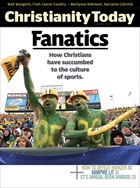
Extreme examples, perhaps. But both are rooted in the same passion that drives spectators to paint their faces with team colors, wear bizarre hats, and engage in the collective delirium that one philosopher has called "too close to the religious to call it anything else." Alumni signal their loyalty by flying their alma mater flags on their front porches and plastering the family car with team logos. And now the truly loyal can arrange for their final rest to be in coffins adorned with their college team's colors.
Americans are consuming sports on an unprecedented scale. The ancient Romans, long considered the gold standard for how sports-crazed a culture could be, were dilettantes compared to the sports fans of this century. The Romans could squeeze 50,000 spectators into the Coliseum for gladiatorial contests—a quaint assemblage next to the 107,000 seats regularly sold for University of Michigan or Penn State home football games. In 2006, Americans spent over $17 billion on tickets to sports contests and $90 billion on sporting goods, over double what they spent on books ($42 billion). Sports magazines take up prime space on bookstore shelves; the granddaddy of them all, Sports Illustrated, sells as many copies in a month (13.2 million) as To Kill a Mockingbird has sold since its publication in 1960. A tenth of The World Almanac is devoted to sports, more than is allocated for business, science, and politics combined.
None of this has been lost on evangelicals, who have been quick to harness sports to personal and institutional agendas. Less than a century ago, major segments of the evangelical community considered sports a cancer on the spiritual life; today their denominational progeny lead the parade to stadiums. The cozy coupling of sports and evangelicalism shows itself not only in the outsized athletic complexes that are common features of church architecture, but also in the ease with which sport and its symbols show up in the sanctuary. Pastors incorporate pithy sports metaphors into their sermons. Famous athletes are invited to pulpits to tell how their faith helps them compete. Some churches celebrate Super Bowl Sunday by canceling the evening service and assembling in the sanctuary to watch the game on large-screen TVs. "Faith nights" sponsored by local baseball teams draw entire congregations to the ballpark. Evangelistic organizations that center on the public's fascination with sports flourish.
Intercollegiate sports are given such a high priority at evangelical schools that, some critics say, they hog the spotlight meant for institutions' spiritual and academic missions. The athletic departments at many of these schools affiliate with the National Christian College Athletic Association, a kind of evangelical whose 100 member institutions vie for championships in 20 sports. And as sports have invaded Christian culture, the symbols of Christianity have invaded sports. Professional football is a heady mixture of toughness, violence, and piety—vicious collisions coupled with post-touchdown genuflections, trash talk mixed with heaven-directed index fingers, anger and aggression interrupted by prayers.
Riotous celebrations are the backdrop to athletes' nationally televised post-game testimonies. Professional football, basketball, and baseball teams have their own chaplains, genuinely concerned for the athletes' souls but sympathetic to the often violent, hypercompetitive culture of excess that players inhabit. In Super Bowl XLI (2007), both teams' coaches had established reputations as Christian gentlemen. The next Super Bowl brought more of the same, as standout Arizona quarterback Kurt Warner and several Steelers players seemed to be showing up everywhere declaring their faith.
Article continues below
The Game in Gomorrah
On one level, Christians' attraction to sports is easily understood. Sports are fun and exciting; when played well and in healthy contexts, they can be constructive leisure pursuits that enrich our lives. But organized sports, played at almost every level, too often bring out the worst in us. With astonishing frequency the reputation of higher education is sullied by players', coaches', and alumni's crimes and indiscretions. Recruiting scandals, under-the-table payoffs, and academic cheating—all perpetrated in the name of athletic excellence—have become such regular features on the sports pages that we have come to accept them as the cost of a Saturday afternoon's entertainment.
In the summer of 2009, for example, we learned that someone had taken the SAT for the University of Memphis's star basketball player the year prior. His coach—who has since moved to the University of Kentucky for a $32 million, eight-year contract—claimed ignorance on the matter. This happened around the same time news reports revealed that former college basketball coach Kelvin Sampson, placed on probation by the NCAA for serious rules infractions while at Oklahoma, committed the same infractions after becoming the coach at Indiana, and had lost his appeal to the NCAA for reinstatement.
Professional sports testify to an excess of money, success, and competitive zeal. Baseball records linger in a purgatory of ambiguity as a result of players' broad-scale use of performance-enhancing drugs. Doping scandals have so plagued the world's premier cycling event, the Tour de France, that New York Times writer George Vecsey facetiously recommended that "a mob of citizens … pick up wooden pitchforks and run the scoundrels out of town."
Fighting is so rampant in the National Hockey League that we now have a website devoted to its glorification, cataloging the fights and fighters. (For those interested, during the 2008-2009 season, 734 fights between 355 players broke out during 173 different games.) When it was discovered that the New England Patriots' head coach had arranged to videotape the sideline signals of an opposing team's coaches, fans showed little moral outrage, probably because it seemed so tame compared with what they'd come to expect.
Lower-level sports tend to mimic those seen on television; thus, it shouldn't surprise us when they mimic the ethos of televised sports. Youth sports programs certainly provide worthy experiences for young people, but with increasing frequency they seem to spin out of control. When a father in California is sentenced to jail for beating and berating a coach for taking his son out of a baseball game, or when a dentist sharpens the face guard on his son's football helmet so that he can slash opposing players, or when the father of a 12-year-old hockey player beats his son's coach to death outside the rink—because, ironically, he thought the coach was encouraging rough play—it's fair to conclude that in many cases youth sports, like those played on a higher level, have lost their way.
Article continues below
That some deep theological insights might be gleaned from such goings-on, or that God might choose to reveal himself in sports—even in those that bring out the crudest of instincts—is, of course, possible. But I believe it is unlikely. Yet even if I am wrong, this by itself doesn't relieve Christians of the duty to seek the redemption of sports, and to point society toward a better way of playing.
The Deafening Silence
Variously described by those inside and outside as narcissistic, materialistic, violent, sensationalist, coarse, racist, sexist, brazen, raunchy, hedonistic, body-destroying, and militaristic, big-time sports culture lifts up values in sharp contrast with what Christians for centuries have understood as the embodiment of the gospel. There are simply no easy, straight-faced, intellectually respectable answers for how evangelicals can model the Christian narrative—with its emphases on servanthood, generosity, and self-subordination—while immersed in a culture that thrives on cut-throat competition, partisanship, and Darwinian struggle. If evangelical ethicist R. E. O. White is right to assert that self-absorption is behind all wrong social relationships and, for this reason, self-denial is the first ethical condition of discipleship, then elite athletes immersed in the self-consumed atmosphere of sports, where self-denial is a recipe for competitive disaster, face a fundamental problem.
This is not the only place where the sports ethic pinches the shoe of Christian theology. While the Bible heralds the human body as the apex of creation, the vessel of the indwelling Spirit, and reflective of the Creator's image, a large and expanding body of epidemiological evidence suggests that sports are an agent of its desecration; the latest investigations of Congress and others focus on the relationship between playing professional football and the risk of dementia.
Article continues below
Further, while honesty, sympathy, and generosity are the idealized derivatives of a life lived with God, recent data reveal that immersion in a culture devoted to proving one's superiority squelches rather than reinforces these virtues. (Witness the stir caused by Cedarville University's former volleyball coach for merely insisting that her players inform the referee when they had touched the ball before it went out of bounds.) As poetry adds zest to language and music adds zest to sound, so competition can add zest to play. At the same time, it is worth asking whether spending our leisure moments comparing talents, plotting self-advancing agendas, and, temporarily at least, stifling feelings of sympathy might foster mindsets that negatively frame our thinking in other endeavors.
If indeed sport is marching toward Gomorrah, it seems to have escaped the attention of large portions of the evangelical community, which continue to bask in the reflected glory of Christian athletes. Much evangelical commentary glorifies athletes and sports, but becomes timid in situations that warrant indictment. Rarely does the evangelical press ask touchy questions about tensions between the moral culture of Christianity and that of big-time sports. The silence is deafening.
In its vision of sports, bolstered by the large number of Christian athletes who have joined professional and collegiate teams, the evangelical community has yet to ask how the influx of believers has affected the morality of sports. There may be no more vivid illustration of historian Mark Noll's "scandal of the evangelical mind" than the way the community has neglected to think Christianly about sport, or has excused itself from crafting a sensible philosophy that will help them mine the spiritual riches that sport has to offer.
The Cost of Intellectual Neglect
Christians' indiscriminate acceptance of sports is just as dangerous as our ancestors' indiscriminate rejection of sports. In today's case, it has three effects: the evolution of an improbable sports theology that has stifled prophetic voices; a well-defined tendency for evangelicals and their institutions to fall into the same ethical quagmires that have trapped others in the sports community; and the Christian community's failure to consider how it might extract sport's potential for spiritual uplift and maximize its capacity to express a Christian vision.
Article continues below
In the intellectual vacuum that has ensued, a locker roomcrafted theology has emerged, purporting to explain the relationship between sport and faith. Thirty years ago, Sports Illustrated's Frank Deford labeled it "Sportianity"—a triumphal evangelism blended with competitive zeal that has been crafted by and for those whose love of athletics often makes it difficult for them to view sports objectively. Sportianity is a mix of locker-room psychology and athletically slanted doctrines of assertiveness and masculinity, abetted by cherry-picked Bible verses prescreened to ensure they don't contradict sport's reigning orthodoxies. Sportianity is more Old Testament, with its allusions to religious wars, than New Testament with its Sermon on the Mount.
In other words, Sportianity is Christian theology vetted and co-opted by the dictates of the sports industry. Not surprisingly, it cannot speak truth to power. Its doctrines are promulgated far beyond the locker rooms of the nfl, the nba, or Major League Baseball. Rationalized and systematized, it is vigorously taught to college, high school, and even younger athletes. Its themes crop up in sermons preached from evangelical pulpits and in articles from the religious press. There are, in fact, few alternative ways of thinking about sports and faith in the evangelical community.
In spite of its theological conservatism, Sportianity advocates a quite worldly view of sports. The concrete trumps the symbolic; doing, achieving, and struggling are favored over mystery, joy, feeling, transport, and spiritual insight. When effort, sacrifice, and competitive success become the preferred ways to glorify God, joyous play—which might be what theologian Robert K. Johnston has called "a prolegomenon [preface] to further encounters with God"—can seem an unworthy offering. In the dialectical, serious-but-not-serious world of play, Sportians tip the scales decidedly toward the serious, made weightier by the evangelistic mission they are anxious to load onto sports.
In the process, sport played for its impact on the soul, sport that illuminates and spiritually enriches, sport that is serious but also festive and fantastical, gets short shrift. Far beyond the Sportians' horizon is the possibility that players can become what Hugo Rahner, author of Men at Play, eloquently called "imitator[s] of the Logos, the Heavenly Wisdom who plays upon the earth, the co-fashioner with God."
Article continues below
Ethical Swamps
It is worth remembering that sport's entrée into Christianity in the late 19th century was largely conditional. Protestant leaders were sympathetic only to the extent that their communities would, in the words of Washington Gladden, a popular preacher of the day, "enter into them and pervade them and transform them by their own vital energy." To these Protestants, sports evangelism was aimed at the institution itself. While sports evangelistic organizations deserve credit for their work with individual athletes, the social enterprise that tempts them—that pulls on their egos and frames their performance in violence and spectacle—is largely ignored. Evangelicals have "entered into" and "pervaded" sports, but have yet to seriously take on the burden of transformation.
Consequently, evangelicals in the sports community have too often been followers rather than leaders, adopters of the dominant ethos rather than trendsetters who challenge it. Unsurprisingly, they often become mired in the same ethical swamps that bog down other athletes and coaches who make no special claims about the transforming power of their faith. Frank Deford warned that this would happen: "The bad things about athletics have rubbed off on religion," he wrote. "Religion is like the tar baby—it's gotten stuck and the more it struggles, the more tar it gets on it. There's the danger when anything moral plays with anything as public, as notorious, as celebrated as sport—you get stuck."
Christians will move toward higher ground when they recognize that many of the ills of sport stem not from violating the creeds of sport, but from over-conforming to them.
Recent instances prove Deford prescient, as evangelicals in sports have struggled to get unstuck when they should have been pointing the way to higher ground. Several years ago, a small Southern Baptist university's president allegedly ordered a failing grade to be removed from the transcript of the school's basketball star to keep him on the team to lead his school to a national championship. National sports pages gave the incident bold coverage, leading to the president's dismissal. The press's curiosity was piqued not so much because another college athletic program was found to be complicit in dishonest acts, but because the episode contrasted sharply with the values the school claimed to believe in and teach. But here was the crushing embarrassment: The president was an ordained minister for whom the school's graduate divinity school was named, the tournament the team won was that of the National Christian College Athletic Association, and the failing grade in question had been earned in a religion course.
Article continues below
Other examples: A Christian high school in Tennessee that prides itself on a bold evangelical stance and fields a powerhouse football team became national front-page fodder for its questionable ethics; two nationally known evangelical coaches were criticized by the press for refusing to concede that their football teams won only because referees had admittedly made mistakes near the end of the game; the basketball program at a large Christian university became so disjointed from its mission ("advancing the frontiers of knowledge while cultivating a Christian worldview") that it became a poster child for just how slimy the subculture of university athletics can get; and the creation of the Christian Wrestling Federation, Christian Wrestling Entertainment, and Ultimate Christian Wrestling—all of which promise spectators the same violence, celebration of power, and grotesque images and freak-show ambiance seen on TV, but not, its promoters point out, "cursing or women parading in skimpy costumes." All of these suggest it is time for evangelicals to step back and rethink their liaison with big-time sports.
Missing The Point
Dutch historian Johan Huizinga pointed out in Homo Ludens that play is based on a certain imagination of reality, and that what's important is to grasp the meaning of this imagination in understanding how play works in human civilization. If Huizinga was correct, the question of how sports can be shaped to inspire the Christian imagination supersedes all claims about how they help us physically and psychologically or publicize our schools or help spread the gospel. Huizinga affirmed what most sports scholars have long noted: that sports, as a form of play, belong to the realm of the aesthetic, the symbolic, the ritualistic. They fundamentally appeal more to our spirits than to our physiologies. That sports first appeared in culture as a form of religious expression is not an incidental fragment of history; indeed, it may signal their proper place in the created order.
Article continues below
Fearful of elevating something as "trivial" as sports to an undeserved place in the pantheon of acceptable ways to celebrate the Holy Spirit's workings, evangelicals have opted to trumpet the practical benefits of sport, even when such claims are overstated. As a result, the Christian community has been like a guest that comes to a banquet, eats the appetizer, and leaves, not realizing what sumptuous delights are to come. Lacking a collective Christian imagination of sports, they have settled for a host of other imaginations: consumer imaginations, which value sport only as it advances financial or public relations interests; military imaginations, which conceive of sport as a partisan encounter where success is measured by victory; and therapeutic and propaganda imaginations, which value sports only as a tool to achieve some material end. The possibility that sport, properly organized and played, can inspire rather than challenge the Christian imagination is left unexplored. So is the possibility that sports can be what Hugo Rahner called a rehearsal "of that Godward directed harmony of body and soul which we call heaven," an expression of "man's hope for another life taking visible form in gesture," a "feeble imitation" of true play, which will begin "only when this world has been left behind."
Some Christian athletes have intuitively recognized this, talking about their athletic endeavors as "praise performances" or "worship experiences," and expressing a desire to "glorify God" using their talents. Yet sadly, such visions of glorifying God are almost always linked to athletic production. God is glorified through demonstrations of grit, muscularity, strategic calculation, and victory, notions that that seem more derivative of the coach's office than of the Bible. As the late theologian Lewis Smedes reminds us, glorifying God means applauding God, and that, he noted, is never very productive—at least on a human level.
Steps Toward a Well-Played Game
The call here isn't to eliminate competition, a treatment that would no doubt kill the patient along with the disease. Sport is impossible without competition. At the same time, I doubt sports can attain their highest purpose in the Christian life with some mere tinkering around the edges. Calls to "keep our games in perspective" have proven no more effective in our day than did Aquinas's pleas for moderation stem the riotous church-sponsored competitions in the 13th century. If sport played by Christians is to have a distinctive slant—especially sport sponsored by Christian institutions—it won't simply be sport done well, or played without egregious violations of the sporting code. It will be sport creatively structured and specifically crafted to express the joy of the faith.
Article continues below
Christians will move toward this higher goal when they recognize that many of the ills of sport stem not from violating the creeds of sport but from over-conforming to them. Progress will be made when the Christian community begins to discriminate among sports, possibly favoring side-by-side competitions (swimming, golf, and track and field, for example), which don't require violence or the mental state to sustain violence, over face-to-face contact sports (football, hockey, and boxing). In particular, it's time for the Christian community to rethink its fascination with football. In light of the physical carnage wrought by this popular sport, Christian schools with football programs may be faced with the uncomfortable choice to either modify- their menu of athletic offerings (i.e., cutting their football programs) or revise their understanding of the human body as the temple of God.
Let Christian athletes, mindful of sport's temptation to pride, shun victory celebrations and consider whether the gospel's spread is well served by on-field prayers, religious gestures, and post-game testimonies. Cheap advertisements of the faith embedded in the cheap milieu of big-time sports smack of cheap grace. Let's scrap the tired images of Christ as coach or Christ as a teammate who is always on our side. It seems to me that hot sporting blood has a much better chance of being leavened when Christ is envisioned as one's opponent.
These and other steps that Christians might take toward the well-played game may seem quixotic, maybe even heretical, to those baptized into the sports religion. They make sense only when framed in the Christian view, that sports are derivatives of the God-given play impulse—intended less to test our spiritual limits than as times and places to recover our spiritual centers of gravity and to rehearse spiritual truths, dim images of the real game that will begin when we leave this world behind.
* * *
A Personal Aside
Nobody likes to think ill of sport. It is all too easy to dismiss critics as prigs who are insensitive to the glorious traditions, unaware of the joys that sports can bring, inexperienced and unfamiliar with its many benefits. My own views have been shaped by a 40-year-long association with sport, first as an athlete (football, basketball, track and field), later as an official (soccer, basketball) and a college coach (basketball), and finally, as a professor and administrator in university departments that prepare physical education teachers and coaches.
Article continues below
In all of this, I have never fallen out of love with sport. In fact, it is my love of sport that inspires my high view of its potential—a much higher view, I would argue, than is held by many who might think me a sport hater. Yet I suppose I have become a hater of what we've allowed sport to become, of the feeble uses to which we try to put it, of the ugly social contexts into which we insist on inserting it, and of its distortions and abuses. Most of all, I am disappointed that Christians have failed to wring from sport its full potential for underscoring that peculiar grace that they claim marks the life of the believer. But as to my love of the essence of the sport experience, there should be no doubt.
Shirl James Hoffman is emeritus professor of kinesiology at the University of North Carolina, Greensboro. This article has been adapted from Good Game: Christianity and the Culture of Sports (Baylor University Press, 2010).
Christianity Today's cover package also included responses from Mark Householder, president of Athletes in Action, Benjamin J. Chase, a former lacrosse player at Wheaton College, and Ted Kluck, author of The Reason for Sports: A Christian Fanifesto.















 While we pray for peace, we need moral clarity about this war.
 We’ve got little information on Jesus’ appearance and personality. But that’s the way God designed it.españolFrançais
 How groups like Hillsong learned to let go of the literal in favor of creative collaboration.españolPortuguês






