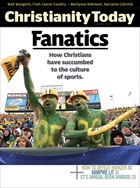
I'm an athlete. I like to run, lift, compete, and win, and I have my very own "fascination with football," as Hoffman puts it. And perhaps I've been blissfully unaware of the fact that sports have historically been considered a little too dirty and a little too lowbrow to be worthy of Christians' intellectual engagement. I guess this explains why the message boards following my online sports columns for CT always evolved into important debates on things like circumcision.
There's a sort of breathless, "finally somebody said it!" quality to Hoffman's essay, except that I think there are a lot of Christians who for years have been doing sports in the way he recommends. I'm referring to those of us who don't get to play on CBS and don't have 9-year-olds emulating our eyeblack, but who have been trying to honor, glorify, and enjoy God through sports—even the high-contact ones.
And without sports like football, there would be precious little of the diversity we all seem to crave at the evangelical schools Hoffman mentions, where the demographic formula seems to be, "take a thousand well-heeled suburban, white, probably home-schooled evangelicals, and add a hundred football players."
Hoffman does a great job of pointing out that sports are full of sinners.Sure, there are a lot of self-glorifying sleazebags in sports.There are also a lot of self-glorifying Christians in sports. For many, God has become nothing more than another lucky pair of socks—another performance-enhancing drug.
But there are also a lot of Christian athletes who care about the Cross, the gospel, humility, joy, and true growth and sanctification. Sports provide a very public and community-oriented way to care about these things. I've met hockey players, boxers, and football players (as well as golfers, runners, and swimmers) who fit this bill.
The thing is, "the concrete trumps the symbolic" for me, in matters of faith as well as in matters of sport. There is something concrete, and comforting, in the authority of Scripture. And there was something of "hard work and pain" in what Christ did on the cross for me, the worst of sinners. And it's the acknowledgement of that work that makes
play—sports—joyful.















 While we pray for peace, we need moral clarity about this war.
 A Christian reconciliation group in Israel and Palestine warned that war would come. Now the war threatens their relevance.españolالعربيةFrançaisрусскийУкраїнська
 The rage of the mob is a poor substitute for real community.






