
On the edge of the Sahara Desert, church growth and discipleship strategies come down to one simple command: Stay alive.
The sub-Saharan African country of Niger is one of the poorest in the world. And with Christians making up less than 1 percent of the population, the survival of each congregation is a constant concern. Unpredictable rain patterns threaten what meager crops are grown. For Nigerien church leaders, "Give us this day our daily bread" is not just a metaphor.
"You find, even within church leadership, the statement, 'Yes, God has called us. We are ministering for God. But how do we survive?'" said Gaston Slanwa, a Cameroonian who trains church leaders in Niger. "That is the question that comes up most often."
"We have a proverb in our language: 'If somebody promises to give you a shirt, look what he is wearing,'" said Nouhou Abdou Magawata, a local Christian who works with a Summer Institute of Linguistics program in Niamey, Niger's capital. "If what he is wearing is good, then you think of him as being able to give you a shirt. If he is in rags, you won't believe him. That is the situation we face. If you are preaching a God of love, but your God does not love you enough to give you enough to eat, what do you tell people?"
How can Christians preach a God of love in a country in which one of every five children dies before his first birthday and citizens routinely face deadly food shortages? Niger's Christian leaders invest much hope and effort into what they call a "two-handed" approach, fulfilling material needs with one hand and sharing the gospel with the other.
"We don't want to just throw food out at people," said Donnie Hebert, a Youth With a Mission (YWAM) leader who works with nomadic herders in the desert terrain of northern Niger. "We can't just tell people about Jesus and not fulfill their immediate needs, and I don't feel you can fulfill their immediate needs without telling them about Jesus."
Even from a distance, this dual approach to Christian outreach in Niger makes sense to economics professor Brian Fikkert, co-author of When Helping Hurts and founder of the Chalmers Center for Economic Development at Convenant College. During an interview about Christian methods for long-term development, Fikkert told Christianity Today, “I don’t believe it’s possible to do true development work without the clear verbal articulation of the gospel of Jesus Christ. At the end of the day, that means that at some point we are saying to people who are not Christians that in fact we have knowledge that they don’t have that they need desperately to come to grips with.
"I don’t conceive of poverty as being fundamentally material in nature alone. There are material elements, but I think of poverty differently. Human beings were created for relationship. Poverty is fundamentally rooted in the broken relationships that we have with God, self, others and the rest of creation. Poverty alleviation, then, is really about trying to restore or reconcile those relationships."
Hardship and Fatalism
Niger, a nation of 15.8 million, has the highest birth rate and third highest infant death rate in the world. The country is one of the lowest ranked on the 2010 United Nations Human Development Index, which measures standard of living.
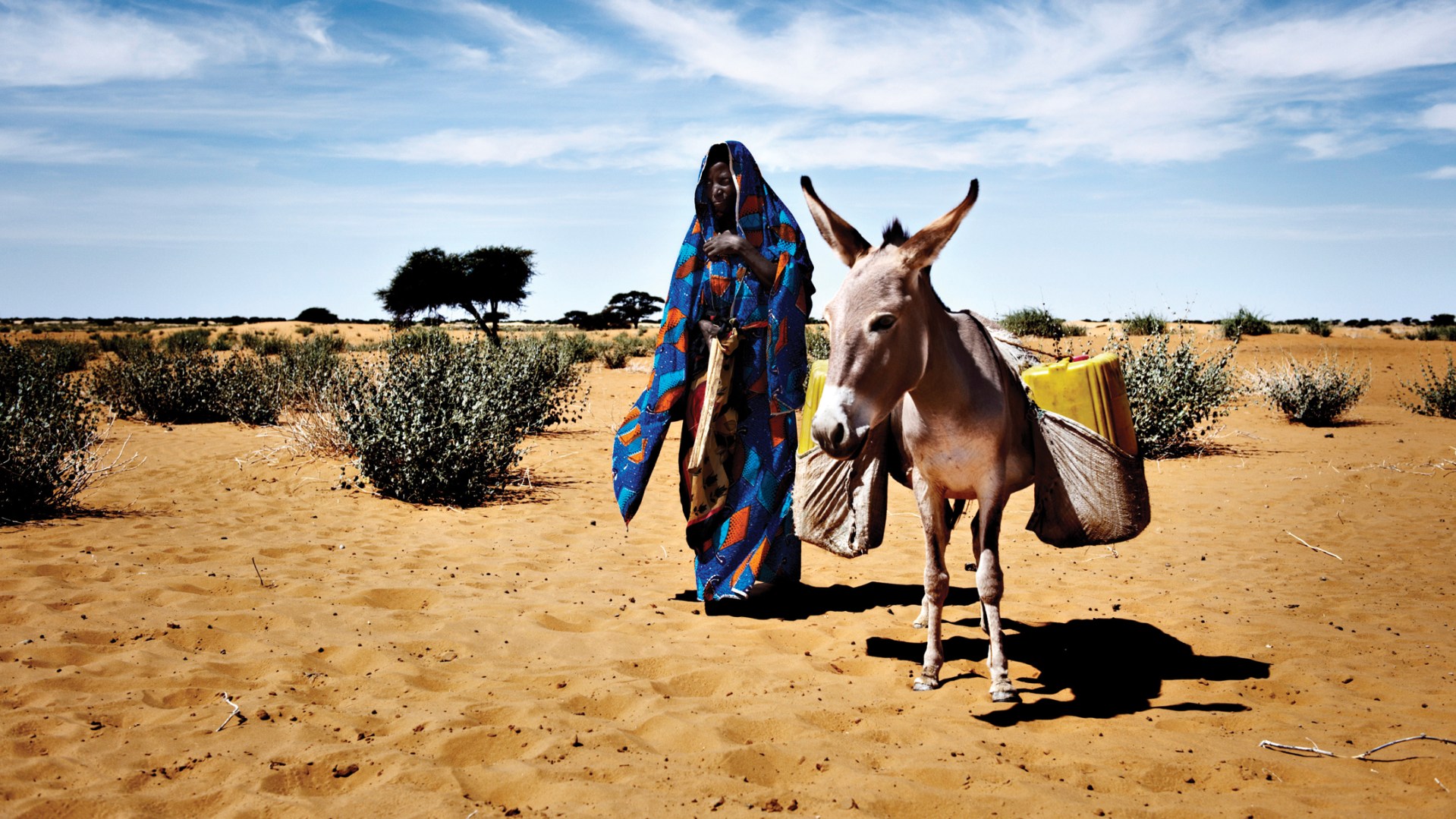
Just north of Nigeria, Niger butts up into the world's largest desert. As a result, 80 percent of the land is unsuitable for farming. Dry season temperatures can spike at over 104°F. Throughout the scorched land, nomadic groups herd skeleton-thin cows and goats from watering hole to watering hole, traveling hundreds of miles in one season to survive.
In the arable south, farmers harvest meager crops of millet, corn, and other vegetables, the same kinds of crops their people have cultivated for generations. In years like 2009, one early, hard rain (or a rain that comes too late) brings a near-famine the following year.
'Yes, God has called us. We are ministering for God. But how do we survive? That is the question.'—Gaston Slanwa, a church educator in Niger
HIV/AIDS is a smaller problem here than in other African countries, but relatively preventable diseases like typhoid ravage the population. Only 19 countries in the world have a lower life expectancy.
In Niamey, the most Westernized city in Niger, goats roam free over garbage and sewage heaps piled along the roadside. Basic hygiene, sewage systems, and Internet use are luxuries. Credible threats of al Qaeda terrorist operations in the mountainous northern region keep Western missions personnel on alert.
Besides disease and famine, internal political disputes plague the country. Niger gained independence from France in 1960, after nearly 40 years of colonial rule. Since then, uprisings and coups have punctuated periods of peaceful, democratic rule. Last spring, a military coup led to the ouster of President Mamadou Tandja. After the nation held a peaceful run-off presidential election to restore civilian rule, Mahamadou Issoufou took office as Niger's new president in April.
One of the biggest ministry challenges is not the sporadic electricity or other hardships inherent to a developing country. It's addressing Nigerien fatalism, the deeply entrenched assumption that nothing can change for the better, an attitude stemming from tradition, religion, and culture.
Mike Schmidt, deputy director of Niger's Serving in Mission (SIM) branch, said Nigeriens "firmly believe what's going to happen is going to happen because Allah has predetermined it." The population is more than 90 percent Sunni. Clay-walled mosques with blue-tile roofs are the largest structures in many rural towns and villages.
Using the Widow's Oil
SIM, which has been in Niger since 1924, trains local pastors in congregational and community leadership. The leaders come to SIM's Bible school in Niamey or learn from missionaries throughout the south. SIM also operates two hospitals and an agriculture project.
Despite decades of experience in Niger, missions leaders have a sobering track record of unsuccessful efforts, including many failed attempts to teach local farmers new growing techniques. Nigerien reluctance is a form of risk management, said Jenny Aker, a Tufts University economics professor and expert on development in Niger.
"After [horrible] things happen to you, you start taking fewer risks," she said. "Maybe you're going to grow the crops you know work in the face of a drought. Maybe you're going to do the things in terms of health practices you've traditionally done or know about."
Missions leaders told Christianity Today that they try to work with the people to discover local solutions. "We ask questions, not propose solutions, and facilitate a process in which people discover that they already have resources to do something about their situation," said Steve, a worker with a Christian development organization (he asked that his full name not be used). "We help them a little bit with the visioning, because sometimes you can't imagine a different world."
Leaders said that the community-driven approach is inspired by the story of Elisha and the widow's oil (2 Kings 4). Elisha starts by asking questions to find out what resources the widow already has to help herself. Only after she answers does he propose a solution that uses what the widow has immediately available: cooking oil.
Together, Nigerien leaders seek their own widow's oil. To that end, organizations like the Christian Reformed World Relief Committee often take groups of villagers to see successful projects elsewhere.
Steve's organization recently took villagers to the southern city of Maradi, where a new way to grow crops was introduced. Peter Cunningham, a SIM leader involved with Maradi's "Sowing Seeds of Change in the Sahel" project, has worked for 10 years to help green the Sahel, the grasslands of southern Niger. As he points out healthy acacia trees and new crop systems, he also stops to notice birds: hornbills, pigeons, and black kites. There was a time, he says, when the region was covered with monkeys chattering in mature trees. Now there is silence.
Under the new system, farmers plant around trees and rejuvenated tree stumps. Healthy trees slow the spread of the Sahara Desert. This eventually leads to larger crop yields and forest cover.
World Vision Australia's Tony Rinaudo pioneered this technique in Niger, also called Farmer Managed Natural Regeneration. The International Food Policy Research Institute highlighted the technique in its popular resource Millions Fed: Proven Successes in Agricultural Development, and the program has been slowly expanding since 1990. In some cases, crop yield has at least doubled as a result. According to Rinaudo, in the past 20 years, farmers have reforested 12 million acres of barren Nigerien land.
Reaping from Rocks
A decade ago, the area around Abalak, an ancient northern city on the edge of the Sahara, was a wasteland, covered with red sand, rocks, and thorny bushes, and dotted with nomads' stick and grass huts. Now, thanks to the steady efforts of local tribal leaders and YWAM's Hebert, some desert areas are producing harvests of local grains, like wild wheat, to feed people and their livestock, the main means of livelihood in the region.
The benefits of change are not hard to find. When the last major food crisis hit the country, families who had been growing wheat and banking the surplus lost many fewer animals than did others.
When Hebert and his wife, Allison, work with a new group, they direct their initial efforts at helping nomads solve problems of daily life. They explain to tribal elders their land rights and seek ways to help them reduce overgrazing, which can quickly turn arable land into desert. Hebert oversees grain banks, which maintain the supply of grain and stabilize prices during famines.
Their work is gaining international notice. In 2009, the United Nations' International Strategy for Disaster Reduction recognized YWAM-Niger for its participatory community programs to improve the lives of Nigeriens in the North.
Once the local economy shows signs of stabilizing, Christian leaders start working on issues like literacy, health care, and leadership development.
Much of that is done through Bible teaching at local churches. The church here, as in much of the Global South, is growing quickly but is still very young.
"God is harvesting people here. The church is growing and membership is growing, but the maturity of the leadership is still weak," said leadership trainer Slanwa. "It takes time for people to understand. Don't force a child of 10 years to do what a child of 15 years should do."
Most Christians are concentrated in a few communities around the capital city and in the south. For example, about 80 Christians in Bawada Daji, a few hours from Niamey, meet weekly for worship. But as might be expected, mature church leadership is in great demand.
Siman Assoumane, who is studying agriculture and rural economics at the University of Niamey, said, "If the one who is supposed to teach does not know what to teach, who will teach? You cannot teach what you do not know. The church still has to be trained."
Despite the internal challenges, Nigerien Christians continue to look outward. As Joseph, a Christian in Bawada Daji, put it, "We want to bless other people."
Ruth Moon, a graduate student at Southern Illinois University-Carbondale, received a travel grant to support her reporting from Niger. John Stott Ministries has provided a grant to Christianity Today to support reporting on international issues.
Copyright © 2011 Christianity Today. Click for reprint information.
Related Elsewhere:
"Tough Calling in Africa" is a sidebar to this article.
Previous Christianity Today stories related to Niger, Africa, or hunger include:
Christian History Corner: The African Lion Roars in the Western Church | Anglican liberals are fretting, conservatives rejoicing, and all are scrambling to their history books: whence this new evangelical force on the world scene? (June 1, 2003)
Hunger Isn't History | The world produces more food than ever. So why do nearly a billion people still not have enough to eat? (November 7, 2008)
A Hand Up: Aid for Trade in Mozambique | Faith-based model teaches rural poor how to use trade to rise out of poverty. (July 8, 2010)