
American evangelical Christianity is ready for its Sally Field moment.
The actress's 1985 Academy Award acceptance speech is famously quoted as, "You like me! You really like me!"
But we often forget that Field was accepting her second Oscar in five years. She had already won the recognition of her peers. What she really said in 1985 was, "I've wanted more than anything to have your respect. The first time I didn't feel it, but this time I feel it, and I can't deny the fact that you like me, right now, you like me!"
Similarly, somewhere along the line we evangelical Christians have gotten it into our heads that our neighbors, peers, and most Americans don't like us, and that they like us less every year. I've heard this idea stated in sermons and everyday conversation; I've read it in books and articles.
There's a problem, though. It doesn't appear to be true. Social scientists have repeatedly surveyed views of various religions and movements, and Americans consistently hold evangelical Christians in reasonably high regard. Furthermore, social science research indicates that it's almost certain that our erroneous belief that others dislike us is actually harming our faith.
So, come on. Join me on stage to exclaim, "You like me, right now, you like me!" No takers? How about at least, "You don't hate me"?
If you have trouble believing this, you're not the only one. My wife and I live in a university town, and the Bible study we host in our home includes a number of graduate students. During one dinner, several students got into a lively discussion about how much people do not like evangelical Christians because of all the stupid things we do.
The feeling of being disliked and alienated has worked its way deep into the evangelical consciousness. We feel it in our bones.
I had just finished researching this topic for a book (Christians Are Hate-Filled Hypocrites … and Other Lies You've Been Told), and I explained that non-evangelicals' views of us are less negative than most evangelicals assume—certainly less negative than what I was hearing in the room. If I could convince anyone of this, I thought it would be them. As fledgling academics, they had learned to appreciate statistical evidence, and I described in detail solid survey research. And these students knew me personally and trusted my judgment. But after I disappeared into the kitchen for a few minutes, the group returned to the nobody-likes-us discussion. The feeling of being disliked and alienated has worked its way deep into the evangelical consciousness. We feel it in our bones.
Persecution Complex
In 2009, the Pew Forum on Religion and Public Life surveyed Americans on, among other things, discrimination in the United States. Evangelicals agreed with Americans overall that Muslims in America face a lot of persecution (58 percent of both groups said yes). But evangelical respondents identified themselves as the second-most-victimized religious group, with 43 percent saying there's a lot of discrimination. This ranked discrimination against evangelicals as worse than that against Jews (38 percent), Mormons (26 percent), and atheists (24 percent)—and blacks (37 percent) and women (38 percent). Among the general population, however, only 27 percent agreed that American evangelicals face much discrimination.
Last month, another Pew Forum survey, of evangelical leaders worldwide, found that while American evangelicals are less likely than their overseas counterparts to say conflict between religious groups is a problem in their country, they are more likely to see non-Christians and especially the nonreligious as unfriendly toward evangelical Christians. American evangelical leaders are twice as likely as their Global South counterparts to consider the nonreligious unfriendly toward evangelicals (68 percent to 33 percent). European leaders are about in the middle (54 percent view the nonreligious as unfriendly toward them).
Why do American evangelicals feel this way? One possible answer comes from the work of Christian Smith, a sociologist at the University of Notre Dame. In a landmark three-year study published in the mid-1990s, Smith and his colleagues sat down with 130 churchgoing Protestants to talk with them for a few hours about their religious behaviors and beliefs. Time and again, the interviewees had stories of unfair treatment at the tip of their tongues, especially stories involving schools, government, and the media. One woman complained that "schools have completely removed anything that has to do with Christianity or God or the Bible or any of that. And then they will let in books like Heather Has Two Mommies, real secular and anti-moral books." Another woman lamented that "Christians are mocked and made fun of by mainstream America. I have even experienced that opposition personally from friends, in subtle ways, thinking me very odd to prefer to go to a church activity over a movie."
Smith concluded that the perception of conflict makes the movement strong and distinctive. Evangelicalism, he wrote, "thrives on distinction, engagement, tension, conflict, and threat"—hence the name of his book: American Evangelicalism: Embattled and Thriving. In fact, said Smith, if we take away the tension evangelicals feel, the movement "would lose its identity and purpose and grow languid and aimless."
Agreeing with the Culture Warriors
It doesn't appear that evangelicals actually experience more oppression than others. In a 2006 study, about 1 in 3 evangelicals said that they hear negative remarks about their religion often or occasionally. That's close to the national average of 29 percent. (For Mormons it was 60 percent, for Jews 38 percent.) If evangelicals do not actually hear many more negative remarks about their faith, it might be that we're simply more sensitive to hearing them.
Regardless of our personal experience, evangelical Christians' sense of being disliked is reinforced when we hear others in our group, especially leaders, telling us we are disliked.
It is easy to point fingers at the evangelical leaders who have made the most headlines fighting a culture war. At the same time, leaders who have fought against the politicization of the movement and the very notion of culture war have made the same argument: Because we keep crusading against Heather Has Two Mommies and just about everything else, we've lost the cultural goodwill we might once have had.
Two studies in particular have influenced this view. In the first, in 2002, George Barna interviewed 270 non-Christians, asking for their impressions of 11 different groups in society. His list included a somewhat random mix of professions, political groups, and religions. At the top end, Barna found that military officers and ministers received the most favorable impressions. Below them, born-again Christians, Democrats, and real-estate agents received the next most favorable impressions. At the bottom end were actors, lawyers, Republicans, lesbians, and evangelicals. Very last, far below any other group, were prostitutes.
Barna presented these findings with alarm. He wrote that they showed that non-Christians are "dismissive" of evangelicals, and he concluded that this negative view was "one reason that evangelical churches across the nation are not growing." His study went viral. It was featured in The Atlantic Monthly under the title "Evangelicals and Prostitutes," as well as in various articles and blogs, all part of a rallying cry for Christians to reform their image in society.
Should we believe this study? In a word, no. George Barna, in his time with the Barna Research Group, produced plenty of accurate and useful studies; this happens not to be one of them. I've already critiqued the study in a recent book, so I won't pile on here. But it's worth pointing out a paradox in the findings: the non-Christian respondents in Barna's study reported having rather favorable opinions of "born-again Christians," who ranked third out of the eleven groups. Barna's training is in theology, and in his work he emphasizes a difference between born-again Christians and evangelical Christians. In some studies, this is a helpful distinction. But most Americans would be hard-pressed to accurately explain the difference between the two; some survey researchers even use the terms synonymously. Rather than illuminating a religious conflict, this study seems to show identification problems.
David Kinnaman (the new head of Barna Research) and Gabe Lyons (of the Q conferences) have significantly advanced the concept of evangelical dislike and, more generally, Christian dislike. For their 2007 book UnChristian: What a New Generation Really Thinks about Christianity … and Why It Matters, they surveyed 440 young people (ages 16-29) who did not affiliate with Christianity—atheists, agnostics, and members of other religions. They asked these "outsiders" about their impressions of Christians. Thirty-eight percent of outsider respondents had a bad impression of "Christianity" as a religion, 36 percent had a bad impression of "born-again Christians," and 49 percent had a bad impression of "evangelical Christians." Only 3 percent said they had a good impression. From these data, Kinnaman and Lyons concluded that "Christianity has an image problem." They also argued that society's views of Christians are becoming increasingly negative over time ("Just a decade ago the Christian faith was not generating the intense hostility it is today"), and that young people in particular view Christianity in a negative light.
The findings were dramatic and hailed by church leaders as a wake-up call. But these researchers haven't been the only ones who have asked how people view Christians, especially evangelical ones.
Feel the Warmth
"I'll read the name of a group and I'd like you to rate that group using something we call the feeling thermometer," researchers for the Faith Matters survey told participants. "Ratings between 50 degrees and 100 degrees mean that you feel favorable and warm toward the group. Ratings between 0 degrees and 50 degrees mean that you don't feel favorable and don't care too much for that group. You would rate the group at the 50-degree mark if you don't feel particularly warm or cold toward the group. Feel free to use the entire extent of the scale."
In the 2010 book American Grace, political scientists Robert D. Putnam and David E. Campbell presented the Faith Matters weather report, which was generally sunny and mild. Jews, Catholics, and mainline Protestants received the highest thermometer scores from non-members (i.e., from non-Jews, non-Catholics, and non—mainline Protestants respectively), coming in at 58 to 59 points. Muslims, Buddhists, and Mormons received the coldest ratings, at 44, 46, and 47 points. Evangelical Protestants came in at the middle, at 52 points, just above the nonreligious, who were at 51 points. (The Faith Matters survey also found that evangelical Protestants rate their own group at a "colder" level than do members of any other religion. Somehow we've become the low self-esteem religious tradition.)
A quick glance at the Faith Matters data tells us that in general terms, American Christianity does not have an image problem, since Catholics and mainline Protestants evoke the warmest feelings. The problem, if it exists, is with evangelical Christians (whom Jews and the nonreligious placed at 46 degrees). Other sources of data, however, suggest that there's something funny going on with the term "evangelical Christian." Namely, the use of the word evangelical might prompt more negative feelings than other terms that identify the same group of people.
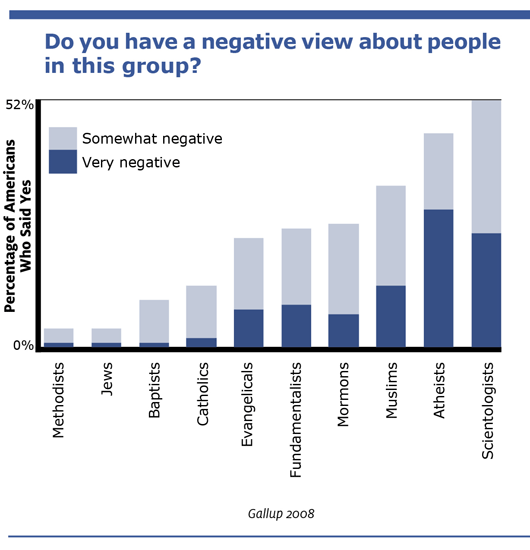
We see this negative connotation of the word evangelical in the Barna and UnChristian findings, where "evangelical" Christians receive much less favorable impressions than do "born-again" Christians. We also see it in a 2008 Gallup study that asked Americans how they viewed a wide range of religious groups (see chart on page 23). Among the general population, about 25 percent had a negative view of evangelicals. Among non-Christians, 50 percent had a negative view. But only 11 percent of the general population viewed Baptists negatively, as did only 26 percent of non-Christians. Here's the catch: The great majority of Baptists are evangelicals.
People seem to be reacting against the label evangelical more than against evangelical Christians themselves.
What do people think of when they hear evangelical? Ron Sellers, president of Ellison Research, wanted to find out, so in 2008, he asked 1,007 randomly selected Americans a simple question: "In your own words, how would you define exactly what an 'evangelical Christian' is? Please be as specific and complete as you can in your answer."
In the most common response, 36 percent of the respondents reported having no idea what the term meant. This alone cautions us about relying on this label in research. Another 8 percent made a negative comment but without giving a substantive definition. The remaining answers were all over the map—including people who thought that "evangelical Christians" meant any Christian who evangelized, was devoted to their faith, was politically conservative, or relied on the Bible. In all, only a little over half of the respondents (56 percent) could offer any type of substantive definition—even a wrong one (like very strict Catholics or angel worshipers). Some of the respondents described evangelicals in harsh language, using terms such as "psychos, stupid, narrow-minded, bigots, idiots, manipulative, fanatics, and greedy." Yet some of the harshest language came from people who couldn't even define what an evangelical is—they just knew they didn't like them.
Ellison's findings harken to a classic sociological study of racial and ethnic discrimination. In the 1940s, sociologist Eugene Hartley asked college students about their attitudes toward different groups. However, his list of groups included several fictitious or otherwise unknown groups, such as the Danireans, Pirenians, and Wallonians. A good portion of the respondents reported having antipathy toward these fictitious groups. So they didn't like people who not only had they never met, but who didn't even exist.
In light of this evidence, does evangelical Christianity really have an image problem? This is a subjective judgment; two people can look at the same data and come to different conclusions. I am surprised at the relatively low percentage of non-Christians who expressed unfavorable opinions about evangelicals. After all, these are people who have explicitly chosen not to accept a Christian worldview. Furthermore, people seem to be reacting against the tainted label evangelical more than against evangelical Christians themselves who, when referred to using different terminology, receive much warmer reactions.
Better All the Time
But are attitudes toward evangelicals getting worse? Here, the data over the past two decades are rather clear, and the answer is, no. They're getting better.
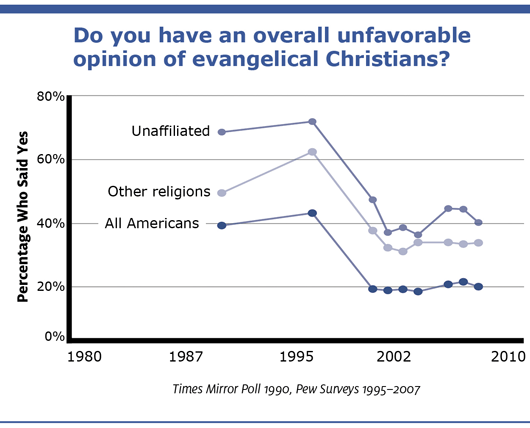
As the chart on the left shows, the Pew Forum found anti-evangelical Christian sentiments highest in the 1990s, when about 40 percent of all Americans and 50-70 percent of non-Christians held an unfavorable opinion of evangelical Christians. By the turn of the century, however, attitudes had grown substantially more favorable. Now, only about 20 percent of all Americans hold unfavorable opinions of evangelicals, as do only about 35-40 percent of non-Christians. This marked change has held steady over the past decade.
Likewise, the age group that views evangelicals most negatively may also be counterintuitive. It turns out that it is old, not young, people who hold the strongest anti-evangelical attitudes. In 2007, when the Pew Forum released its most recent data on the question, 45 percent of non-Christian respondents ages 50 and over expressed unfavorable opinions of evangelicals. This was meaningfully higher than the 36 percent of young respondents (ages 18-29) and the 32 percent of middle-aged respondents (30-49) who said this. While popular discussion focuses on young peoples' attitudes, the story here isn't "losing the next generation" but rather "what Grandpa is cranky about now."
Learning from Lip Piercings
Does it really matter that evangelical Christians assume the worst when it comes to how others think of us? Actually, it probably does—a lot. To understand why, we need to thank Henri Tajfel, an esteemed 20th-century social psychologist. Tajfel was a Polish Jew who, during World War II, joined the French army and was captured by the Germans. Somehow, despite acknowledging being Jewish, he survived the war in prisoner-of-war camps. When he returned home at the end of the war, he found that his entire immediate family and most of his friends had been killed in the Holocaust. This profound experience led him to dedicate his life to studying intergroup relations with the aim of reducing intergroup conflict.
Tajfel's social identity theory assumes that people derive some of their self-concept from their group memberships. For example, you can think of yourself as an American, a woman, a Red Sox fan, a pickup-truck owner, and so on. Because group memberships are important for our sense of self, how we perceive the groups to which we belong directly affects how we see ourselves.
Tajfel's theory assumes that most people think positively of the groups to which they belong. As a result, we tend to have an "in-group bias," having overly positive views of our groups and unduly negative views of other groups. This process, according to Tajfel, sets the stage for intergroup conflict, with each group thinking they are superior to the other groups.
But what happens when people view their own group negatively, as many evangelicals seem to? According to Tajfel, this situation creates emotional and mental tension. Since people are driven to see themselves in a positive light, and our self-concept is tied to our group memberships, then feeling bad about our group makes us feel bad about ourselves, and something's got to give.
Tajfel identified four strategies that people use to reconcile this type of situation: (1) Work to raise the status or quality of the group to which you belong. This can take the form of protest or other collective action. (2) Hide your association with the group, so as to avoid any stigma associated with it. (3) Distance yourself from the group or leave it altogether. (4) Disengage from non-group members, spending more and more time with members of your own group, by whom you feel affirmed.
Various studies illustrate these response strategies. In one, psychologists studied people with prominent body piercings in visible parts of their body (i.e., other than their earlobes). These prominently pierced people anticipated that mainstream society would view them as "weird" and reject them because of their appearance. In response, some took extra pride in their appearance, working to define it as "cool" and "meaningful." Others developed subcultural groups, spending more time with other, similarly pierced people. Others, however, hid their piercings around other people or removed the piercings altogether.
Another study examined Hispanic students attending predominantly white colleges. Some of them joined Hispanic student associations, thus intentionally spending more time with fellow Hispanics. But others distanced themselves from their Hispanic identity to be more comfortable around Anglos.
Applying Tajfel's work to evangelicals and their negative group image, we can expect evangelicals to adopt any one of the four strategies in varying degrees. Some might hide their affiliation with Christianity, choosing to be quiet about their faith with others for fear of rejection. Others, unable to reconcile their participation in Christianity with what they view as society's rejection of it, might leave the faith altogether. Finally, some might choose to avoid non-Christians, spending more time in "holy huddles." In this way, they receive the affirmation they crave and avoid perceived condemnation from outsiders.
Some evangelicals today, meanwhile, are strongly advocating that Christians reform their image in the world by acting more Christlike. No doubt we should act more Christlike, but an emphasis on "acting better" to create affinity between evangelicals and others might be misguided if that affinity already exists; it potentially overstates and even creates social barriers and conflict. Furthermore, this emphasis might actually deter evangelism, reduce commitment to Christianity, and even drive some Christians out of the faith.
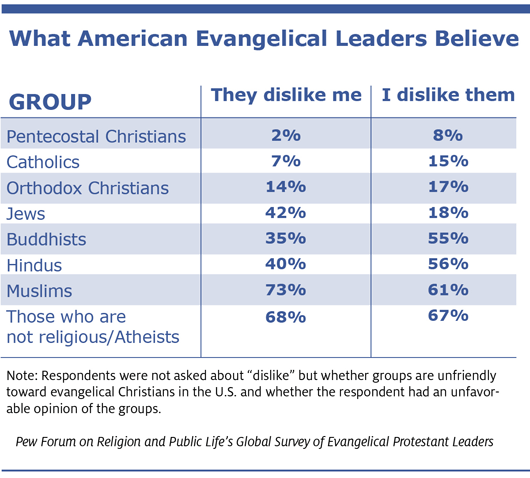
If American evangelicals do have an image problem, it's not our neighbors' image of us; it's our image of them. The 2007 Pew Forum study found that American Christians hold more negative views of "atheists" than non-Christians do of evangelical Christians. (The most recent Pew survey found similar attitudes; see the chart above.) Now, I am not a theologian, but this seems to be a problem. We Christians are called to love people, and as I understand it, this includes loving people who believe differently than we do. I'm not sure how we can love atheists if we don't like them.
Ultimately, evangelical Christians might do well not to spend too much time worrying about what others think of us. Christians in general, and evangelical Christians in particular (depending on how you ask the question), are well-regarded in this country. If nothing else, there's little we can do to change other people's opinions anyway. Telling ourselves over and over that others don't like us is not only inaccurate, it also potentially hinders the very faith that we seek to advance.
Bradley R. E. Wright is an associate professor of sociology at the University of Connecticut. His most recent book is Upside: Surprising Good News about the State of Our World (Bethany House).
Copyright © 2011 Christianity Today. Click for reprint information.
Related Elsewhere:
See "Inside CT: Do They Like Us?" for more on perceptions of the evangelical movement.
R. E. Wright's books Christians are Hate-Filled Hypocrites and Upside; Christian Smith's American Evangelicalism; David Kinnaman and Gabe Lyons' UnChristian; and Robert D. Putnam and David E. Campbell's American Grace are available at ChristianBook.com and other book retailers.
Additional Christianity Today coverage of the evangelical movement includes:
Polling Evangelical Leaders | Both unanimity and diversity emerge in a recent poll of the Lausanne delegates. (July 25, 2011)
The New (Evangelical) Mainline | American evangelicalism is displacing the old mainline. How do we keep from suffering the same fate? (May 12, 2009)
Inventing Evangelicalism | No one was more pivotal to the emerging movement than carl F.H. Henry. (March 1, 2004)
The New Capital of Evangelicalism | "Move over, Wheaton and Colorado Springs—Dallas, Texas, has more mega-churches, mega-seminaries, and mega-Christian activity than any other American city." (May 21, 2002)