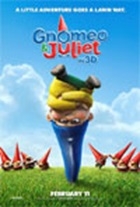
Romeo and Juliet's star-crossed lovers have provided plenty of fodder for filmmakers over the years, from faithful adaptations to re-imaginings like Westside Story and the MTV-styled Romeo + Juliet. But never has the story been reinterpreted for CGI-rendered garden gnomes. Enter Gnomeo and Juliet, an unabashedly goofy animated adventure that nudges and winks its way haphazardly through the Bard's tale, taking more than a few good-natured liberties as needed.
The action takes place, naturally, on Verona Street, where a certain Miss Montague (voiced by Julie Walters) lives in hostility next to an equally acrimonious Mr. Capulet (Richard Wilson). But never mind the humans. Miss Montague's extensive garden is inhabited and maintained by blue gnomes, while a community of red gnomes nurtures the Capulet yard. When no one is looking, the gnomes come to industrious life, busying themselves with extensive (and inventive) lawn maintenance, mower races, various family and romantic relationships, and, of course, despising their rivals.
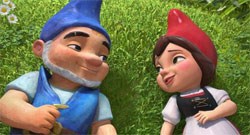
Gnomeo (James McAvoy) and Juliet (Emily Blunt)
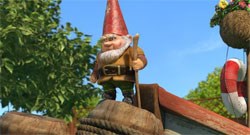
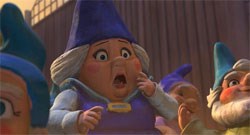
The Blues hate the Reds, and the Reds hate the Blues, and so (it seems) it shall ever be, until Gnomeo (James McAvoy), son of Lady Bluebury (Maggie Smith), meets and falls in love instantly with Juliet (Emily Blunt), daughter of Lord Redbrick (Michael Caine). From there, things get more complicated, and loonier, by the second.
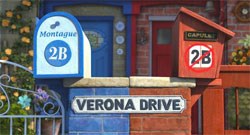
Gnomeo and Juliet has plenty of fun with its Shakespearian roots, indulging in an endless stream of shameless puns (Miss Montague lives in 2B, while Mr. Capulet makes sure to note that his home is NOT 2B) and even allowing Gnomeo to argue plot points with an animated statue of the Bard himself (voiced splendidly by Patrick Stewart). But the filmmakers don't lose site of their target demographic; familiarity with the original story is a bonus for adults but not essential for the film's younger audiences.
Lord Redbrick (Michael Caine)
My own kids were attuned to more recent inspirations and influences, noting similarities to Toy Story, certain Veggie Tales installments, and Shrek. The comparisons are warranted. The genius of the "animate objects who have to pretend they are inanimate when humans are looking" is definitely Toy Story turf, but it's used to particularly fun effect in Gnomeo and Juliet, especially when the gnomes must pause in the midst of an epic battle to strike imbecilic garden poses in the presence of a passerby.
Gnomeo's unapologetic silliness is reminiscent of Veggie Tales, and it turns out that Starz Animation, the Canadian company who produced 2008's The Pirates Who Don't Do Anything (as well as 2009's visually-stunning 9) is the connection. The team at Starz is to be commended for rendering a vivid, whimsical gnome-universe in which the characters are vibrant and dimensional without losing their "ceramic-ness"—quite an accomplishment. And the 3-D aspect of the film is commendably subtle; Gnomeo and Juliet's colorful world is rich, nuanced, and layered without an over-reliance on headache-inducing gimmicks. The 3-D is in no way essential to this film, but neither is it irritating, and that's an accomplishment too.
Verona Drive, of course, and note the puns on the mailboxes
The film comes by its Shrek echoes naturally; director (and screenplay contributor) Kelly Asbury is a long-time animation artist best known for helming Shrek 2, and he and an extensive list of writing collaborators definitely aim for the pop-culture references and modern-twists-on-a-classic-tale devices that define the Shrek franchise. Some of this humor is more lowbrow than one would hope, from tired references to squirrels dropping their "nuts" to an oddly selected Brokeback Mountain reference. Most of the weaker material flies by so quickly that the flatter jokes are quickly forgotten, but one wonders what a sharper script could have done for Gnomeo and Juliet. As it stands, the film is highly entertaining, but it lacks the character development and story poignancy that could have made it a classic. Gnomeo and his pals are no Woody and Buzz; they even pale next to Shrek and Donkey. But they are fun.
If Gnomeo and Juliet suffers in its screenplay, it thrives in its soundtrack, which is primarily a series of songs old and new from executive producer Elton John (who even gets an animated cameo in a fantasy-sequence in the film). Vintage nuggets like "Saturday Night's Alright for Fighting," a re-recording of "Crocodile Rock" (with Nelly Furtado), and a cover of the Beatles' gem "Hello Hello" (with Lady Gaga) help fuel the action. Even the film's orchestration plays with motifs from John classics, and it just works.
Lady Bluebury (Maggie Smith)
Over all that music, Gnomeo and Juliet proffers an exceptional voice cast. McAvoy and Blunt are note-perfect in the lead roles, and a solid assortment of mostly Brits fuels a quirky spectrum of supporting characters, from Juliet's ditzy sidekick Nanette (Ugly Betty's Ashley Jensen) to Gnomeo's testosterone-amped pal Tybalt (Jason Statham). And how many films boast theatrical royalty like Dame Maggie Smith, Richard Wilson, Julie Walters, and Michael Caine on the same cast list as Ozzie Osborne (inexplicably but hilariously given the role of "fawn") and Hulk Hogan (the obvious choice for a ridiculously machismo lawn mower commercial voice-over)? It's a diversity of talent befitting the melding of Shakespeare, Elton John, and garden gnomes; those unopposed to a little lunacy will enjoy the adventure.
Article continues below
Talk About It
Discussion starters
Consider this quote from Martin Luther King Jr: "Darkness cannot drive out darkness; only light can do that. Hate cannot drive out hate; only love can do that." Was that true in the battle between the Blues and the Reds? What happened when each side tried to make the other side pay for what they had done wrong?
Were Gnomeo and Juliet right to keep their love secret from their family and friends? Could they have handled the situation differently?
When Lady Bluebury and Lord Redbrick thought they had lost their children, they realized what their fighting had cost them. Have you ever had to lose something important to you before you realized what your actions were costing you? Is there anything you are in danger of losing now?
The Family Corner
For parents to consider
Gnomeo and Juliet is rated G. There are several fight scenes and a recurring sense of peril (the audience is led to believe the protagonists have died on more than one occasion), but it is all portrayed with such a sense of fun that likely only very young children will be frightened. There are numerous double entendres of a crude nature ("Let's kick some grass!"; a squirrel drops "nuts as big as ball-ders"; we see some gnome butt cheeks; and a gnome fountain "pees" in the garden), but most of them fly by very quickly and will be missed by younger kids.
Drake and Kendrick Lamar’s rivalry reveals our craving for controversy—and what’s lost when community is based on shared hatred, not love.
Russell Moore
Gnomeo and Juliet
1 of 4
Gnomeo (James McAvoy) and Juliet (Emily Blunt)Lord Redbrick (Michael Caine)Verona Drive, of course, and note the puns on the mailboxesLady Bluebury (Maggie Smith)














 While we pray for peace, we need moral clarity about this war.
 But let’s not mistake it for calling.
 Drake and Kendrick Lamar’s rivalry reveals our craving for controversy—and what’s lost when community is based on shared hatred, not love.