Q & A: Tim Pawlenty on Evangelicals and the Issues
The former governor of Minnesota has announced his presidential candidacy. Here's CT's earlier interview on issues like cap & trade, foreign policy, and whether evangelicals have influence in the Republican Party anymore.
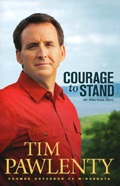
Courage to Stand
by Tim Pawlenty
Tyndale, January 2010
320 pp., $21.99
Tim Pawlenty knows that he doesn't carry the same name recognition that former Alaska governor Sarah Palin does, but that doesn't keep him from testing the 2012 presidential waters. The former governor of Minnesota said recently that he is "leaning" towards a run as he promotes his new book Courage to Stand (Tyndale). An outspoken evangelical, Pawlenty attends Wooddale Church, led by Leith Anderson, president of the National Association of Evangelicals. CT recently spoke with Pawlenty about issues like the environment, health care, and foreign policy, plus the number of evangelicals considering a 2012 presidential run.
Your book encourages Christians to be involved in public issues. At what point might Christians rely too much on political solutions to current problems?
I started with the perspective of someone who says that faith is separate from public law and public service; it really isn't. We have, as a country, a founding perspective that we're founded under God; our founding documents reference and acknowledge God, and acknowledge that our rights and privileges come from our Creator.
For those who have an interest in or passion about an issue, being involved in the political process is important. It isn't for everybody; there are other ways to serve, including the family, neighborhood, faith-based organizations, charitable organizations, and also reaching out and helping somebody on a one-on-one basis.
Recently, Alabama governor Robert Bentley spoke at a Baptist church about accepting Jesus Christ as your Savior, and then said, "I'm telling you, you're not my brother and you're not my sister and I want to be your brother." How does someone balance being evangelistic while also having the obligation of a governor representing a religiously diverse state?
I'm not familiar with the Alabama situation, so I can't comment on it. Beyond that, when I go into the public square and speak about faith matters, first of all, I try to not inject my own personal editorial comments. If I make a faith-related comment, I usually quote from the Bible, often from the Old Testament. I remind people that our country is founded under God, and the founders thought that was an important perspective. I watch my tone so I don't get judgmental or angry about issues. I try to express myself in ways that are measured and appropriate and hopefully civil and positive. Lastly, I try not to say that God is on my side, but I strive to be on God's side.
You write that whenever Christian leaders try to influence social policy, it's important to remain goodhearted, measured, and loving. Do you think Christians have struggled with these qualities in politics?
Some have. Of course, it doesn't take many to create a stereotype or impression on broader audiences. For people who might be a little skeptical about people of faith in public life, or people of faith who have large television exposure or something, [they have seen] a lot of fallen leaders. There have also been times when people came across as fairly judgmental. It's most effective to reach out in a way that's respectful and loving, even if we disagree. You win more arguments or draw people in to get a fair hearing if your approach is thoughtful and civil and respectful in these matters.
In light of President Obama's meeting with the president of China, what kind of relationship should the U.S. have with countries that curtail religious freedom, like China and others?
First of all, we should get our finances in order. China has so much leverage over us, and it's hard to tell off your banker. We've given them too much leverage over our economy, which diminishes our ability to speak with the right kind of moral authority and authority in general on other matters. We need to speak consistently about our values as a people, and that includes religious respect and the ability for people to worship freely. We've got to get our own house in order if we're going to be an effective voice on how other countries should change.
Indiana governor Mitch Daniels called for a truce on social issues in order to focus on the federal deficit. How do you prioritize these issues?
This is not a comment about Mitch; I'll just tell you what I believe. If you're going to be a leader in public office, whether at the state or federal level, you've got to be able to do more than one thing at a time. We've got to be able to walk and chew gum at the same time. I am proud to be labeled a fiscal conservative and a social conservative. My view is it's not either/or; there needs to be room in the debate for multiple issues, and we need to be able to do more than one thing at a time.
Some conservative groups have decided to opt out of CPAC because of its inclusion of the group GOProud. Where are the fault lines in the Republican Party on social issues—what are issues the party can't compromise on?
We can't ask people to compromise core values. On matters of core values, you can't ask and shouldn't expect people to compromise. These values are of such a core nature that it's not realistic or fair to ask people to set them aside. Most conservatives, including me, have strong views on a variety of issues. I've been pro-life my whole life. I've been in favor of traditional marriage. It's not just something you can toss to the side or throw out the window.
Article continues below
Do you agree with those who say that even with the executive order, the new healthcare law is the largest expansion of abortion funding since Roe v. Wade?
I was very disappointed that the Democrats and those who were on the other side of this issue didn't simply put into the law the Hyde amendment language. Now President Obama is saying it was eventually accomplished through an executive order, but there are a lot of us who don't believe that. It wasn't satisfactorily addressed.
During your term as governor, you supported reductions in greenhouse gases and a regional cap and trade plan. What measures should the federal government support to care for the environment?
All of us should be in favor of reducing pollution, but we need to do that in a way that doesn't wreck the economy. I came to the conclusion after looking at it very carefully that cap and trade is the wrong approach. I think it is a ham-fisted approach that is government-centered and top down, and the burdens it would have visited on the economy were unwise and really unbearable.
On the broader issue of what else we can do to reduce pollution, the primary answer will revolve around breakthroughs in technology and innovation. A game-changing development has occurred in the last few years, that is the massive amounts of natural gas that have been found within the United States. Many experts are now predicting that we have enough natural gas in the country to power the base load natural energy needs of the country for a couple hundred years. More nuclear energy would certainly help with reducing emissions. If there's more emphasis on nuclear, I think someday somebody will be able to bring to the market clean coal technology that will help us utilize the 250-year supply of coal that we have. And of course there are some promising renewable energies, but we've got to be careful how we use those, because some of them make more economic sense than others.
Article continues below
Do you think evangelicals will have more or less influence in the 2012 presidential race than they have in the past, especially with the Tea Party movement's rise?
I think they may be a very important part of the Republican Party and the conservative coalition. It is a coalition, and there is no one group that dominates the whole coalition. To be successful, we're going to need the support of all of those groups and more, and we're also going to need to convince independents and conservative Democrats to join our cause as well.
It seems like there are several evangelicals who are considering presidential runs, such as Sarah Palin and former Arkansas governor Mike Huckabee. Is that any indication that evangelicals are rising to leadership in the party?
Yes, and I also think it's an affirmation of these people feeling a sense that they have something to offer because of who they are and what they believe, the values that they have and how they line up with the values of the country.
You seem to get comparisons to Palin and Rep. Michelle Bachmann.
[A comparison to] Sarah Palin, of course, is a compliment. She's a force of nature, she's kind of in a league of her own when it comes to attention and the media's focus on her so far. I don't know if she's going to run or not, but I think she's a remarkable leader. I know Congresswoman Bachmann, I campaigned for her, I consider her a friend and I have a positive and good relationship with her as well. Voters will have to choose the style of who they want representing the party as a nominee.
Going back to evangelicals' involvement in politics, do you think evangelical pastors and leaders have influence in the Republican Party?
It really varies depending on the individual pastor and individual church. Rick Warren, for example, is a remarkable leader and he has a huge ministry. His voice and perspective influence millions of people. But as a church leader and individually, he doesn't get involved in partisan politics. I don't think you can make a sweeping comment about any one person—you have to look at it on an individual basis.
As evangelicals consider a candidate they could support, how can they navigate between candidates who have strong faith backgrounds?
It sorts itself out over time. Some of these folks won't even run. As you mentioned, there will be a number of evangelicals in the field, and people will have to sort through it, but there will be no shortage of choices. One thing I would say is that it's important that words and deeds match up. It's important to look at people's records in public office and see if they've done what they've said they'd do. Also look at their background and the life that they've lived.
Article continues below
What kinds of barriers do you think you'd have to overcome if you run for President?
One is unfamiliarity; I'm not well known outside Minnesota. A year ago I polled Republicans nationwide and only 15 percent of them even knew my name. Iowa and other places have a tradition of liking underdogs, so that's another thing to think about. You have to raise the right amount of money to be competitive. So far so good on that front.
I always remind people that the preamble of Minnesota's constitution says, "We the people of Minnesota, grateful to God for civil and religious liberties," and goes on from there to talk about the importance of perpetuating those to future generations. I think that's a powerful starting point for these discussions and a powerful point to keep in mind.
Courage to Stand is available from ChristianBook.com and other book retailers.
Other media coverage of Tim Pawlenty includes:
Tim Pawlenty talks faith, Barack Obama partisanship in book | As he weighs a run for president, former Minnesota Gov. Tim Pawlenty uses a new book to construct his national political narrative, from the son of a truck driver to a politician guided by faith—and also works in some blows at President Barack Obama. (Politico)
Evangelicals For T-Paw? | Could MN Gov. Tim Pawlenty (R) be the Mike Huckabee of 2012? (National Journal)












 While we pray for peace, we need moral clarity about this war.
 We’ve got little information on Jesus’ appearance and personality. But that’s the way God designed it.españolFrançais
 How groups like Hillsong learned to let go of the literal in favor of creative collaboration.españolPortuguês





