
"Love in this world doesn't come out of thin air. It is not something thought up. Like ourselves, it grows out of the ground. It has a body and a place." So writes Wendell Berry in his breathtaking novel Hannah Coulter. If any four sentences can sum up the core thesis of Craig G. Bartholomew's Where Mortals Dwell: A Christian View of Place for Today (Baker Academic), then surely it is these.

Bartholomew, a professor of philosophy, religion, and theology at Redeemer University College in Ontario, has written what ought to become the introductory book for evangelicals interested in issues of place-making. While other evangelicals have written well on issues of land use and conservation—Lisa Graham McMinn and Megan Anna Neff's Walking Gently on the Earth: Making Faithful Choices about Food, Energy, Shelter and More (2010) comes to mind—Bartholomew's book engages more comprehensively with what the Bible has to say about place. For that reason alone, it is likely to appeal to a broad swath of readers, including many evangelicals.
American Christians often struggle to understand the role of place in Scripture. Like much of Western philosophy generally, many recent forms of American evangelicalism marginalize or ignore the particular settings within which divine and human dramas unfold. We assume that place is trivial, merely incidental to the Bible's core message of salvation. And then, predictably enough, we read Scripture in such a way that our assumptions are confirmed. To such unwelcome habits, Bartholomew offers a bracing resistance.
The Geography of Redemption
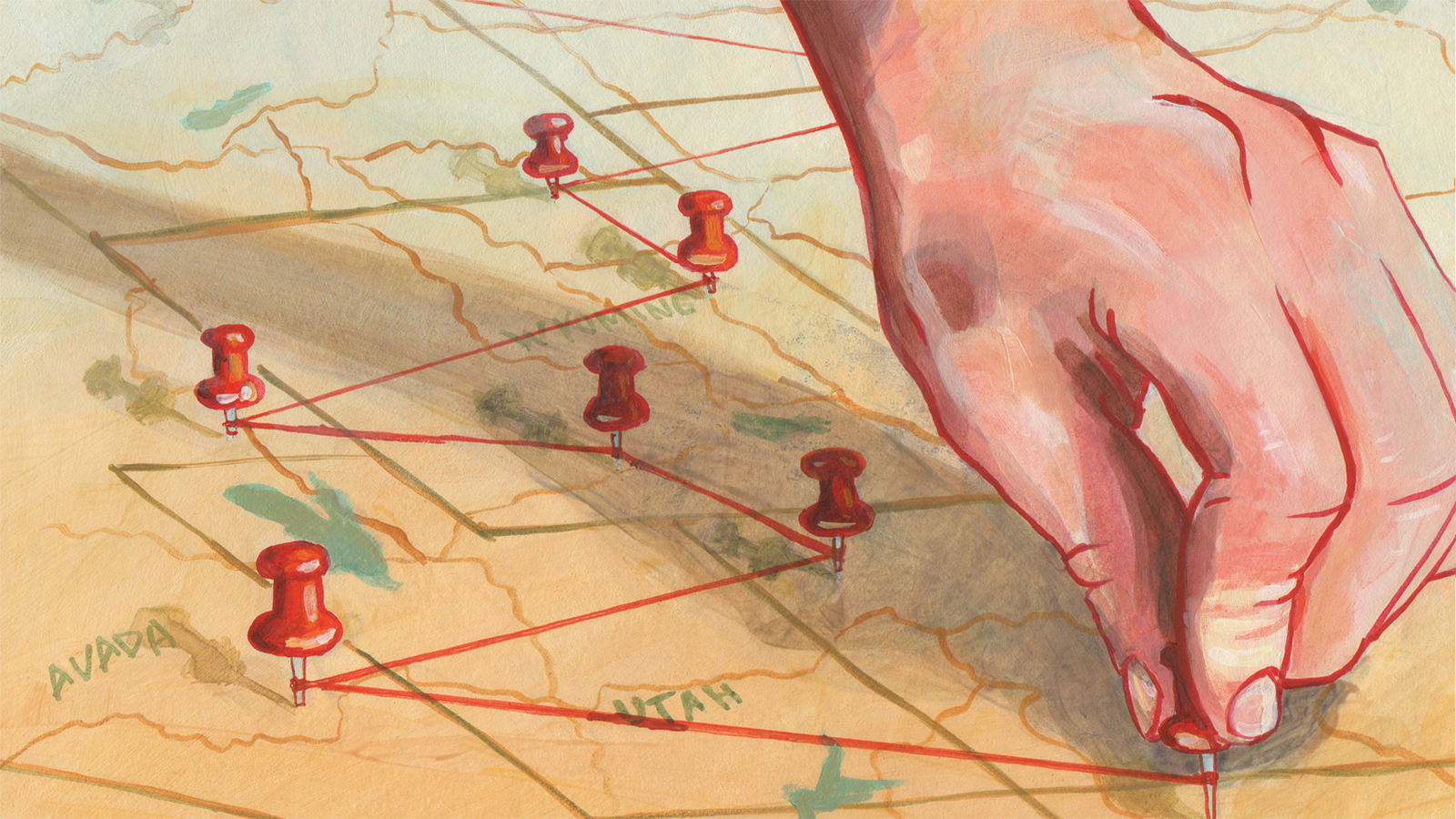
Bartholomew attempts to define place in the book's opening pages, but the concept tends to resist tidy definition. For most of us, the term conjures up highly evocative images, but we would struggle to give it a dictionary definition. Bartholomew offers a few principles to aid us: First, "[place] is a human concept," and "to be human is to be placed." Second, "place results from the dynamic interactions of humans and their particular location." Third, "although space and place are inseparable, place must be distinguished from space." These principles form the foundation of the book.
Bartholomew's opening chapters show the centrality of place in the Old Testament. When God speaks to Cain, he tells him that "the voice of your brother is crying out to me from the ground." The land itself tells of Abel's murder. God calls Abraham to a particular place, Canaan, and makes his pleasure known to Israel through its eventual provision. And later, when God's judgment falls upon his wayward people, his punishment of choice is exile from the Promised Land. To contemporary Westerners who view particular places as incidental to their lives, the centrality of place in the Old Testament can be quite jarring.
Yet it should not be surprising. From the very beginning, God's plan for creation was mediated through the particulars of a specific place and specific people. Genesis 1 speaks in grandiose, universal terms of God's plan for humanity to "fill the earth and subdue it" (1:28). It's a noble, epic calling, but to individual human beings, it can seem too large to be believed, much less realized. Until we continue reading. In Genesis 2, we find God focusing—focusing, not narrowing—the scope of that work. He does not give the creation mandate to Adam. Rather, to "the man of the ground" (adama means "ground" in Hebrew) he gives a very specific task: stay in the garden, work it, keep it. From the universal heights of the creation mandate, we immediately descend to the particular task of tending a garden and the failure of Adam and Eve to tend it well. This is the story of the Old Testament: emplacement in the garden, displacement on account of sin, and ever after, man's quest to be reemplaced.
Turning to the New Testament, Bartholomew shows how the redemptive work of Jesus Christ fulfills this very quest. Just as the Cross does not replace the Old Testament sacrificial system, but embodies the perfect sacrifice that system foreshadowed, the New Covenant—open to all who confess Christ—does not erase dreams of a Promised Land, but announces the true kingdom those dreams were meant to envision. What the Cross is to the Mosaic sacrificial system, the New Jerusalem is to Eden and the Promised Land. God's new creation will be a restoration, not a negation, of the places we have known before.
Bartholomew illustrates this point by quoting N. T. Wright: "The point of the present kingdom is that it is the first-fruits of the future kingdom; and the future kingdom involves the abolition, not of space, time, or the cosmos itself, but rather of that which threatens space, time, and creation, namely, sin and death."
The Jesus who proclaimed this kingdom was not some abstract theologian-philosopher, bereft of earthly allegiances, who swooped into the world to propagate an otherworldly message. Rather, as Bartholomew demonstrates, he was very much a first-century Jewish rabbi, and his mission brought the emphatically historical work of the Old Testament to its crescendo. If the New Testament isn't structured around the theme of place as explicitly as the Old, this is only because the New Jerusalem ideal was implicit within the worldview of Christ.
Starting Conversations
In the second part of Where Mortals Dwell, Bartholomew turns his attention to what other Western thinkers have said about place. Here, at some length, he contrasts the idea of "space"—a mere "position" or "point"—against the thicker tradition of place, in all its nitty-gritty particularity. Bartholomew traces a pattern of conflating "space" and "place" from its beginnings in medieval reflection through its culmination in the thought of Isaac Newton. From Newton onward, Westerners have struggled to think philosophically about place, even growing averse to the concept. Bartholomew also explores how Christians have understood place, highlighting thinkers ranging from Irenaeus—whose theology was quite friendly to place, since he stood opposite the other-worldly Gnostics—to Karl Barth. Here he finds the Anglican and Dutch Reformed traditions especially instructive for evangelicals seeking help in developing a Christian view of place.
To contemporary Westerners who view particular places as incidental to their lives, the centrality of place in the Old Testament can be quite jarring.
Finally, in part three, Bartholomew begins the difficult task of constructing a theology of place for today. His discussion touches upon themes of the home, the church, the garden, the city, the arts, and food production. The discussion runs the gamut from big-picture questions of city planning to more intimate matters, like how a front door helps or hinders a home's homeyness. Some readers may feel frustrated with this section, either because it is too short or perhaps too free in volunteering specific prescriptions. However, such criticisms miss the mark. Bartholomew isn't looking to create hard and fast rules for every conceivable situation. He seeks, instead, to provide some general principles that might inspire new conversations about creating and preserving those places that promote human flourishing.
Most importantly, Where Mortals Dwell forces evangelical readers to reevaluate their assumptions about the nature of life and Christian ministry. We tend to measure our lives by the yardstick of professional success, and evaluate our ministries according to their theological purity, numerical size, or accumulated wealth. Those aren't always bad standards of judgment, but any value system that excludes the role of place cannot help being badly inadequate. It is, after all, in particular places that we grow up, go to school, find jobs, marry, raise children, and enjoy friendships. If nothing else, Bartholomew reminds us of a truth we're inclined to forget: that only within this matrix of particular loves and loyalties can we encounter and follow the risen Christ.
Jake Meador, a recent graduate of the University of Nebraska, blogs at Notes from a Small Place. His writing has appeared in Books & Culture and Relevant.
Copyright © 2011 Christianity Today. Click for reprint information.
Related Elsewhere:
Where Mortals Dwell is available from ChristianBook.com and other book retailers.
CT also has more music, movies, books, and other mediareviews.