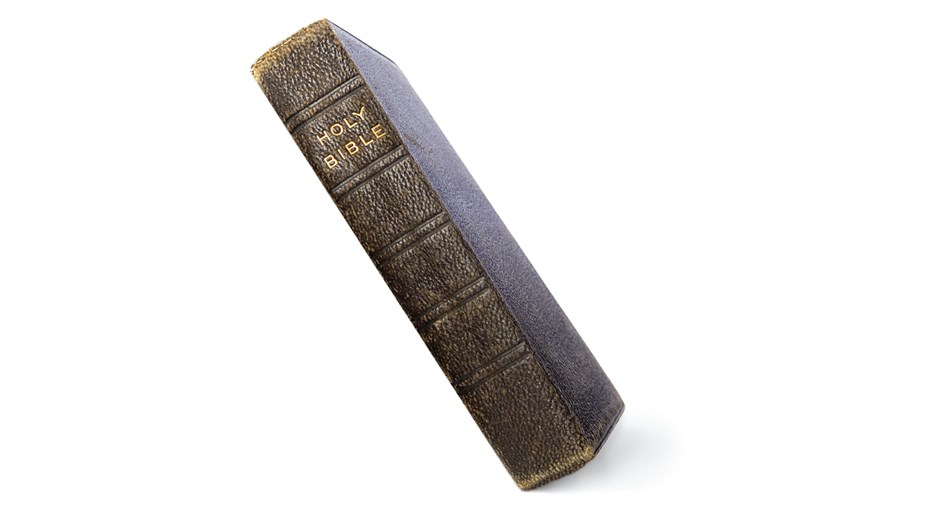
A recent poll from LifeWay Research found that 89 percent of American households still own a Bible, with the average home having 4.1 Bibles. But owning a Bible is different from reading it—and pollsters might be surprised by what happens when many Americans do.
Most polls, surveys, and studies that have examined the Bible's influence have looked at views of its inspiration and methods of interpretation. Gallup, for example, has for four decades asked Americans how literally the Bible should be taken. Comparatively very little research has looked into what happens when one actually reads the Bible, especially when one reads it independently outside the church.
Perhaps we've assumed that such questions would be redundant, merely one more measure of religiosity, along with how often one attends church, how literally one views the Bible, and how much one prays. When researchers look at these indicators, they usually find a correlation with both political and moral conservativism. It's not always the case, but it is a trend. Reading the Bible on one's own makes a difference, too. The interesting part, however, is the unexpected difference it makes.
Frequent Bible reading has some predictable effects on the reader. It increases opposition to abortion as well as homosexual marriage and unions. It boosts a belief that science helps reveal God's glory. It diminishes hopes that science will eventually solve humanity's problems. But unlike some other religious practices, reading the Bible more often has some liberalizing effects—or at least makes the reader more prone to agree with liberals on certain issues. This is true even when accounting for factors such as political beliefs, education level, income level, gender, race, and religious measures (like which religious tradition one affiliates with, and one's views of biblical literalism).
Terrorism, Justice, and Science
In 2007, the Baylor Religion Survey asked Americans how often they read the Bible on their own. (It was a five-point scale in this study, ranging from "never" to "several times a week.") It also asked whether the federal government should expand its authority to fight terrorism—a reference to the Patriot Act. For each increased level of Bible-reading frequency, support for the Patriot Act decreased by about 13 percent.
Frequent Bible reading also influences views on criminal justice. As might be expected, respondents who were more politically liberal were prone to disagree with the statement, "The government should punish criminals more harshly." Unexpectedly (at least given the conservative stereotype), the more frequently people read the Bible, the more they too are prone to disagree with the statement. This is not an anomalous finding: Support for abolishing the death penalty increased by about 45 percent for each increase on the five-point scale measuring Bible-reading frequency.
Reading the Bible affects attitudes toward science as well. If you just ask people about biblical literalism, you don't find statistically significant differences in views of whether science and religion are compatible. But the more someone reads the Bible, the more likely he or she is to believe science and religion are compatible. (For each increase on the five-point scale, the odds that they see religion and science as incompatible decrease by 22 percent.)
Justice and Consumption
Some of the most interesting findings relate to moral attitudes. "How important is it," the survey asked, "to actively seek social and economic justice in order to be a good person?" Again, as would be expected, those with more liberal political leanings were more likely to say it's very or somewhat important. And those who read the Bible more often were more likely to agree. Indeed, they were almost 35 percent more likely to agree at each point on Baylor's five-point scale. That may be bad news for Glenn Beck, who last year told believers to leave their churches if they hear "social justice" language being used. Likewise, contrary to liberal media stereotypes, those who are most engaged in their faith (by directly and frequently reading its source material) are those who are most supportive of social and economic justice. A reading, politically conservative literalist is only slightly less supportive than a non-reading, politically liberal non-literalist.
Likewise, the survey asked whether one must consume or use fewer goods in order to be a good person. Political liberals and frequent Bible readers are more likely to say yes. A conservative Bible reader might not be as prone to say yes as a liberal non-reader, but think of it this way: Ask an evangelical who is politically conservative, has some college education, has an average level of income, is a biblical literalist, and does not read the Bible, and you'll have only a 22 percent chance he or she will say reducing consumption is part of ethical living. Ask the same person, only now they read the Bible, and you'll have a 44 percent chance they'll say so. It's still not a majority, but the swing is dramatic.
Article continues below
Why The Bible Pushes You Leftward
The discussion becomes even more interesting when we consider who is most likely to read the Bible frequently. It's evangelicals and biblical literalists, those who tend to be more conservative on these topics. In other words, those who read the Bible most often are more conservative, but the more they read the Bible, the more likely it is that their views will change, at least on these topics.
Why does this happen? One possible explanation is that readers tend to have expectations of a text prior to reading it. Given the Bible's prominence in our society, it's little wonder that many people think they know what's in it before they open it up. But once they start reading it on their own, they are bound to be surprised by something, and this surprising new content is then integrated and grafted on to the familiar. Beliefs do change with the addition of new information.
But it doesn't have to be unfamiliar content to surprise the reader. It just has to be personally relevant. Frequent Bible readers may have different views of biblical authority, but they tend to read it devotionally, looking for ways in which Scripture is speaking directly to them. They will read until struck by something that sticks out in the text. Even if the reader thinks the Bible has some error or needs a lot of interpretation, this thunderbolt moment can take on tremendous personal significance.
But frequent Bible readers don't just see the Bible as personal. They also see it as authoritative, written by an author who had a specific context and intent, and they want to conform to its message. After all, why read the Bible with no desire to embrace what it teaches?
In short, sometimes reading the Bible can change views and attitudes because readers are surprised by what's in it. Other times, it's just a matter of discipleship.
Aaron B. Franzen is a graduate student in the sociology department at Baylor University. This research is undergoing peer review.















 While we pray for peace, we need moral clarity about this war.
 As my doubts about his teachings grew, so did a secret fascination with Jesus.
 How groups like Hillsong learned to let go of the literal in favor of creative collaboration.españolPortuguês






