There is a moment in The Mill & the Cross in which the power of art, in particular sacred art, to capture the eternal in the hugger-mugger of ordinary life—and even in the most horrific and seemingly meaningless events—is revealed with stunning clarity. André Bazin, the great Catholic film critic and theorist, wrote about the mission of art to rescue the world from transience and corruption, to capture moments and events in time and space before they slip into the irretrievable past, and so bear witness to the hand of God in creation. I don't know if I've ever seen this idea more resoundingly affirmed than in The Mill & the Cross.
If that description intrigues you and makes you want to see the film, I almost think you should stop reading here until you've had a chance to see it, especially if you're lucky enough to catch it on the big screen. I've seen The Mill & the Cross twice, and I'm grateful that I went into my first screening stone cold, without having read a single review or description.
Coming out of my first screening, I wanted more than reviews: I wanted a book, preferably well illustrated with photographs. I was gratified to learn that there is such a book—two books, in fact. The Mill and the Cross, by art critic Michael Francis Gibson, is an analysis of Bruegel's 1564 painting The Way to Calvary, and inspired the film, which Gibson cowrote with Polish artist and filmmaker Lech Majewski. Gibson and Majewski also collaborated on a second, expanded edition of The Mill and the Cross that combines images from the painting and Gibson's text with notes from the film production as well as photographs and storyboards.
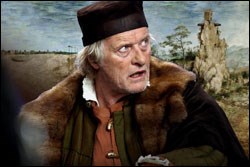
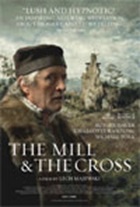
Rutger Hauer as Pieter Bruegel
The Mill & the Cross (the film; note the ampersand) is thus a sort of dialogue between two artists across half a millennium, mediated by a writer. Like Gibson's text, the film is a meditation on Bruegel and The Way to Calvary. The painting is in a way an immersive experience: It is a large panel, about 4 feet by 5½ feet, crammed with such a wealth of detail, depicting a vast throng of about 500 people of all walks of life—peasants, tradesmen, clerics, merchants, officers, nobles—that the viewer is drawn to stand closer and closer to appreciate each detail in turn.
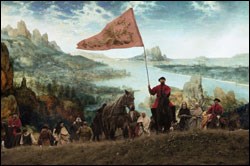
The film makes the experience even more immersive, bringing the world of the painting to life with an extraordinary digital blend of live action, 2D and 3D imagery, and bluescreen photography. The world it evokes is partly Bruegel's own Flemish world; in keeping with time-honored custom, Bruegel vested The Way to Calvary in contemporary garb, and most of the throng are dressed as 16th-century Flemings, and go about their business unaware of the sacred drama inconspicuously unfolding in their midst. Provocatively, the armed riders in red tunics escorting Christ to his death are not literal Roman soldiers, but Spanish police—mercenaries of Philip II policing Flanders, putting Protestant heretics to death.
The film likewise depicts glimpses of 16th-century Flemish routine: men chopping down a tree in the forest; a horse drawing a cart; a peddler packing a large pack. Some of these vignettes connect with details in The Way to Calvary; others don't. One household, in which a young wife tends a large clan of raucous children, is Bruegel's own.
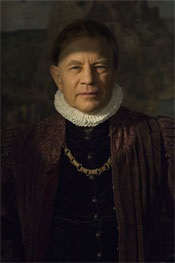
Michael York as Nicolaes Jonghelinck
One of the most horrifying sequences illuminates a prominent feature in the painting: a tall post on the right side of the painting propping a wagon wheel in the sky. Bits of rope and cloth hang from the wheel, and a crow perches on its rim—mute evidence of a grisly practice all too suggestive of crucifixion.
Literal crucifixion, of course, was not practiced in Flanders, yet there Christ stumbles under the weight of his cross in the exact center of the painting, with Simon preparing to help him carry it. In the film, as Bruegel wanders about the Flemish countryside planning his painting, we see vignettes from the Last Supper and the Passion.
In fact, the film inhabits the world of the painting—and Bruegel is there inside his own work, explaining everything to his patron, a wealthy merchant of Antwerp named Nicolaes Jonghelinck (Michael York). In the world of the painting, Bruegel orchestrates his composition like a film director preparing a big crowd set piece, sketching the scene like a storyboard artist.
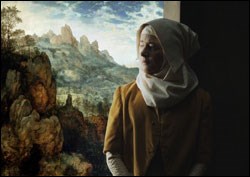
Charlotte Rampling as Maria
Sometimes the players seem aware that they are models in an artistic endeavor, as when we see a woman, named in the credits as Maria, being elaborately garbed in the anachronistic apparel that Bruegel uses for St. John and the holy women—monumental figures in the foreground, set apart by a rocky rise, looking like expatriates from another artistic era. Yet Maria's grief watching the scenes of passion and crucifixion is that of a mother, for in the world of the painting she is the Madonna. (For what it's worth, I'm told that the real Bruegel used no models and did no preliminary sketches or under-drawing.)
Jonghelinck, too, is both Bruegel's real-world patron and a figure in his work. He is disturbed by the harsh realities of his times—by the actions of the Spanish forces in his country—and particularly by the persecution of the young prophet. "I heard the things he said," Jonghelinck frets, "how he would tear down the cathedral and rebuild it in three days. None of us had any problem with that! We understood he was talking about reform." (Jonghelinck, Maria, and Bruegel are the only speaking roles in the film, not counting the soldiers' Spanish banter.)
Article continues below
All this is anachronistic, of course, but it's an anachronism at the heart of Bruegel's painting. Christ's actions were once for all, and his words cannot be transposed into a 16th-century Christian context—but Jonghelinck's comment credibly approximates how a sympathetic rabbi or Pharisee in the first century might have understood Jesus' words, even if such an understanding would have been inadequate.
Among those persecuted or threatened by Philip's forces in the Low Countries might have been ancestors of my own. Johannes Greydanus, who originated my family name, was a contemporary of Bruegel living in Friesland, and our family was Dutch Reformed from the beginning. I am a first-generation Catholic convert, but I nevertheless find the idiom of the film, paralleling Catholic persecution of Protestants with the passion of Christ, natural enough. Whatever we do to the least of these, whoever they may be, we do to Christ. He was crucified with the Catholic martyrs in England, and with the Protestant martyrs in the Low Countries.
In Bruegel's painting, towering over the countryside, is a feature certainly not copied literally from life: a rugged, column-like promontory with a windmill on a round platform improbably perched at the peak, framed against the backdrop of the sky. In the world of the film this mill is ubiquitous, always looking down on the lives of men below, sometimes distant on the horizon or glimpsed through windows.
An early sequence reveals a precipitous wooden stairway leading up to the mill, and the mighty machinery thundering away inside. With the dramatic camerawork and the clamor of the soundtrack, it seems vaster and more imposing than any real windmill; I was put in mind of the engine room of the Titanic, or of something even more vast and fantastic. ("Windmill like a Star Destroyer!" I scribbled in my notebook.)
Eventually we learn from Bruegel that his mill in the sky, with its wheels and stone within ever in motion, grinding out the grain for daily bread, is a cosmic symbol: the wheels of fate, the spheres of the heavens, "grinding the bread of life and destiny."
Article continues below
The painting comes to life
Only a tiny, distant figure in the painting but playing a larger role in the film is the film is the miller himself: a silent, enigmatic figure in the sky, looking down on the lives of men, inscrutable as the Lord in the middle chapters of Job. Only once does he intervene—in response to the artist, who seeks to make sense of the senseless spectacle unfolding before him, to wrestle the senseless moment to the ground.
The final shot, a slow pan backward from the real painting in the Kunsthistorisches Museum in Vienna, is haunting and unsettling. The echoes of the last scenes of Bruegel's peasants linger, but their voices are long gone, and the vitality of Bruegel's creative act seems muted in its institutional setting. The film proposes that The Way to Calvary is a prayer. It is a melancholy thing to see a prayer in a museum.
Talk About It
Discussion starters
If you could have any artist take you inside one of his paintings, show you around its world and explain it all to you, what painting would you pick? What questions would you ask the artist?
What religious works of art (paintings, icons, crosses or crucifixes, statues, etc.) do you have in your house, or in your church? Do you think such images are important or not important? Why or why not?
What does the Bible have to say about visual arts?
Do you have a favorite style of sacred art? What is it and why?
What do you think of how the film ends? What does the ending not show? What do you think of that? Discuss other ways the film could have ended. Is the ending satisfying or not? Why?
The Family Corner
For parents to consider
The Mill & the Cross includes some grisly and disturbing imagery as well as brief full nudity and fleeting sexuality. There are depictions of passion narrative violence (whipping, beating, a crown of thorns) and a literal crucifixion as well as another scene in which a man is beaten and left strapped high in the air to die—a historically accurate depiction of the exhibition of condemned victims' bodies—where crows pick at his mangled face. In another scene a woman is buried alive—also a historically accurate depiction of the execution of women heretics. Bruegel and his wife are briefly seen in bed together, and his wife is briefly seen entirely naked, front and back, while getting dressed—a sight in which one of the boys takes a furtive interest. There's also a fairly graphic glimpse of a mostly clad couple groping in the grass, though no explicit nudity there.












 While we pray for peace, we need moral clarity about this war.
 But let’s not mistake it for calling.
 The champion of “native missions” trained more than 100,000 evangelists but got in trouble for financial mismanagement.