The decade since 9/11 has taught us the limits of force. Imposing democracy on Iraq and Afghanistan has come at a terrible cost to all parties, with no guarantee of long-term success. Meanwhile, Tunisia and Egypt gained freedom almost overnight in a grassroots protest against powerful regimes.
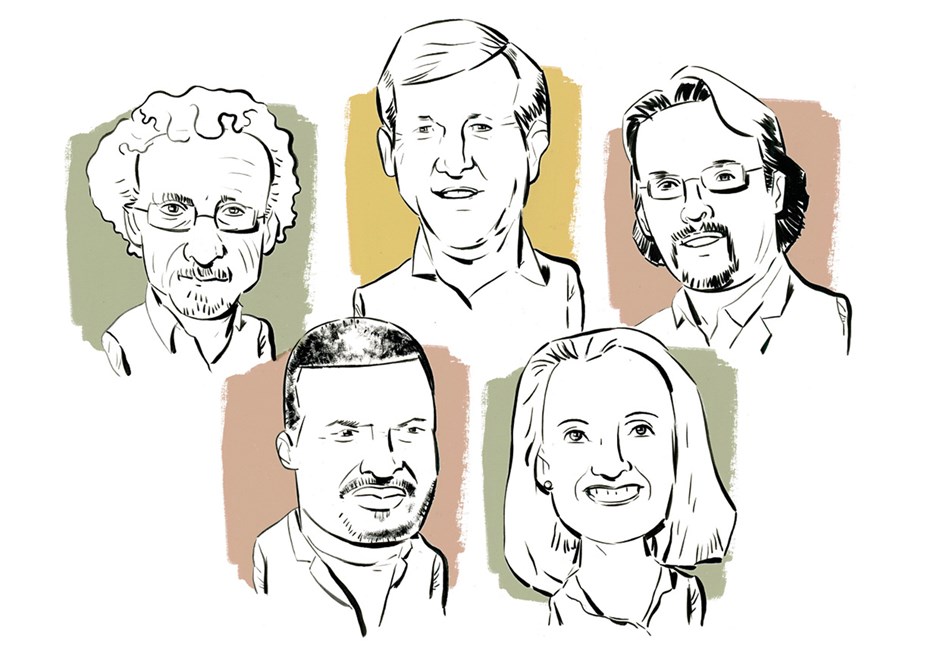
As Christians, we believe in a counterforce of grace. Lewis Smedes and others have identified three stages of forgiveness: first, recognize the worth of the person you are forgiving; second, surrender the right to get even; third, put yourself on the same side as the one who wronged you. Increasingly, I'm convinced that we need more of this attitude toward those who seek to harm us.
In 1999, Australian missionary Graham Stuart Staines was burned to death by a Hindu mob in Orissa, India. In 2007, German missionary Tilman Geske was tortured and murdered by five Turkish fanatics. The widows of both men made sensational headlines in those countries by repeating the words of Jesus: "Father, forgive them, for they know not what they do."
I am not a pacifist; I believe that we must pursue justice. Yet a Christian history stained by anti-Semitism—holding an entire people responsible for the actions of a few—teaches us the terrible consequences of not following Jesus' way. We dare not do to Muslims what we have, to our shame, done to Jews.
* * *
Harry R. Jackson Jr., international presiding bishop of the International Communion of Evangelical Churches
I will never forget evacuating our ministry's downtown offices in Washington, D.C., on 9/11. For the first time in my life, I watched the U.S. population collectively experience a sense of vulnerability that heretofore had been reserved for persecuted minorities. For three weeks, local church attendance soared as deep spiritual needs were no longer anesthetized by drinking, sex, and overeating.
What was missing? First, local church revivals could have begun, marked by deep repentance and personal piety, prayer, and devotion to the Scriptures. Second, a national spiritual awakening could have broken out. Third, a prophetically motivated clergy and leadership could have truly become the nation's spiritual shepherds by "speaking truth to power."
Awareness of a missed opportunity during the weeks following 9/11 empowered us to more fully embrace future opportunities. A better understanding of how spiritual awakenings occur led our team to create a public policy group called the High Impact Leadership Coalition. This year, we have begun our most daring step toward creating a Christian counter culture: the development of the International Communion of Evangelical Churches, a confederation of 1,000 related houses of worship. We hope to influence the next generation's thought leaders by planting multiracial, disciple-making churches near major universities and winning 2 to 5 million souls in the next decade.
Wess Stafford, president of Compassion International
From the ashes of 9/11 arose both horror and hope. We Americans, united in our grief, became better versions of ourselves: our giving was more generous, our volunteering more enthusiastic, our worship more ardent. We unabashedly flew our flags and sang "God Bless America."
As it did for others, the magnitude of the blow energized my faith and filled my heart with pride and gratitude to be an American. Something new awoke in me on 9/11: life was more precious, time was short, evil was frighteningly real, and I was more motivated than ever to ensure that goodness prevailed.
I became even more passionate about my mission to fight the evil that grinds good, hardworking, and even godly people into poverty and its desperate consequences. I was heartened to witness the church being stirred to a greater desire to advance on this battlefield. Compassion International more than tripled in size this past decade as a result of God's people living out their faith. Many have realized that "doing good" is not good enough for the suffering poor—we need a level of commitment that goes further, one that reaches out more deeply and sacrificially.
Thanks to the will of the 9/11 generation, we now believe that it's not only necessary but also possible to push extreme poverty right off our planet. I think we can—and will—in my lifetime.
* * *
Samuel Rodriguez, president of the National Hispanic Christian Leadership Conference
During the 10 years following 9/11, as a Christian, husband, and father, I discovered that extremism comes in many shapes and sizes. Every extreme, whether ideological, spiritual, or political, carries potentially catastrophic destruction. I came to realize that the greatest antidote to extremist posturing lies embedded in the simple reality of the Cross.
The Cross that embodies the hope of glory for mankind simultaneously carries a powerful truth that life is both vertical and horizontal. Vertically, we stand connected to God and his kingdom; horizontally, we stand in communion with culture and society. Life brims with vertical and horizontal dichotomies: sanctification and service; covenant and community; faith and action; righteousness and justice; John 3:16 and Matthew 25; Billy Graham and Martin Luther King Jr.
Article continues below
Yet what is the strongest section of the Cross? Where should we live as followers of Christ, as parents, spouses, ministers, and citizens? Not in the extremes or outskirts but in the nexus, where the vertical and horizontal intersect: the center. How do we collectively triumph over extremism, moral relativism, spiritual apathy, cultural decay, and religious totalitarianism?
The only authentic, transformative solution to cultural challenges stems not from the donkey or the elephant but rather from the glorious intersection known as the agenda of the Lamb.
September 11 was an alarm that penetrated my daily responsibilities and my busy ministry schedule, warning me … of what? Ten years ago, I could not have answered that question. All I knew with certainty was that God was trying to get the attention of his people, including me. Like the prophet Isaiah in the year that King Uzziah died, I looked up with the eyes of faith.
What I saw was not just a fresh vision of Jesus Christ. Like Isaiah, I also saw a humiliating vision of my own sin. I spent days on my face before God, confessing my sin and receiving his cleansing. The result was an authentic experience of personal revival. The immediate impact was a renewed vibrancy in my relationship with God, an increased fervency in prayer, clearer insight into God's Word, and a sharpened focus in ministry.
But the alarm did not fade away. Instead, I have heard it reverberating throughout the past 10 years: from Hurricane Katrina to the record-breaking floods, forest fires, tornadoes, droughts, and snow storms; to the collapse of our major financial institutions; to the economic recession; to the inability to win the war in Afghanistan. The alarm keeps resounding because so many people have not heeded, or even heard, the warning.
And what is the warning? Simply this: It is five minutes to midnight on the clock of human history. Judgment is at the door. Jesus is coming! It's time to wake up and get right with God! Are you listening?
* * *
Article continues below
Richard Stearns, president of World Vision U.S.
The September 11 attacks jolted Americans into realizing that our nation was no longer, and never again would be, an "island" protected from the senseless brutality of terrorism. The world became smaller that day, and the person who could not find Afghanistan and Pakistan on a map suddenly wanted to learn more about those and other Muslim countries.
From the standpoint of international development, the attacks were a catalyst for renewed interest in and commitment to helping address the underlying problems that prompted 19 men to hijack and crash four jetliners, killing themselves and nearly 3,000 others.
Consider that over the past 10 years, private donations for international causes have more than quadrupled; Bono and Bill and Melinda Gates were Time's 2005 "Persons of the Year"; Bangladeshi microfinance expert Muhammad Yunus won the Nobel Peace Prize in 2006; the Clinton Global Initiative was established in 2005 to foster collaboration among corporate and humanitarian leaders; and Half the Sky: Turning Oppression into Opportunity for Women Worldwide, by Nicholas D. Kristof and Sheryl WuDunn, became the "must-read" book of 2009.
On September 10, 2001, many Americans had never pondered our nation's role in an increasingly complex and interconnected world. By the morning of September 12, few of us had not. And 10 years later, we recognize that it is better to embrace the challenges we face globally rather than retreat, build walls, and pretend that America can exist on its own.
Ten years ago, my family and I watched in surreal horror as the events of September 11 unfolded on the television screen, stunned as our eyes beheld something that our brains told us was impossible. During the ensuing decade, our world stumbled into a new millennium, battered by financial crisis, wars, and disasters, and shrunken by technological innovation. Amidst all this, our five grandbabies arrived with sheer determination to enjoy life.
How have I changed during this short span of time? I have become an incurable optimist. The arrival of tragedy is no longer the arrival of impossibility, no longer an impasse, but rather the arrival of God's presence amid difficult circumstances.
Today I am more convinced than ever that there is indeed a relational God present, personal, and involved in the midst of the mess and wonder of humanity, who is good all the time, and who respects the human creation more than we do; that there is a Spirit who is stirring countless hearts to everything that is good, causing us to question the fundamental paradigms that push us to harm and hurt and, in turn, inspiring us to create the new, the profound, the elegant, and the beautiful.
Article continues below
In the center of it all is Jesus, who is the revelation of True Good and in whom we have hope, not just individually but for us as the human race. One God, one Relentless Love.
* * *
Matt Redman, Christian worship leader, songwriter
My wife and I were due to fly from England to the United States on September 12, 2001, for a few months of sabbatical. The morning of September 11, our bags were packed, and we were ready to set off the next day. But the horrific events unfolded, and of course, our plans shifted. Later in the week, international flights resumed, and we managed to get on one of the first flights out.
During the first few days we spent in the United States, it seemed that, in all the shock and vulnerability, many people were heading to church for comfort and clarity. I was so impressed by the preachers: every place we visited, we heard messages of hope and reminders of God's sovereignty.
But it left me wondering: What could we sing to God at a time like this? It was as if our worship songs were missing some important vocabulary—the language of tragedy and struggle, of the valley at the bottom of the mountain—which I found surprising, as the Psalms are full of lament.
Soon after the tragedy, my wife and I wrote "Blessed Be Your Name." It's a simple worship offering about choosing to worship and trust God no matter what the season.
September 11 taught me that when it comes to worshiping God, we must trust, of course. But we can also be real, raw, and honest. We can lay our frustration and confusion before God and still rejoice. Doing so tells God we know he is bigger than all of our issues—and also provides a window of hope to a watching world.
When I lived in Steamboat Springs, Colorado, I nannied for an incredible family with four children. The parents had been out of town and were scheduled to return the morning of September 11. I was in the kitchen pulling cereal boxes out of the cabinet when they arrived, and remember clearly their announcement: "Margaret, turn on the television." I followed them into the living room and remember sitting glued to the television in a haze of disbelief and unanswered questions.
Article continues below
What had just happened in our world? And how soon would it happen again? A tragedy that's regular news in other nations touched our own soil. And we have never been the same.
But beyond those initial reactions to tragedy, 9/11 has shifted the questions I'm asking about my life. Instead of asking, "What if Jesus returns in my generation?" I find myself asking, "What if he doesn't?"
A decade after 9/11, we are still here. And what if that continues for another decade, and another? How do I need to live right now to pass on the faith in a meaningful way to the next generation? What does it look like to love my neighbor when his or her beliefs are so different from my own? How do I navigate the cultural shifts taking place in our world?
September 11 has been a profound wakeup call to love Jesus and others more.
* * *
Douglas Wilson, pastor of Christ Church in Moscow, Idaho
Of course, a stupefying event like 9/11 should never be reduced to a matter of personal growth or understanding. At the same time, to be unchanged by such an event, or not to notice such changes, is to be ranked in the top tier of those who are not really paying attention.
The American public square is teeming with people, and therefore opinions, and 9/11 brought many of those opinions about public aspects of faith into sharp conflict with one another. Two of these opinions have stood out in the past decade: radical Islam and Western secularism. The radical Islamist option is a hard, sectarian line, but the postmodern-affected secularists appear to be about as firm and steady as Belshazzar's knees. We need an alternative.
But what—besides residual motor memories from a distant and vanishing era—can provide us with a foundation for a continuing free society? Christian forms of a reactionary and tight sectarianism seem both doctrinally wrong-headed and impractical.
As a consequence, a line of thought since 9/11 has brought me, by degrees, to champion something called mere Christendom. This is, I am convinced, the only genuine alternative to secular American exceptionalism on the one hand, and radical Islam on the other.
* * *
Will Willimon, presiding bishop of the North Alabama Conference of the United Methodist Church
On 9/11 I thought, For the most powerful, militarized nation in the world also to think of itself as an innocent victim is deadly. It was a rare prophetic moment for me, considering Presidents Bush and Obama have spent billions asking the military to rectify the crime of a small band of lawless individuals, destroying a couple of nations who had little to do with it, in the costliest, longest series of wars in the history of the United States.
Article continues below
The silence of most Christians and the giddy enthusiasm of a few, as well as the ubiquity of flags and patriotic extravaganzas in allegedly evangelical churches, says to me that American Christians may look back upon our response to 9/11 as our greatest Christological defeat. It was shattering to admit that we had lost the theological means to distinguish between the United States and the kingdom of God. The criminals who perpetrated 9/11 and the flag-waving boosters of our almost exclusively martial response were of one mind: that the nonviolent way of Jesus is stupid. All of us preachers share the shame; when our people felt very vulnerable, they reached for the flag, not the Cross.
September 11 has changed me. I'm going to preach as never before about Christ crucified as the answer to the question of what's wrong with the world. I have also resolved to relentlessly reiterate from the pulpit that the worst day in history was not a Tuesday in New York, but a Friday in Jerusalem when a consortium of clergy and politicians colluded to run the world on our own terms by crucifying God's own Son.















 While we pray for peace, we need moral clarity about this war.
 As my doubts about his teachings grew, so did a secret fascination with Jesus.
 The rage of the mob is a poor substitute for real community.






