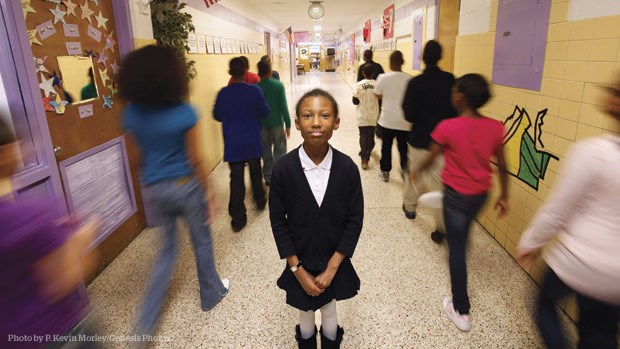
When Cheryl Burke first walked into the dark lobby of Chimborazo Elementary School, where she had just been appointed principal, she noted the distinct smell of urine. Outside, the playground was littered with "40s," large empty beer bottles, and crack cocaine was stashed in one of the bathrooms. "I just cried," says Burke, recalling that day in 1996.
Sixteen years later, the brightly lit lobby sports two armchairs and a coffee table. Where black asphalt once surrounded the buildings, there is now green grass. Sterile white cinder-block hallways now vibrate with colorful stripes of paint. Over the years, "Miz Burke," as she is known to staff, parents, and students alike, convinced the local faith community to pray for the school, raise funds, and counsel and tutor students. Chimborazo's scores on the state Standard of Learning exam have climbed, and now the number of students declared "proficient" in math and reading hovers around 60 percent.
Still, 88 percent of Chimborazo's students are so poor they receive free or reduced-price lunches; with that poverty comes a litany of challenges for the PK-5 school. As bright and beautiful as Burke has made it, Chimborazo reflects its local community, with all its hurts and all its possibilities.
Many Americans, including many Christians, do not consider urban schools like Chimborazo good enough for their children. Despite federal programs such as George Bush's No Child Left Behind and the Obama administration's Race to the Top, American students still struggle to achieve basic academic goals. The nonpartisan Broad Foundation for Education reports that 68 percent of American 8th graders can't read at their grade level, and most will never catch up. Nationally, 70 percent of students graduate from high school, and only 50 percent of African American and Latino students graduate on time.
But in recent years, a growing number of Christians across the country have felt called to take up the educational challenge in their own communities. In many of those communities, including Richmond, Virginia, the tide seems to be turning.
A Dream Realized
Over the past decade, a group of mostly white, middle-class Christian couples have moved into Church Hill, the community served by Chimborazo Elementary School. Unlike most families in Church Hill, these four couples have the financial and social capital to send their kids to private schools or to homeschool. Yet they have chosen otherwise. Building on the firm foundation Principal Burke has laid, they want to help restore a community struggling against generational poverty, and they believe a key component is sending their own children to the community's public school.
Sophie, Luke, Jack, and Chanan are all kindergarteners at Chimborazo, but the story of how they arrived there begins before they were born.
In 1995, most of their parents met as first-year students at the University of Virginia (UVA) in Charlottesville. They lived together for their final years of college (along with seven other men, including my husband) as an unintentionally diverse cohort: Corey Widmer, a lanky blonde interested in missional theology, and Matt Illian, then a cross-country runner, are white; Danny Avula, a stocky man who is quick to smile, is Indian; and Romesh Wijesooryia, a Jefferson scholar with athletic gifts that earned him a spot on the college's nationally ranked soccer team, is Sri Lankan. As the men's friendships developed, so did their awareness of the ethnic segregation among UVA's Christians. They wanted to figure out a way to bridge those divides.
So, Wijesooriya led a group of white and black Christians on a spring-break trip to Jackson, Mississippi, to meet Christian community development "grandfather" John Perkins and serve at his Voice of Calvary ministries. The trip sparked a vision. Widmer says, "[We] wondered if one day we might do this together—move into an urban community together and live out the principles of the Christian Community Development Association."
For years, the vision remained dormant. Then a number of prerequisites fell together. Avula and Wijesooriya joined a residency program at the Medical College of Virginia in downtown Richmond. Illian, a private wealth manager who works from home, had enough job flexibility to move to Richmond. That same year, Widmer received the call to become a pastor in a Richmond church. By that time, each man had married a woman who shared the vision for planting roots deep in an urban community.
But they didn't want to set up shop in just any poor area.
'What would it communicate to our neighbors if we said, "We're moving into your neighborhood, but we don't consider your
schools and public institutions good enough for our families"?'—Corey Widmer, Richmond pastor
"We wanted to be invited into the neighborhood, and we wanted to go to a place where God was already at work," says Mary Kay Avula. When they visited Church Hill, they met with local Christians. Among them, providentially, was Don Coleman, a local pastor. After they had talked, Coleman "claimed us as an answer to his prayer," says Avula. "He sensed that the Spirit was calling us long before we did."
Article continues below
When another Christian, Selena Ruffin, invited the couples to move to her street, three of the four families became her immediate neighbors. The Widmers moved in a few blocks away—all in Church Hill. They soon connected with Angie and Percy Strickland, another Christian couple who had arrived in Church Hill three years prior, setting up Church Hill Activities and Tutoring (CHAT).
Church Hill sits, literally, atop a hill overlooking Richmond's downtown. Once home to Richmond's upper class, it still features a number of historic churches. But the demographics have radically changed. It now hosts a majority African American population, and most residents live at or near the poverty line.
The UVA families quickly built relationships with their neighbors: The Wijesooriyas took in a young unmarried couple expecting their first child, and the Widmers housed two high-school boys when their mother needed temporary support. But the uva families soon realized the move would not come without costs. Catherine Illian, a petite woman with curly brown hair, recalls a time when she heard shouting and scuffling outside her door. "I was ready to call the police when I looked outside and saw that it was just a group of men socializing and talking very loudly …. I am still learning the difference between loud friendly banter and something more aggressive."
Illian faced aggression head-on in August 2007, when she and Mary Kay Avula watched a man across the street firing a handgun. "I was scared," Avula recalls. "But I was also well aware that there were dangers associated with living here."
Despite the taste of violence, Avula says her family never considered leaving. "There are dangers no matter what path you choose in life. Some of them you think you can control, but you can't."
Each family took jobs that served Richmond's poor. Danny Avula became Richmond's deputy director of public health. Romesh Wijesooriya, a pediatrician at Virginia Commonwealth University, began studying childhood obesity, a chronic health problem in urban areas. With Ruffin, some of the families revived a local Christian nonprofit, Urban Hope, to ensure affordable housing throughout the neighborhood. And Mary Kay Avula started teaching at Chimborazo Elementary.
In 2007, John Perkins returned the visit and came to Church Hill. He encouraged the families, but voiced one concern, remembers Widmer: "The church is absent. Without worshiping together, you will become a loose, disconnected group of social activists rather than a Christ-centered community." That prompted Widmer and Pastor Coleman to form a weekly gathering for Christians and seekers called East End Fellowship.
Article continues below
But a test of their commitment was on its way.
What to do with the Kids?
Within a year or two of arriving in the neighborhood, the couples all had children of their own, and they began to talk about where to send them to school. The adults' own educational backgrounds were varied: four had attended public schools, three had attended private schools, and one, Catherine Illian, had been homeschooled through 10th grade. The friends talked about starting a charter school, or founding a Church Hill campus of a private school on Richmond's South Side. But as much as such schools might eventually benefit the community, they chose another option.
"Investing in the public school meant that we were investing in an existing institution that was trusted by the community," notes Matt Illian. "Anything else that we were to start would really take decades to build that same level of trust."
But gaining the trust of the community couldn't be their only concern. "After some pretty intense late-night crying sessions with God and Matt, I decided that Jack would be gaining more than he would be losing … the decision to send him to Chimborazo forced me to trust God in a way I hadn't before," says Catherine Illian, recalling her fears about sending their son to Chimborazo. "I grew up in a family where education was one of the most important things that we could do for our kids," says Danny Avula, who graduated from UVA at age 19, then finished medical school and earned a master's degree in public health. "But that attitude can become an idol."
Together the group decided to send their kids to Chimborazo. Corey Widmer asks, "What would it communicate to our neighbors if we said, 'We're moving into your neighborhood, but we don't consider your schools and public institutions good enough for our families'?"
These men and women in Richmond are not alone. Across the nation, Christians are in one way or another investing in local public schools, using a variety of strategies to help turn things around. Nicole Baker Fulgham, a Detroit native, for years taught with Teach for America, a non-profit that trains teachers to work in low-income communities. After serving as Teach for America's vice president of faith community relations, last fall she founded the Expectations Project, which equips churches, nonprofits, and individuals to help low-income public schools. "I've been blown away in the past couple of years by the receptivity and interest of the Christian community," says Fulgham, who is based in Washington, D.C. "We now have solutions to some of the problems and so we can mobilize faith communities to respond."
Article continues below
The Memphis Teacher Residency (MTR) is one such solution. It is the only urban teacher residency program in the country with a Christian identity. The nonprofit trains teachers in an intensive one-year residency, where they are paired with a teacher-mentor in a Memphis classroom. By the end, residents have earned a Masters of Arts in urban education through nearby Union University, and a Tennessee state teaching license. In return, residents teach in an underserved Memphis school for at least three years. Founder David Montague roots MTR's educational reform in a broader context. "We're only willing to do education reform within a community development approach," says Montague, "so that a child can be born in [a given neighborhood] and have a great teacher from kindergarten all the way through 12th grade."
Like the families in Richmond, some Christians begin by moving into low-income neighborhoods. After five years in a strong school district, Kirsten Strand and her husband moved to Aurora, Illinois, to serve in an urban context. They had felt the call for years, but had put off moving because of the struggling school system. Ultimately, "we decided that our kids would receive a wonderful life and cultural education, even if the academic experience wasn't as enriched," says Strand. Her husband left his job in corporate America to become a third-grade teacher at the school. Other families moved to East Aurora for similar "missional" reasons. "We've found the schools here to be very open and eager to partner with our church, so we've been able to start tutoring and mentoring programs and engage in the schools in lots of ways," says Strand. "We really don't need to 'bring God' to East Aurora. We just need to join him in what he is already doing here."
Jake Medcalf describes his family's move into City Heights, California, as "the ministry God dragged us into." He and his wife, Joan, had been serving the affluent community in Pacific Beach. Jake oversaw youth ministry at a local church, and began forming relationships at the local Mission Beach High School. Only then did he realize that 90 percent of his students were bused to the school from 10 miles—and a socioeconomic world—away. A few years later, he and Joan moved into the kids' neighborhood, where the average income for a family of four is $18,000. Jake's philosophy for doing so is simple: "If you're called to a people, you need to live among the people." The Medcalfs' daughter will begin kindergarten at the school next fall. "We could bus her out because our local schools are underperforming," says Jake. "But we are in the same boat as our neighbors."
Article continues below
Stephanie McLeish, a mother of three in New Orleans, echoes Medcalf's sentiments. McLeish's oldest son attends a local public school where he is the only white student in his class and where 89 percent of his peers receive free or reduced price lunch. McLeish and her husband belonged to a group of families representing four New Orleans neighborhood churches who met for a year to discuss starting a Christian school.
"In the end," McLeish says, "many of us felt this was an excellent time for the church to engage the public schools of our city." She explains the theological basis for her convictions: "Christ is at work redeeming all things, not just souls but also places, systems, business, and even education." McLeish has lived in the neighborhood for a decade, and more recently, she and her husband have invested more deeply in the local school, volunteering regularly and hosting teachers for dinner. "The problems as well as the blessings of living in this impoverished community have become my own," says McLeish.
'A Tenuous Hope'
The families who moved into Church Hill have found that forces beyond their control continue to impede Chimborazo's growth. Mary Kay Avula notes that "many families struggle to get their basic needs met, and some don't have permanent residences. Many have witnessed acts of violence or have a family member who is incarcerated. Students need a great deal of support to be successful in school when they face the various risk factors associated with poverty."
Catherine Illian, an active member of Chimborazo's PTA, explains the challenges of engaging parents: "We have parents without transportation, parents working two jobs, single moms with multiple kids, grandparents as primary guardians, parents who work at night and sleep during the day and find coming to night meetings difficult, parents who didn't do well in school themselves and are intimidated by school and what that represents."
Article continues below
But other Christians in Church Hill have filled in the gaps. Principal Burke has organized buses to pick parents up for PTA meetings and found grant funding to host a food bank alongside the meetings. Pastor Coleman joined the Richmond City School Board as a way to represent his neighborhood's needs. Michelle Macklin, PTA president, and Leon Warlington, another local parent, show up at Chimborazo every morning simply to help in whatever way is needed. CHAT has flourished in recent years and now operates at five different Church Hill locations, tutoring dozens of neighborhood kids one on one a few afternoons a week. Lawson Wijesooriya leads the Blue Sky Fund, a local nonprofit that gives youth from urban environments an outdoor experience. Part of her work involves monthly experiential learning projects with the third-grade students from Chimborazo Elementary.
'I've been blown away in the past couple of years by the receptivity and interest of the Christian community.'—Nicole Baker Fulgham, the Expectations Project
But the most comprehensive effort to address the academic needs of students in the neighborhood has been spearheaded by Matt Illian. He has assembled a taskforce of current and future parents to make Chimborazo the first Richmond City elementary school that follows the International Baccalaureate methodology. The IB initiative would involve overhauling the entire curriculum and training every teacher. But Principal Burke has championed the initiative from its inception, and the vast majority of Burke's staff voted in support of the curriculum change. The Richmond School Board unanimously supported it.
As Illian says, "We got momentum going because we wanted to support the local elementary school. This wasn't just for our children. All children [in the area] will receive a world-class education." Illian's taskforce has committed to raising over $400,000 to fund the teacher training and media and material upgrades, in order to reach full authorization in May 2014.
As in East Aurora, New Orleans, and City Heights, Church Hill Christians have their sights set on more than education reform. After the birth of her and Danny's first child, Mary Kay Avula stopped teaching at Chimborazo Elementary. But she invited all the girls from her third-grade class to her house for weekly Bible study. Now in high school, the girls still meet weekly. Mary Kay and Lawson co-lead the study, but also take the girls to doctors' appointments, help their families pay the bills, and have recently begun steering them through the college admissions process. All girls in the original group have "a sincere faith in the Lord," says Mary Kay.
Article continues below
Meanwhile, East End Fellowship's congregation has grown. Corey Widmer describes the 200 congregants who show up every Sunday afternoon as a "pretty amazing mix of people—rich and poor, black and white …. Literally there are homeless people and partners in major law firms sitting in the same room together."
The couples are quick to point out that while they hope to serve the community, they also assume that they and their families will be blessed by living there. Danny Avula says, "Our neighbors don't just need us—we need them. In the context of these diverse, complex, and beautiful relationships, we find our wholeness." They look to the future with what Avula calls "a tenuous hope"—a hope that generations of suffering will be undone by the power of God's Spirit, at work in believers who continue to pray and look for God's kingdom to come among them.















 While we pray for peace, we need moral clarity about this war.
 A Christian reconciliation group in Israel and Palestine warned that war would come. Now the war threatens their relevance.españolالعربيةFrançaisрусскийУкраїнська
 The government plans to close its porous border with Myanmar to boost security, separating ethnic groups that straddle the boundary.






