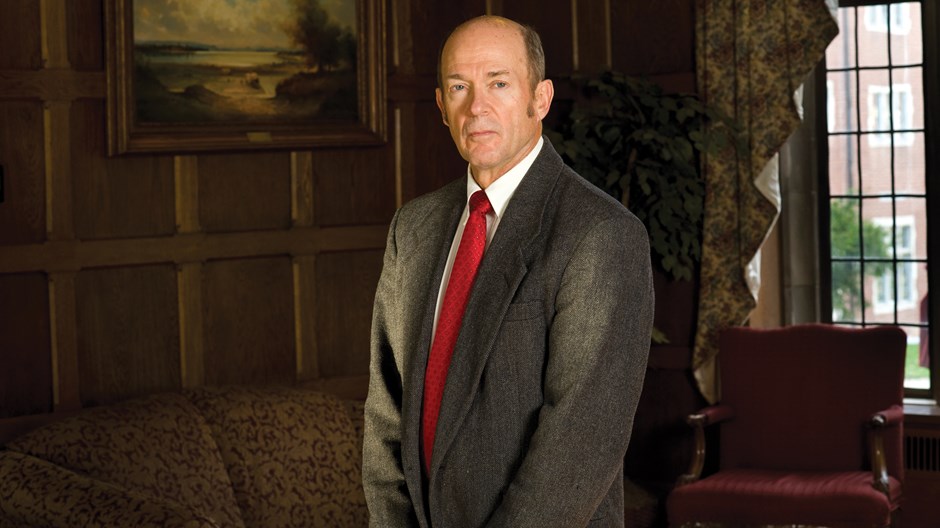
To have so many candidates in the current campaign say faith is a significant part of their lives and has a major impact on how they think about politics and policies—this is unique." So says Gary Scott Smith, professor of history at Grove City College in Pennsylvania. He should know. He wrote a book that examined the faith of 11 American presidents (Faith and the Presidency from George Washington to George W. Bush, Oxford University Press), and is working on another that looks at the faith of 11 more, including President Obama.
Presidents have often made assertions of faith, Smith says, but to have such a high percentage of candidates do so is unusual in American history. Senior managing editor Mark Galli talked with Smith about what difference, in fact, faith has made in the White House.
What strikes you most about the religious nature of this election?
First, that there is confusion about the nature of Obama's faith. On the one hand, you have 20 percent of the population still saying he's a Muslim. You have a group of socially liberal evangelicals who are very positive toward Obama's faith. You have theologically and politically conservative evangelicals and Catholics who are quite upset with the President because of various policies he holds, particularly on abortion and gay rights. So you have quite a spectrum.
Second, on the Republican side, it's unique to have two Mormon candidates (Jon Huntsman and Mitt Romney), which has raised a lot of concern among evangelicals.
But in our history, we've had at least four presidents who were Unitarians—who were heterodox from a traditional Christian perspective. John Adams was a Congregationalist, and Thomas Jefferson was an Episcopalian, but both were Unitarians in belief.
John Quincy Adams clearly identified with Unitarianism. And the most famous Unitarian was William Howard Taft. He was affiliated with a well-known Unitarian congregation in Washington. In the 1908 campaign, Teddy Roosevelt campaigned for and defended him; he argued that Taft's religious views were essentially mainstream except on the deity of Christ, and that they shouldn't be an issue in the election.
In a country that celebrates the separation of church and state, the House of Representatives recently and overwhelmingly reapproved "In God We Trust" as the U.S. motto. This suggests that religion continues to play a significant role in our public life.
The role is great. We have a more strident group of agnostics and atheists and non-churched people in our country than we've ever had. We can go back to the group that now calls itself Americans United for the Separation of Church and State (originally called Protestants and Other Americans United for the Separation of Church and State), which started in 1947. Over the past 60 years, this group has complained that Americans are not properly recognizing the boundaries of the First Amendment. But the issue has become more important in the past 10 to 15 years. So there is more pressure than ever on politicians to be careful about the way they express their faith. We also have much more media scrutiny than ever.
'Americans want their chief executive to have a strong religious faith. They want to know that the President prays, seeks God's guidance, and believes God is in control of the universe.'—Gary Scott Smith
At the same time, we've continued to have many religious candidates and presidents. The presidency of George W. Bush is well known for this, but we can also go back to Bill Clinton. Arguably, Clinton used more religious rhetoric than George W. Bush did. And we've had a series of recent presidents—George H. W. Bush, Ronald Reagan, Jimmy Carter—who claimed to have deep faith. Obviously Clinton did some things that made people question his, but they all used a great deal of religious rhetoric, and certainly all of them stepped over the boundaries of what separationists say is permissible.
But look at what the founders did in the realm of politics. They declared national days of prayer and fasting. They allowed chaplains for the Senate and the House. They allowed military chaplains. The most outspoken separationist, Jefferson, who gave us the famous statement about the separation of church and state, was okay with the federal government funding evangelistic missions to Native Americans, and with allowing worship to take place in the Hall of the House of Representatives in Washington, D.C., when very few congregations were functioning in Washington.
What has been the President's religious role in our nation's history?
In the absence of a national chaplain, the President sometimes has functioned in that role, partly because of the expectations of the American people. When we have a crisis, whether it is a war or a tragedy—like the shootings in Tucson or a space disaster—we expect the President to function almost as our civic priest. We want him to give us assurance that God is still in control and that the people who have died have died for a good cause and that they're going to be eternally blessed. President Obama did this in his 10th anniversary speech for the victims of 9/11, and in his speech for the victims of the Tucson shooting. Nearly every President has at some point given speeches where he has acted as a national chaplain, a high priest of civil religion. Of course, they're very careful in those discourses to talk only about God, not Jesus, and to use generic religious language.
Article continues below
The other potential religious role is for the President to serve as a prophet of civil religion. Abraham Lincoln is the greatest example. He tried to stand above the conflict of the Civil War and say both sides were at fault, needed to repent, and needed to be charitable toward one another.
All kinds of polling data show that Americans want their chief executive to have strong religious faith. It's usually in the 70 to 75 percent range, depending on how the question is asked. They want to know that the President prays, seeks God's guidance, and believes God's in control of the universe. They typically don't want the President to wear his religion on his sleeve, to be too overtly religious. That scares people; Americans consider that potentially divisive. But they do want the President to be a person of faith.
Some Christians say that civil religion is an alternate, idolatrous faith, one that competes for the Christian's loyalty. Others think it relatively harmless, and others believe it is a positive good—at least up to a point. Where do you fall on the spectrum?
'The main thing to look at is the candidate's character, which of course is often connected to his worldview and faith commitments.'
Our society is pluralistic. It's diverse. The New Testament doesn't say that we're supposed to use government to impose our values on other people; everybody should have the same civil rights to propagate their own religious convictions. Of course, you don't allow human sacrifice. You don't allow things that are beyond the pale of civic responsibility. But Muslims, Buddhists, Hindus, secular humanists, Christians, Jews—everybody should have the same civil rights in society.
So what do you do if you're a Christian President? What do you do if you're George W. Bush or Barack Obama? How do you function? They rightly recognize that they are the President of all the people. How do they effectively follow Christ in the political realm? Well, you probably can't speak explicitly about Jesus, because that would be politically divisive (unless you're talking to Christian groups or making proclamations about specific Christian holidays). So you are probably going to use generic language.
Article continues below
You can debate exactly what "civil religion" means, and it can be idolatrous. I don't think it has to be idolatrous. However, it would be difficult to pinpoint a time in American history when it's been clearly idolatrous. In a pluralistic society, religious freedom is most consistent with what the New Testament teaches about the role of the magistrates; they are not instructed to use their power to force people to believe any particular thing.
Among the presidents you've studied, who have been the most personally devout and theologically orthodox?
In terms of traditional orthodoxy, Woodrow Wilson, Jimmy Carter, and George W. Bush would be at the very top. William McKinley would also be on that list; he was a very devout Methodist.
If we are simply looking at presidents who had a strong interest in religion, I'd emphasize John Quincy Adams. I'd also put Jefferson on that list, because he extensively studied religious writings, especially the Bible; he read the Bible probably half an hour a day. And he often read it in French and Italian to get insights that he couldn't glean from English translations.
My book tries to draw correlations and connections between presidents and public policy. I examined how their faith may have affected their policies in office. Harry Truman was a rather devout man, and he knew the Bible very well and quoted it extensively. Reagan was also close to the top, as was Eisenhower.
Which presidential administrations have been most shaped by the chief executive's religious convictions?
Carter's and Wilson's. I would say Truman's, too. You can clearly see it in Truman's recognition of Israel. One main reason he went against the State Department and George Marshall, his Secretary of State—who argued that it wasn't a good strategic move to recognize Israel—was his understanding of the Bible and his belief that the Jews deserved to have a Promised Land. Truman saw himself as a kind of Cyrus giving back the land to the Jews. He said so on the record a couple times. His administration was shaped substantially by his personal faith.
Reagan's faith played a substantial role in his presidency. George W. Bush's faith informed his faith-based initiatives and his reasoning regarding his war against terrorists.
Article continues below
I covered 11 presidents in the first book. I'm doing 11 more in the second. In all 22 cases, you can find correlations between faith and policy. I never argue that a President's faith directly caused him to adopt a certain policy, but I do argue that it's reasonable to conclude that his faith was a strong part of the mix.
Your next book will include President Obama. What are some ways his faith has shaped his presidency?
Obama was more outspoken about his faith when he was campaigning than he is now. Look at the campaign speeches he gave, especially the 2006 speech at the Sojourners Call to Renewal conference, and the 2007 speech to the United Church of Christ (his so-called "A Politics of Conscience" speech). He gave his testimony in numerous speeches, and he tied what he was planning to do to scriptural injunctions, particularly pertaining to the least of these and being our brothers' keepers. That was a big theme.
Many people were surprised when he decided to continue Bush's faith-based initiatives. Some have been concerned about how he's implemented that program, but he has continued it. His health-care policy is related to his concern for the poor. He's connected his faith to a number of policies, but not as much as one would expect, given what he said during his campaign.
But I don't think Obama has capitalized on many other opportunities to tie his faith to his policies and his style of governance. And he's hurt himself by not identifying with a church in Washington, D.C.
How much should citizens, especially Christians, consider a candidate's personal faith when determining their vote?
I wouldn't make it the number one consideration. The main thing to look at is the candidate's character, which of course is often connected to his worldview and faith commitments. We should look as much as possible at character issues.
Second, we should look at the whole gamut of policies a candidate promotes and see how that accords with what we think is best for our nation and with our understanding of Scripture. It's possible that a candidate with weaker faith commitments will have policy prescriptions that are more in line with what Scripture teaches.
If everything else were equal, I would be more inclined to support the candidate who has a strong faith and who looks to God for guidance and who covets the prayers of the American people, who is a person of prayer and who's part of a worshiping Christian community. But I would put character and policy analysis first.
Article continues below
How Presidents Religiously Identified
John Adams: Congregationalist/Unitarian, Saw God's hand in U.S. history
Thomas Jefferson: Episcopalian/Unitarian, A devoted Bible reader
Abraham Lincoln: Baptist/unaffiliated, 'Architect' of civil religion
William McKinley: Methodist, Wanted to Christianize the Philippines
William Taft: Unitarian, Teddy Roosevelt defended his faith
Woodrow Wilson: Presbyterian, Deep faith influenced his international policies
Harry Truman: Southern Baptist, Believed he was Cyrus to the Jews
Jimmy Carter: Southern Baptist, First self-acknowledged evangelical president
George W. Bush: Methodist, Faith-based initiatives a result of his faith
Barack Obama: Congregationalist, Gave his testimony many times in 2008
Gary Scott Smith's research on George Washington's faith during his presidency is included in Christianity Today's new eBook Faith and the American Presidency, available for Kindle and Nook.
Previous CT interviews with political figures include:


















 While we pray for peace, we need moral clarity about this war.
 As my doubts about his teachings grew, so did a secret fascination with Jesus.
 The rage of the mob is a poor substitute for real community.






