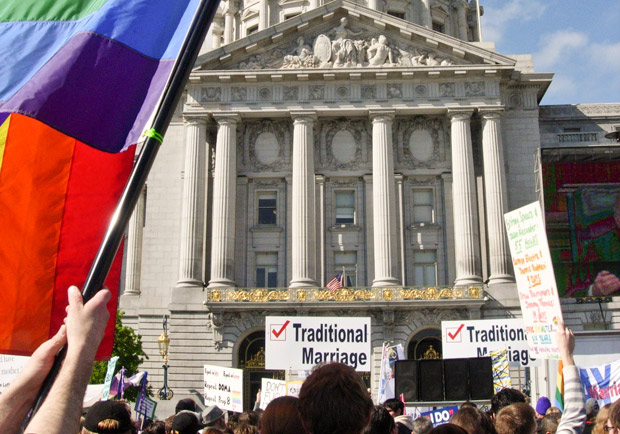
A ruling Tuesday by the Ninth Circuit Court of Appeals leaves backers of California’s Proposition 8 only one more avenue for appeal—the U.S. Supreme Court.
In February, a panel of three judges from the Ninth Circuit ruled that California’s ban on same-sex marriage was unconstitutional. Proponents of Proposition 8 then asked for a larger review by 11 of the 25 members of the circuit court; today’s vote by a majority of the Ninth Circuit denies reconsideration of the decision.
The Ninth Circuit said that California’s ban on same-sex marriages would remain in place for now. The circuit court gave 90 days for an appeal to be filed with the U.S. Supreme Court.
In response to the decision, Alliance Defense Fund senior counsel Brian Raum pointed to a dissenting opinion by Judge Diarmuid O’Scannlain, beginning with a quote from President Obama’s recent announcement that he supported same-sex marriage. The president called for a “respectful conversation” as states decide the issue.
“Today our court has silenced any such respectful conversation,” O’Scannlain wrote. “We should not have so roundly trumped California’s democratic process without at least discussing this unparalleled decision as an en banc court.”
The Supreme Court may not give the case a full review. Despite the salience of same-sex marriage in national politics, the legal issues raised by the panel could be too narrow to merit the Supreme Court’s attention. Judge Stephen Reinhardt wrote a carefully tailored decision in February that limits its importance to constitutional jurisprudence.
The three judge panel said in February that the events in California were unique because same-sex couples were able to marry before the proposition changed the state constitution. Other states could, under the ruling, preemptively ban same-sex marriages, but they cannot nullify same-sex marriages already in place.
In May 2008, the state supreme court ruled that a law passed by voters in 2000 defining marriage as the union between one man and one woman violated the state constitution’s gender and sexual orientation protections. The voters overturned the decision just months later in November by passing Proposition 8, which added to the state constitution, “Only marriage between a man and a woman is valid or recognized in California.”
The issue with Proposition 8, according to the panel, was that it not only banned future same-sex marriages, it also invalidated the 18,000 same-sex marriages that occurred in the months between the state supreme court decision and passage of the proposition.
“Proposition 8 serves no purpose, and has no effect, other than to lessen the status and human dignity of gays and lesbians in California, and to officially reclassify their relationships and families as inferior to those of opposite-sex couples,” the panel wrote.
The panel rejected arguments that the proposition advanced legitimate state interests in areas such as child-rearing, procreation, education, or religious freedom, saying that the proposition was instead motivated by hostility toward homosexuals.
Charles Cooper, lead counsel in favor of the proposition, said, “The idea that Californians—of all people—sought to ‘send a message that gays and lesbians are of lesser worth,’ as the [February panel’s] decision claims, is simply absurd. Voters from all walks of life, political parties, races, and creeds supported Proposition 8.” The Supreme Court could decide to deny consideration of the appeal, which would allow the panel’s ruling to stand. If the Court hears the case, it would likely consider only the constitutional issues raised by the appeals court. The Court is not limited in any way and could decide to take the case and make a decision on broader questions about the constitutionality of same-sex marriage, states’ rights, and the legitimate powers of government.
Copyright © 2012 Christianity Today. Click for reprint information.
Related Elsewhere:
Previous coverage of Proposition 8 and the courts include:
Ninth Circuit Declares California’s Proposition 8 on Marriage Unconstitutional | A panel ruled that a proposition to define marriage as between a man and a woman violates the 14th Amendment to the U.S. Constitution. (February 7, 2012)
Why the Proposition 8 Decision Matters | That Judge Walker’s ruling is not a surprise does not make it any less of a landmark. (Al Mohler, August 5, 2010)
What Is the Gospel Response to the Prop. 8 Decision? (August 9, 2010)
Prop. 8 Ruled Unconstitutional (August 4, 2010)