Christianity Today stands squarely in the evangelical tradition of the faith. We believe this is worth reaffirming precisely because of the way the word evangelical has become debased in our time.
Evangelicalism has become identified, at least in the media that shape so many Americans' imaginations, with the politics of fear—both Christians' fear of losing crucial cultural battles and secularists' fear of theocracy coming just around the bend.
When the word evangelical becomes associated with one position or party—let alone when it is uttered with a whiff of fear in the air—it falls far short of the glorious hope that makes the Good News good. That hope has nothing to do with the rising or falling of political parties or even nations. Instead it is the announcement of a coming kingdom that will never pass away. And the announcement of that kingdom begins with, "Be not afraid."
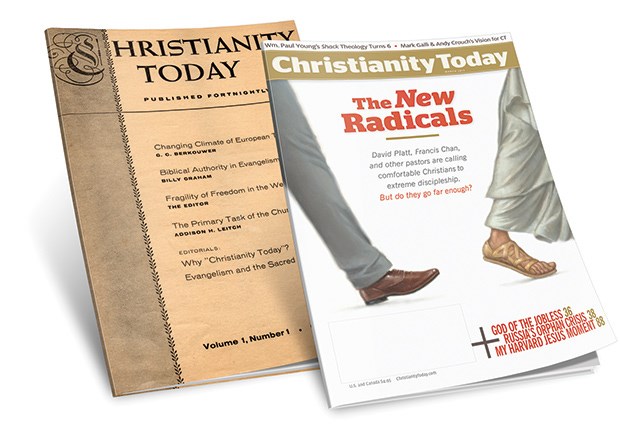
To be sure, evangelical Protestants have often gloried in being, as sociologist Christian Smith once put it, "embattled and thriving." The postwar evangelical movement saw itself, not entirely without reason, on the outside looking in at the institutions of global Christianity. Theologian Karl Barth once dismissed a pointed question from this magazine's original editor with a facile joke about "Christianity Today or Christianity Yesterday?" Carl Henry, never one to back down, promptly replied, "Yesterday, today, and forever."
Henry's publication was of little consequence to the great German theologian, but Henry's chutzpah was warranted. Evangelicalism—in the true sense of the word—was never meant to be a marginal movement within the Christian faith. And the focus of this magazine is not a small piece of the Christian story, but rather its living heart, the Christians in every tradition and communion who seek to love God with all their heart, mind, soul, and strength.
The focus of this magazine is not a small piece of the Christian story, but rather its living heart, the Christians in every tradition and communion who seek to love God with all their heart, mind, soul, and strength.
There will always be Christian fundamentalisms—strident calls to flee the world and purify the church—and Christian liberalisms—misguided attempts to align the church with the world's agenda. But as the past century shows, both are self-limiting movements. They are unable to retain their children or persuade a wider public. Only evangelical faith—immersed in the Word, animated by the gospel, waiting in hope, and empowered by the Spirit—can offer news that is good enough to pass on to our children's children and to engage a wary, weary world.
If this is true, though, it requires a new and deeper seriousness from us. Christianity in our time, especially in the West, suffers from a host of self-inflicted wounds. All too often, the story of American Christianity, not least its evangelical varieties, is about the depth and power of the gospel being poured into the shallowest of vessels.
North American evangelicals can be astonishingly innovative and entrepreneurial, but we can also be indifferent to history and unconcerned about the future. We can be remarkably generous and dedicated, and blithely enslaved to consumerism and technology. We can be amazingly concerned about the needs of the world, and infuriatingly condescending to leaders from places where the needs are greatest. We can be unsurpassed in our cultural savvy, and embarrassingly thin in our cultural production. We are experts at building movements that last a few short years, and innocents at what it takes to sustain change over time.
As Fuller Seminary's Richard Mouw likes to say, "The church is in really bad shape today. It's almost as bad as it was in the first century." The church that Christ promised to build survived the license of Corinth, the legalism of Galatia, and the lukewarmness of Laodicea. It will survive, and more than survive, in our time, because it is built not by human hands but by Christ himself. He constantly renews and reforms his people. He breathes new life and new forms into being in response to institutional decay. And every day he calls sinners from every nation to himself, transforming them into sons and daughters in a new family.
Christianity Today is for everyone who has been caught up in that story, everyone who wants to know how that story is unfolding in our time. We cannot imagine a more exciting time to be Christians than today, and we can't imagine a better job than leading Christianity Today. We hope you will join us for the adventure ahead.
Have something to add about this? See something we missed? Share your feedback here.















 While we pray for peace, we need moral clarity about this war.
 A Christian reconciliation group in Israel and Palestine warned that war would come. Now the war threatens their relevance.españolالعربيةFrançaisрусскийУкраїнська
 The plan would organize UMC churches in four global regions, with each given more leeway around same-sex marriage and other theological issues.






