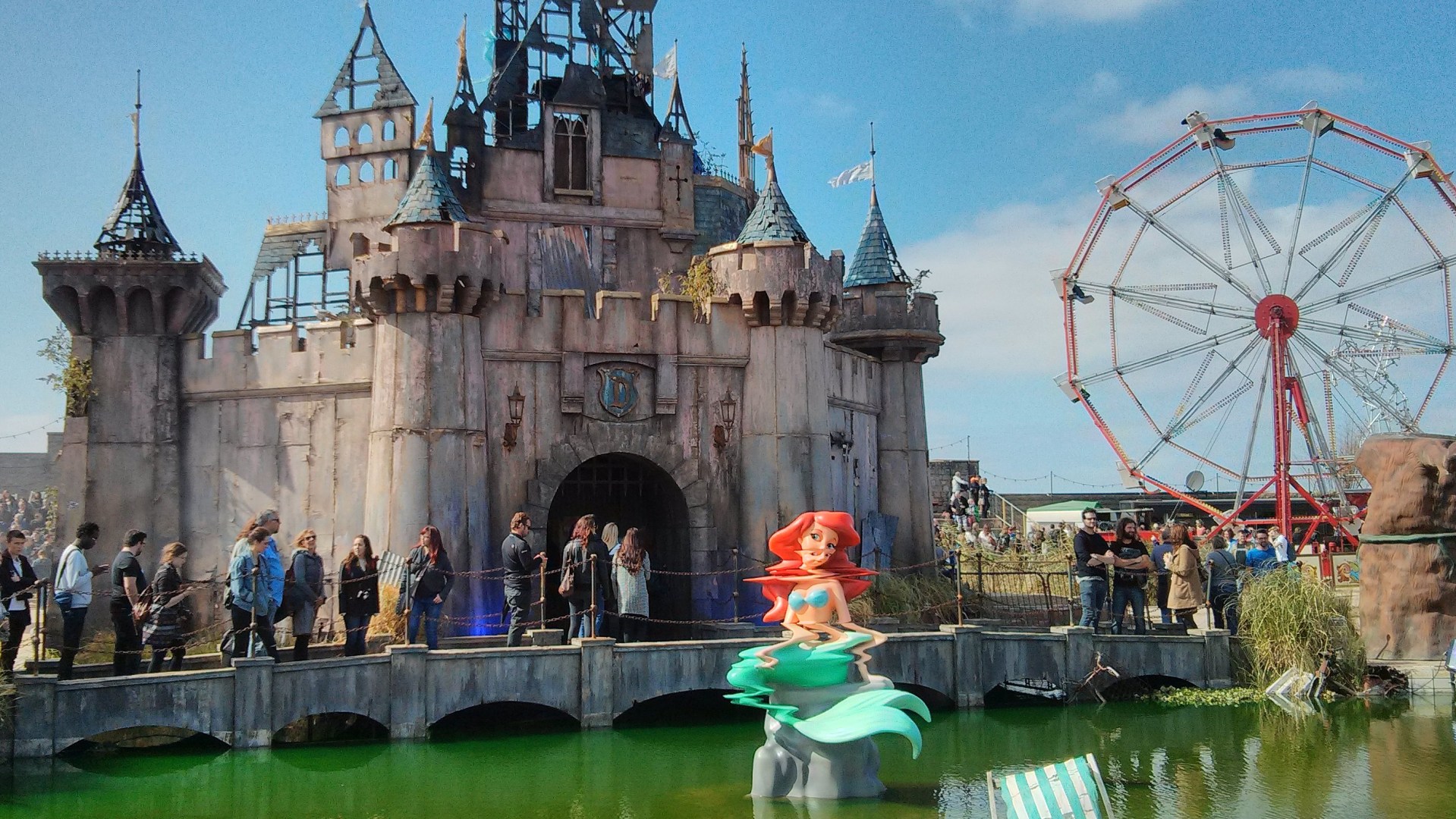
Bright paparazzi flashes illuminate the toppled pumpkin carriage with a princess slumping out of the side window. The warped mermaid perches over stagnant, mildewed water, her four eyes staring pointedly at nothing. A surly park attendant holds a bunch of black balloons that read, “I AM AN IMBE-CILE.” Bemused?
This is Dismaland, a “family theme park unsuitable for children” dreamed up by Banksy, a British graffiti artist turned social activist. Though Dismaland is advertised as a theme park, it is more accurate to call it an art exhibit. More than 50 artists contributed work to display in the 2.5 acre seaside exhibit in Somerset, England. The pieces address numerous social and political issues, and take a rather—ahem—dismal tone.
Park visitors may express their uneasiness in a variety of ways. But no one can experience the offerings of Dismaland comfortably. That is, after all, the point.
This seems to be a rather odd way to spend leisure time, but the park is promoted for those who are “jaded by the over-corporate blandness that passes for family light entertainment.” Dismaland stands in direct opposition to the fantasyland from which it derives its name, criticizing what Banksy sees as Disney’s shallow brand of optimism that is ostensibly built on earnest wishes, insipid goodness, and, of course, a little bit of pixie dust. Dismaland, in contrast, is light on parades and big on principle, which is both strange and compelling.
Dismaland portrays humans as they have often been treated—as vessels for extortion, abuse, neglect, and, when they have served their purpose, indifference.
Dismaland enthusiasts aren’t people who revel in misery but rather see the pretense of simplistic, magical amusement as a sham. The abrupt reversal of the “happily ever after” trope is an acknowledgment of their personal experiences with the world, ones in which carefree innocence is a distant memory, almost a ridiculous one in the face of dreadful reality.
Dismaland villains do not crouch or wilt or stumble. Instead, Dismaland’s main fare is evil, and not the flat evil stepmother or the obviously conniving usurper to the throne. This is real, actual evil, the kind that seethes and stares and overwhelms. Dismaland’s villains are dynamic, formidable, unyielding forces of entropy, greed, and callousness. They are not bound up in a single personality, but rather nameless, faceless contagions that drive real people into suffering. Dismaland portrays humans as they have often been treated—as vessels for extortion, abuse, neglect, and, when they have served their purpose, indifference.
So what do we make of the Grim Reaper’s ecstasy at riding a bumper car? How should we respond to a mass of artists who have banded together to mock one of America’s most iconic images of fantasy and imagination? It may assuage our uneasiness to disengage, to pretend that ignoring evil is the same thing as resisting it. Disney has built an empire on this principle, regularly stealing from the Grimm Brothers’ treasury and adapting fairy tales to suit our modern sensibilities. We like our stories sanitized, following a formula that is predictable and happy and safe for children. But the problem with this reluctance to look evil in the eyes—besides the cowardice it betrays—is that such a view of reality is not complete. Dismaland firmly holds our gaze to make us face the fact that we are in real danger. We are continuously bombarded by threats to our health, safety, and happiness. Even if we manage to survive these perils, at the end of a handful of decades, death waits to collect us all.
We are wired for art, symbol, and narrative. The art we consume, analyze, and love matters because we have been commanded to bear witness to the truth.
And the relentless dangers emphasized by Banksy’s bemusement park are not external threats. They have, horrifyingly, come into being by the work of human hands. We crowd refugees onto boats. We click our cameras when tragedy strikes. We insult, deride, neglect, maim, and kill. We aren’t simply viewers of this art. We create it. Dismaland isn’t so much the clever imaginings of a cynic as it is the daring admonishment of a societal watchdog adamant on warning us that our pretenses of cheap delight are foolish and destructive.
Dismal indeed. And while it is true, it is, thankfully, quite incomplete.
The problem with Dismaland is that, despite its best efforts to stand in opposition to Disney World and the like, it fosters the same kind of narrow vision that Disney World perpetuates. Disney may ignore certain horrors in the world, but Dismaland shields itself from Disney’s blazing glory. The world is too vile for us to be blithe. It is also too beautiful for us to be afraid. The answer to the question of which worldview is more accurate is a resounding yes. There is so much goodness. There is so much horror. And there is so much room for redemption.
We are wired for art, symbol, and narrative. The art we consume, analyze, and love matters because we have been commanded to bear witness to the truth. We crave grace to give us eyes to see and ears to hear. It is a mistake—indeed, a grave deception—for us to entertain exclusively the art of the creation phase when it is so clear that the Fall has infected our world.
And so we eschew saccharine smiles yet refuse abject despair. We rejoice in creation once was but also mourn its twisted demise. Still, we have reason to hope. This small, small world is not static. This story will not end in a whimper. We staunchly wait for its redemption. Let us anticipate, eagerly, the glorious renewal of all broken, beautiful things.
Amanda Wortham teaches literature to a fantastic group of teenagers at a classical Christian high school. She lives a little south of Birmingham with her husband, Ben, and their splendid toddler girl.