December 06, 2009 by Samuel Goldwyn/ Roadside Attractions
Similar to Chariots of Fire and Shadowlands in tone, Amazing Grace balances faith and filmmaking in a historical drama that depicts an ordinary Christian doing extraordinary things because of his beliefs.
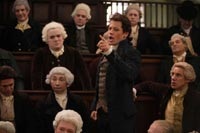
For those unfamiliar with the lead character, William Wilberforce was elected to British Parliament in the late 18th century at the age of 21. Some years after that, he underwent an experience that brought him back to the Christian faith—to the point where he was prepared to leave politics behind to fully devote his life to God as a clergyman or monk. His friend from college (and future Prime Minister) William Pitt tries to convince Wilberforce to stay in Parliament because he's such a gifted orator, as seen in several debates on the floor. Pitt asks, "Will you use your beautiful voice to praise the Lord or change the world?"
To quote another character in the film, "We suggest you can do both."
Ioan Gruffudd as Wilberforce
The principled Wilberforce makes it clear early on that he is privately opposed to Britain's thriving slave trade, and several prominent abolitionists of the era (Thomas Clarkson, Olaudah Equiano) do their best to gain his support. In this film, it is John Newton—a former slave ship captain and the author of the hymn "Amazing Grace"—that ultimately convinces his friend Wilberforce to take up the cause for reasons both moral and spiritual.
And so he does, but at what cost? The British abolitionists become the world's most vocal opponents to slavery, causing Wilberforce to lose popularity with many of his countrymen and colleagues. Some even label him a seditionist—a serious accusation at the time with the newly established United States, an imminent French Revolution, and a mentally ill King George ruling England. Which are precisely the reasons Clarkson suggests to Wilberforce that revolution may be the best way to instigate change.
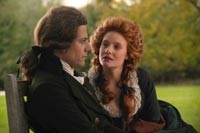
Wilberforce with Barbara Spooner (Romoa Garai)
It's enough to drive a crusader to sickness, as both Wilberforce's health and cause begin to fail about the same time. We know how this story ends, but it's nonetheless compelling to watch the famed abolitionist's uphill battle to maintain his passion and fervor and see his calling through to the end of slavery—a worldwide blight on humankind that still goes on to this day.
The screenplay by Steven Knight (Dirty Pretty Things) succeeds in capturing the essence of Wilberforce and his accomplishments, never shying away from the man's faith but never making it the central component either—just as Eric Liddell's refusal to run on the Sabbath was vital but not paramount to Chariots of Fire.
Amazing Grace seems more honest because of such balance, and acclaimed director Michael Apted (whose previous credits include Coal Miner's Daughter, several documentaries, and a James Bond movie) succeeds in rendering the story with authenticity. There's something to be said for a film that succeeds in making Parliamentary legislation suspenseful, even when you know the ultimate outcome. It also helps that chunks of the movie are told in flashback to add urgency and weight to the storytelling—a straight timeline would have been less interesting.
Albert Finney is brilliant in the role of John Newton
Some parts run a little dry, but the film avoids falling into a dull rut. Scenes of Wilberforce as politician are inspiring like a Capra film, yet tempered with scenes of Wilberforce the college buddy and family man—Christians will especially appreciate a scene where our protagonist spends time outside his home in quiet time with God. Descriptions of the harsh conditions on a slave ship are quite sobering, and Newton's grief for past transgressions (and joyful response to God's grace) are especially touching.
There's also room for levity with charming quips from Pitt, Clarkson, and Fox, not to mention a sweetly handled romance in the form of Wilberforce's budding relationship with Barbara Spooner, who later became his wife. Their shared private joke is chuckle-worthy, as is their attempts to find a reason not to fall in love.
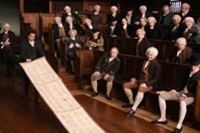
William impresses his colleagues with an anti-slavery petition
Such qualities are expertly carried by an Oscar-worthy cast, which probably shouldn't be surprising with so many familiar British thespians involved. Ioan Gruffudd (Fantastic Four) is an inspired choice as Wilberforce—charismatic, charming, yet bringing just the right amount of gravitas to the part. It's nice to see Rufus Sewell (The Illusionist) play some of the comedic relief as Clarkson, after portraying the nemesis in so many films. Speaking of which, Ciaran Hinds (The Nativity Story) plays smug so well as Wilberforce's chief opponent. And Michael Gambon (Harry Potter and the Goblet of Fire) charms in the small part of Lord Fox. But it's the performance of Albert Finney (Erin Brokovich) as Newton that has most people buzzing—though he's only in two scenes, he's the movie's best (though long shot) chance for awards season next year.
The only thing missing here is the sort of inspired moviemaking that sets apart a landmark motion picture. Chariots of Fire had those scenes on the beach and an unforgettable score. Amazing Grace has an impressive finale with a bagpipe band, but that's not enough. Like Shadowlands, it's played rather strait-laced and predictably, like a glorified Masterpiece Theater special on BBC or PBS. That's primarily what keeps this movie from earning our highest rating, but it's certainly not enough to dampen a whole-hearted recommendation.
Article continues below
What's particularly interesting about Amazing Grace is that the abolition of slavery is the driving force behind it, yet the movie is more about one man's response to injustice—thus hopefully inspiring reactions of our own. It's an example of how we're called to step out of our comfort zones, even when our words and actions are not easily embraced. It's a well-told cinematic example of a man who used his faith and God-given opportunities to change the world for good.
Talk About It
Discussion starters
What are your thoughts about Wilberforce's prayer time in his backyard garden (see Matthew 6:5-7)? Does God provide an answer to his prayer? In what form?
In the movie, Wilberforce describes his life as changed by God—"He found me." Is Wilberforce's initial response proper or misguided? Are we called to a life of piety, or to serve as the hands and feet of God? What does it mean to be "in the world, not of it," and how do we avoid "cocooning"?
Wilberforce makes many "unpopular" decisions in this story. Would you have done the same under similar circumstances? What about pressures to your health or your individual freedom? What temptations does Wilberforce face in his efforts? How do we find the courage to press on for what's right? What guidance do we have?
Wilberforce helped spark change that affected world history and social justice for good. Where does such change begin? What qualities need to be secure in order to take such action?
Wilberforce is depicted as a skilled orator. What makes him so effective? Wit? Intelligence? Persistence? His faith? What can we learn from the manner in which he engaged his opponents? Do you believe Wilberforce wins his cause honorably? Does he "cheat," as said in the film, or is he simply playing to the faults of his opponents?
John Newton tells Wilberforce that faith sometimes comes more like a slow drip than a bolt of lightning. Do you agree? Can you give examples in your own life? Is either more or less powerful than the other?
Read 1 Timothy chapters 1 and 4 In what ways does Wilberforce characterize Paul's instructions to Timothy?
Article continues below
The Family Corner
For parents to consider
Amazing Grace is rated PG and suitable for most audiences. There are some graphic descriptions of how the slaves were treated on the ships, but no violence is depicted other than a man beating a horse off screen. Words like "hell," "damn," "ass," and "nigger" are used, but sparingly. Viewers under 12 or so will likely be bored by the film's historic content and talky tone, but can otherwise handle it if they're familiar with the subject of slavery from school.
compiled by Jeffrey Overstreet from Film Forum, 03/01/07
Michael Apted's new film about William Wilberforce, Amazing Grace, celebrates the value of valiant political action without misleading us about the hardship and suffering that fall upon those who determine to do the right thing.
Wilberforce (1759-1833) suffered on several fronts as he stood like David to the Goliath of British Parliament, seeking to change their minds and hearts on the issues of slavery. The cross he bore—that is the focus of the film. But while Wilberforce may not have lived long enough to come out from under the shadow of such persecution to bask in the joy of his victories, it is clear that he is strove with one eye fixed upon heaven. His treasure lay there, his heart set upon pleasing God.
Amazing Grace rises above almost all recent films about Christian faith for its willingness to portray the complexities, hardships, and unanswered questions that characterize the road of faith. It is also features a cast that deliver impressive, memorable performances. And it manages to avoid being too "preachy." Wilberforce's story truly reflects the glory of Christ as we see him sacrificing so much for to redeem others.
It's a pleasant surprise in an otherwise uninspiring season at the movies. My full review is at Looking Closer.
Russ Breimeier (Christianity Today Movies) says, "Similar to Chariots of Fire and Shadowlands in tone, Amazing Grace balances faith and filmmaking in a historical drama that depicts an ordinary Christian doing extraordinary things because of his beliefs."
He praises many aspects, especially the script by Steven Knight. "The screenplay … succeeds in capturing the essence of Wilberforce and his accomplishments, never shying away from the man's faith but never making it the central component either—just as Eric Liddell's refusal to run on the Sabbath was vital but not paramount to Chariots of Fire.
Article continues below
Amazing Grace seems more honest because of such balance, and acclaimed director Michael Apted … succeeds in rendering the story with authenticity."
Harry Forbes (Catholic News Service) says, "Amazing Grace should find favor in schools, but this is no dry history lesson. Rather, it's a vital tribute to the man who, as his epitaph states, 'prepared the way for the abolition of slavery in every colony of the empire.'"
Adam R. Holz (Plugged In) says, "Many movies pretend importance. Few, however, make good on their lofty ambitions. In contrast, Amazing Grace isn't landing at the multiplex with a multimillion dollar ad campaign trumpeting its arrival. And yet, the messages it delivers are important. … Amazing Grace reminds us that God's calling on our lives is not neatly divided into sacred and secular categories."
Greg Wright (Past the Popcorn) says, "As a history lesson, Amazing Grace is beyond admirable." He also calls it "a powerful indictment" of slavery, and "an Oscar-bait complex powerhouse." He adds, "As an example of ensemble acting that might be more memorable than anything else we'll see this year, we couldn't ask for more." But he concludes, "[T]he whole doesn't quite add up to the sum of its parts. There's something missing here, something passionate and vibrant that only comes through when Finney is onscreen, or in the stirring moments of the closing credits."
Christian Hamaker (Crosswalk) says, "With so much going for it, the film is easy to recommend, but it's a qualified recommendation. Why? Because although … Apted tells Wilberforce's story competently, his nicely lit scenes are heavy on dialogue and very light on camera movement. Such an approach is not inappropriate for a historical drama, but after so many standard shots of characters talking to each other, the film begins to feel heavy and somewhat inert."
He also finds trouble with the flashback structure, but concludes, "Amazing Grace is an amazing story, a reminder that believers are called to persevere through trials, and that we sometimes reap rewards in this life as well as the next."
Cliff Vaughn (Ethics Daily) says it "delivers everything you want: solid script, outstanding performances, clever wit, tight drama, inspiring story."
Mainstream critics are fairly impressed as well. For those who think that the mainstream press will always dismiss films that show faith in a positive light—see what a difference a strong script, artful cinematography, and great performances can make?
Beyoncé’s right. Whether listening to Cowboy Carter or reading theology, diversity is a good thing.
Khristi Adams
Amazing Grace
1 of 4
Ioan Gruffudd as WilberforceWilberforce with Barbara Spooner (Romoa Garai)Albert Finney is brilliant in the role of John NewtonWilliam impresses his colleagues with an anti-slavery petition














 While we pray for peace, we need moral clarity about this war.
 A Christian reconciliation group in Israel and Palestine warned that war would come. Now the war threatens their relevance.españolالعربيةFrançaisрусскийУкраїнська
 Beyoncé’s right. Whether listening to Cowboy Carter or reading theology, diversity is a good thing.